



Cranes, hard hats and dump trucks are just some of the clues that Wayne County’s housing stock is growing.
It’s hard to keep track of the medley of projects that are in various stages, and you might be surprised by how many organizations — and which ones — are jumping in to work on the issue.
Officials say appealing housing is needed to attract more residents, a core part of the community’s current economic development focus. Thus, plans are being made to build homes in incomplete subdivisions.
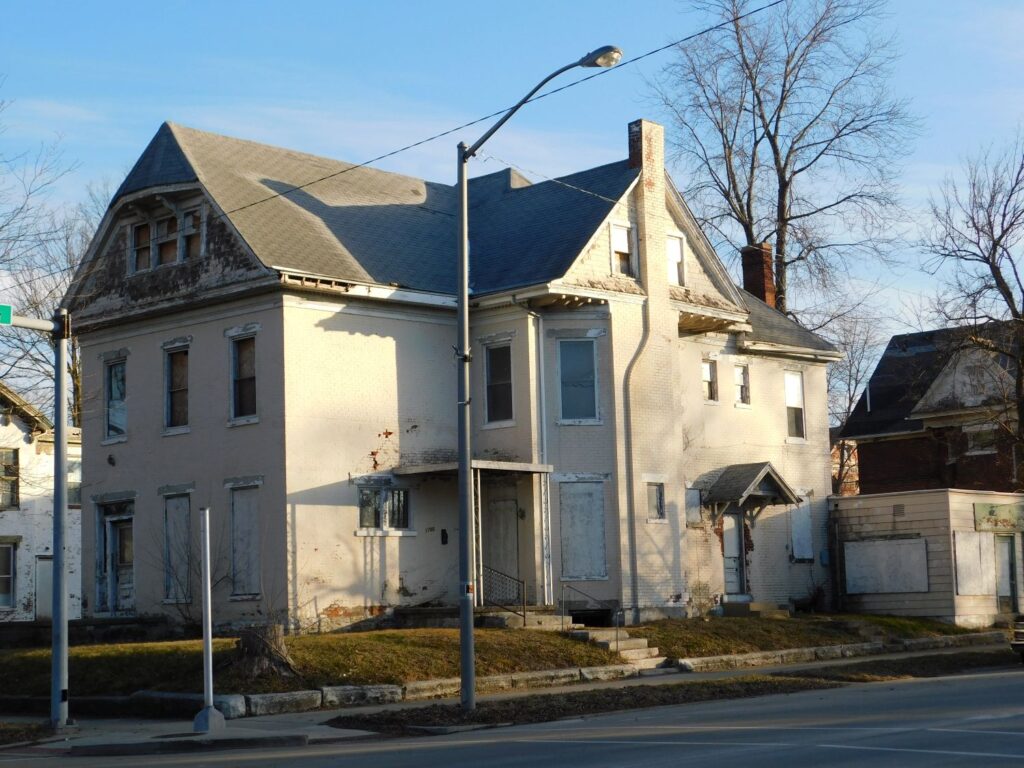
Historic neighborhoods with homes that have fallen into disrepair are being rescued. New homes are being added to fill in gaps created after demolitions of blighted properties throughout the past decade. And several downtown buildings are getting a new life that will blend housing and commercial spaces.
Sudden progress can be exciting, but patience is warranted. Many projects are still in planning stages, and when multiple sources of private, state, local and county funds, and nonprofit contributions are all leveraged, preparations can take months or years.
While all that work is happening, two new initiatives are still in development: a land trust and a land bank both aim to preserve commercial buildings and homes that could be at long-term risk for decay.
What follows is an overview and visualization of several of these recent initiatives, part of an ongoing series of reporting from the Western Wayne News about new housing and real estate developments in the community. We also profiled one group working on historic restoration efforts, and future coverage will explore other organizations and their work in more detail.
Rescuing Richmond’s resources
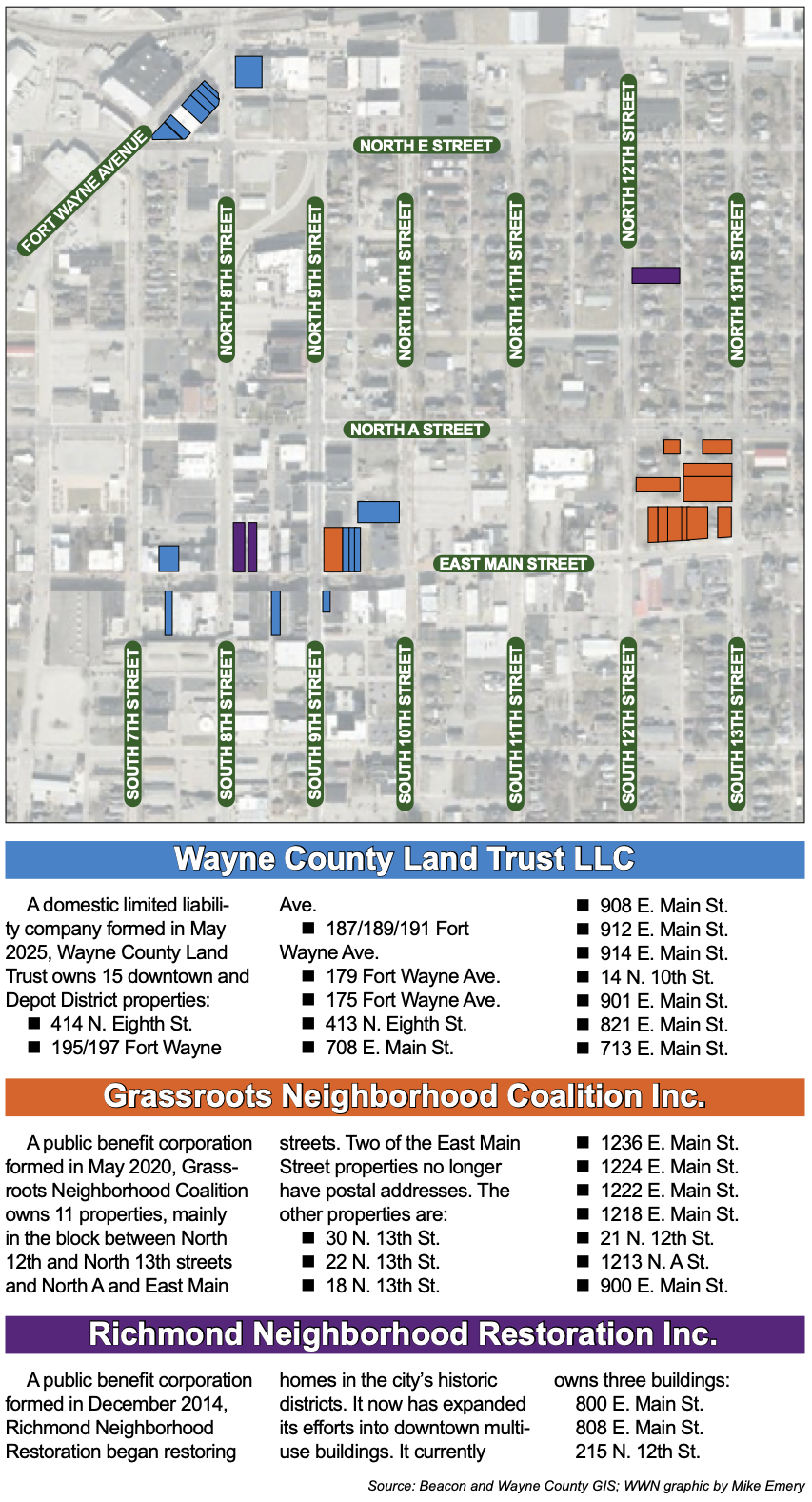
Richmond’s aging buildings and need for housing stock have spurred efforts to rescue the city’s resources. Several organizations are taking ownership of properties with plans to help the resurgence. The map below shows, by color, which properties three of those groups own.
Wayne County Land Trust
Wayne County Foundation and other local partners and stakeholders have created a community-driven, nonprofit investment entity, a land trust, to accelerate downtown revitalization.
In the past, out-of-town buyers have purchased key residential and commercial property in the area, and then allowed it to deteriorate, or made plans that didn’t align with the community’s needs.
Trust leaders call the current process “investing in ourselves” with local insight, ownership and accountability to create new opportunities for housing and small business.
The trust is designed to be a long-term owner of the properties it restores so that the profits are reinvested back into the community in perpetuity.
Formed in 2025, it has so far purchased 15 properties. Real estate development experts are facilitating revitalization and construction. Once work is completed, the trust still owns the buildings, and it will engage property management professionals to operate them on the trust’s behalf.
A board of five local private sector leaders experienced in real estate, law, finance and economic investment is leading the trust, supported by a local advisory committee. All are volunteers.
The trust is funded through philanthropic and investment capital. Although it’s a 501(c)(3) non-profit, the properties will voluntarily remain on the tax rolls and continue to contribute to tax revenues.
The trust is currently seeking renters for the newly renovated apartments at 901 E. Main St. in the former Readmore bookstore.
LEARN MORE about the Wayne County Land Trust at forwardwaynecounty.org/wayne-county-land-trust/
Wayne County Land Bank
Meanwhile, in a separate initiative led by Economic Development Corp. of Wayne County, details are being finalized on an interlocal agreement between Wayne County and City of Richmond to create a land bank through Intend Indiana.
Land banks monitor and preserve properties until a developer is found, helping prevent them from becoming blighted eyesores requiring demolition.
Cambridge City also is a partner in the new program.
READI 2.0
Last fall, EDC announced it received $5.1 million through Indiana’s Regional Economic Acceleration and Development Initiative 2.0 with support from Lilly Endowment Inc.
Three million is earmarked for downtown revitalization, including $976,000 for the historic Elizabeth Starr Historic District and $1.12 million for the Vaile neighborhood.
- Starr: Three homes were acquired in December in north Richmond for renovation. Seven more are to be acquired this year and six in 2027 for a total of 22. An option to purchase those homes has been processed. They will be returned to owner-occupied status to stabilize the area and preserve its character.
- Vaile: Indianapolis-based nonprofit Intend Indiana’s initiative Affordable HomeMatters Indiana LLC is leading construction of 22 new single-family homes on vacant lots south of downtown Richmond near Vaile Elementary. They’re geared for low- to moderate-income families. Several partners are contributing, including Wayne County Foundation, which made a $1 million Impact Investment Loan toward Vaile improvements.
- Downtown revitalization: Building owners soon will be able to apply for a second round of funding. It expands upon the earlier $2 million Hoosier Enduring Legacy Program project, and some of those renovations are still underway across the county. The program focuses on remediating blight, reactivating vacant and underutilized commercial buildings, creating upper-story housing units, and supporting historic preservation to spur private investment.
Valuing Vaile neighborhood
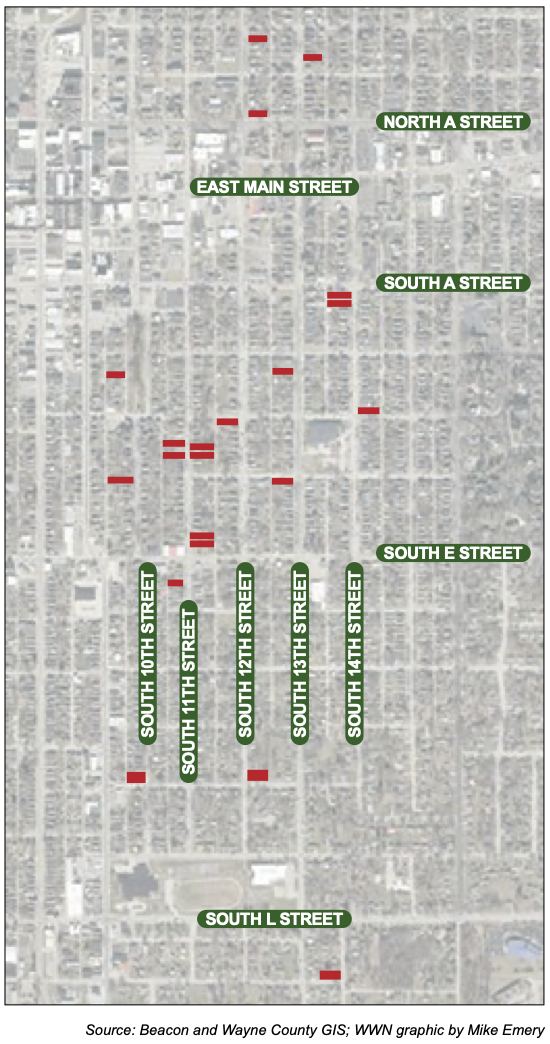
The Economic Development Corp. of Wayne County initiated a project to improve Richmond’s Vaile neighborhood by rehabilitating properties where blighted homes were demolished. Affordable HomeMatters Indiana LLC, a domestic limited liability company formed as an initiative of Intend Indiana, owns 18 properties on South 10th, South 11th, South 12th South 13th and South 14th streets that it will maintain while searching for crews to construct them. It also has three other properties on North 12th, North A and North 13th streets for the EDC. Most of Affordable HomeMatters’ Vaile properties no longer have postal addresses. The properties Affordable HomeMatters owns are show in red.
Revitalize Richmond
About two years ago, Earlham College learned it won $25 million through Lilly Endowment’s College and Community Collaboration Initiative, triggering a flood of new activity and additional investment.
Revitalize Richmond, which runs through Dec. 31, 2028, will, in total, invest about $108 million to give downtown Richmond new life. Some of those projects include:
- AP Development: The Brownsburg company has planned a $30 million renovation of five large buildings to create 100 apartments and 20,000 square feet of retail space. Several of the buildings (725-735, 726, 728, 809-817 and 828-832 E. Main) have upper-level residential and office space that’s been vacant for decades.
- 6Main: Construction progress is evident at Flaherty & Collins Properties’ $37 million 6Main apartment complex at 601 E. Main St. About 150 apartments are planned at the former Elder-Beerman store site.
- Richmond Neighborhood Restoration: The organization’s recently restored downtown apartment space includes the Readmore building (901 E. Main) and above the Secret Ingredient storefront (720 E. Main). RNR has completed several residential projects, including 2237 E. Main. They are currently working on 215 N. 12th St.
Additional projects
- Housing Accelerator Program: EDC is coordinating incentives for the addition of 82 single-family homes in unfinished platted subdivisions. Wayne County is leveraging $820,000 toward infrastructure for the $26 million estimated investment. Homes will cost $250,000 to $450,000. Seventeen are planned in Meers Estates north of Cambridge City, 24 will be in Centerville’s Willowbrook Place and 41 are in Richmond (Garwood Acres, Sandbridge Hills and Hidden Valley).
- Smith Hill development: One approved concept would have 178 single-family homes and 100 townhomes occupying 80 acres south of Backmeyer Road between South 37th and Garwood Road in Richmond. Local officials are awaiting feedback from Indiana EDC, as about $4.33 million in funding is coming from the state through Wayne County’s READI 1.0 allocation.
- Chester Heights Apartments: In 2025, an additional 72 units in three buildings were approved for the former Berryfield Park land. Construction will bring the complex’s total unit count to 274 with 16 buildings.
- Grassroots Neighborhood Coalition: City of Richmond officials established this nonprofit public benefit corporation in May 2020 to reduce blight near downtown. It now owns three properties in the first block of North 13th, six in the 1200 block of East Main, one on North 12th, one on North A and 900 E. Main St. When the coalition was formed, Richmond Redevelopment Commission allocated $300,000 to improve that block and $300,000 for owner-occupied home rehabilitation.
- Senior housing: In 2024, Richmond Common Council approved rezoning land in the 1900 block of Chester Boulevard for a Louisville-based company wanting to construct a $44 million assisted living facility.
- Habitat for Humanity: Good News Habitat for Humanity renovated one home (523 S. 11th St.) in 2025 and is renovating and doubling the size of 910 Sheridan St. in 2026. Donations and volunteers are welcome.
- Bridges for Life: The Richmond-based social service organization has created a Building Together program to help those overcoming addiction. It provides housing and employment to individuals struggling to secure both, while teaching marketable construction trade skills. Wayne County commissioners have given a few properties that were slated for a deed sale to Bridges for Life and Good News Habitat for Humanity.
- Additional homes have been added through private initiatives along Garwood Road in Richmond and other locations.
Nonprofit proud of ‘cohesive’ efforts for housing solutions
For 11 years, Richmond Neighborhood Restoration has focused on rehabilitating historic residential homes. Recently, the nonprofit’s work has aligned with other organizations addressing the city’s housing needs.
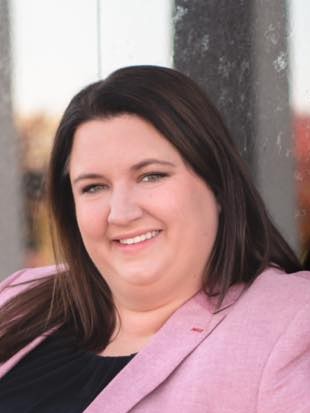
Roxie Deer, RNR’s executive director, described the collaborative effort as a Venn diagram, with the various organizations’ circles overlapping.
“I think for the first time in this community’s history, all of the major players in housing are working together to figure out the best way to get all types of housing created,” she said. “And I think that’s probably one of the most exciting things that’s happening.”
RNR joins the Economic Development Corporation of Wayne County, Revitalize Richmond, and Wayne County Foundation to address an issue that did not exist a decade ago.
“When RNR first started, housing wasn’t a topic of discussion. We know from all of the housing studies that have been done through the EDC, that housing is a number one priority for this community. We can’t grow if people don’t have a place to live,” said Deer.
In addition to restoring older homes, RNR has invested in a few downtown commercial properties, most notably the Readmore building, over the last three years. They’ll continue their smaller-project model in tandem with the collective group working to improve homes in particular neighborhoods.
Their next assignment is the Starr Elementary neighborhood, focusing on 2-3 homes on North 12th Street specifically. Deer sees this strategized effort as the key to success for the community, rather than each group working independently.
“Imagine if all of these entities said, ‘No, we’re each going to take our own neighborhood and we’re each going to compete for funding against each other.’ We’re never gonna move the needle that way,” said Deer. “It has to be cohesive.”
Deer is especially proud that other communities are taking notice of Richmond’s approach.
“They’re going, ‘Hey, why are they able to move the needle? What’s happening?’ And there aren’t a lot of communities that have the level of collaboration that Richmond’s experiencing right now.” Deer credits Wayne County Foundation director Rebecca Gilliam and EDC’s president Valerie Shaffer, for this outcome.
“Those two really want everyone to work well together.”
RNR currently owns three properties: 800 and 808 E. Main St., and 215 N. 12th St.
Do you have questions you want answered about the work to preserve and expand Wayne County housing stock? Email contact@westernwaynenews.com or call 765-478-5448 x3 and our reporters will try to incorporate your thoughts into future coverage.
A version of this article appeared in the January 21 2026 print edition of the Western Wayne News.