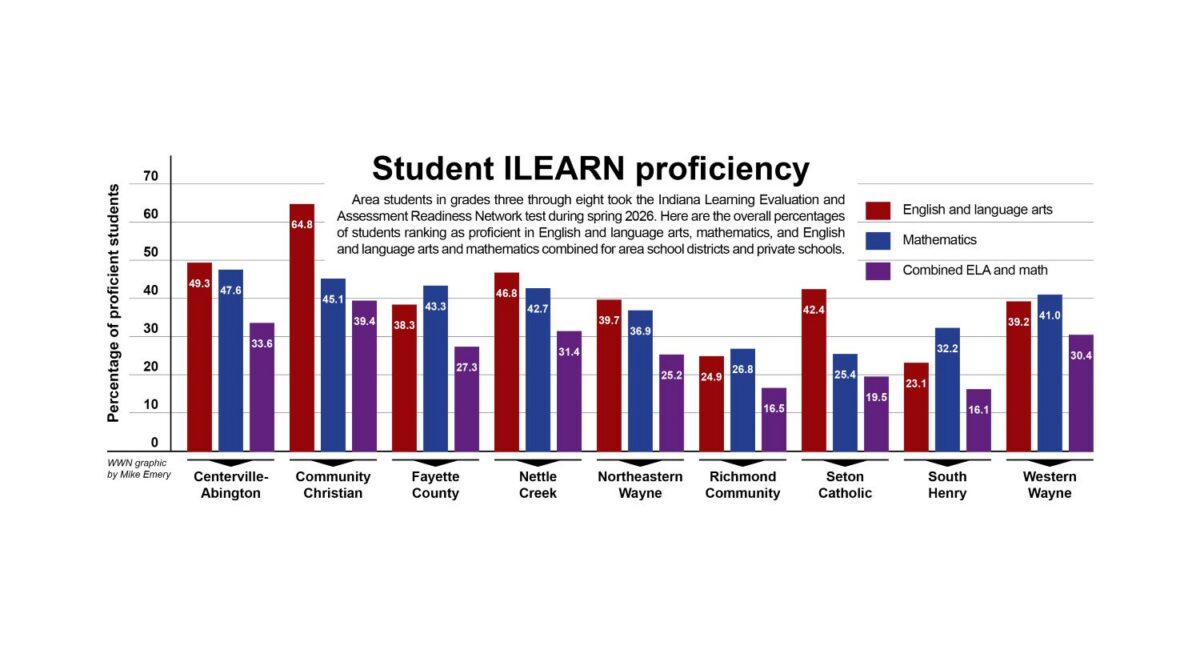
While several schools made gains, results of newly revised Indiana standardized tests show many students in Wayne County schools still struggle with English and math skills.
Indiana Department of Education shared the spring’s Indiana Learning Evaluation and Readiness Network, or ILEARN, results on Sept. 25.
Statewide, 42% of students in grades 3-8 were proficient in English/language arts and 42.7% in math, but only 31.5% were proficient in both.
Most local public or private districts performed above or close to Indiana’s statewide proficiency percentages in ELA and math as individual subjects, but their students were well below 50% proficiency in both subjects.
Wayne County superintendents say the results show several areas of strengths plus areas where they have meaningful opportunities for continued improvement.
Melissa McIntire, who joined Western Wayne Schools as its superintendent as the new school year began, said ILEARN results give them evidence of what is working and a clear responsibility for where they need to improve.
“I am proud of the areas where our students met or exceeded the state, and I am equally focused on the areas where we must grow,” she said. “Every number represents a student…At Western Wayne, we will hold high expectations while meeting every child where they are and helping them grow.”
Mike McCoy, Centerville-Abington Community Schools superintendent, said educators realize that these scores represent a new baseline for ILEARN, so it is difficult to compare previous year’s scores to this year. After analyzing results and comparing them to scores across the state, CACS is very proud of its students’ scores, he said.
School leaders say they see some positives from those tests, such as Centerville-Abington third graders’ 72.4% proficiency in math, which is among the state’s best, and Northeastern and Nettle Creek’s double-digit gains in social studies.
Math proficiency rose 7.2 percentage points at Richmond Community Schools’ Fairview Elementary, and Starr Elementary’s math proficiency went up 5.4 percentage points.
Nettle Creek
Nettle Creek Schools Superintendent Emily Schaeffer said her team will use the data to make further improvements.
“Our goals reflect ambitious expectations for student achievement, and we are using this data, along with classroom and other assessment information, to refine instruction, provide targeted support and monitor progress throughout the school year,” Schaeffer said. “ILEARN is one measure of student learning, and we will continue to use multiple sources of data to make informed instructional decisions and support every student’s academic growth.”
One example of their 2025–2026 growth included Hagerstown Elementary increasing social studies proficiency from 41% to 51%. Hagerstown Jr.-Sr. High School increased math proficiency from 31.5% to 37% and ELA proficiency from 52.5% to 61%.
Western Wayne
“Our goal is clear,” McIntire said. “We want every student in Western Wayne Schools to continue growing academically while also developing the confidence, skills and support necessary for long-term success. We will continue to study our results, refine our practices and work together as a school community to provide every student with opportunities to grow and succeed.”
Student performance data helps educators concentrate their time and resources on the knowledge and skills students are expected to learn while responding directly to areas of need, she said.
WWS instruction will remain closely aligned with Indiana Academic Standards, and ongoing assessments of student knowledge help determine which standards require additional instruction, reteaching, intervention or reassessment, McIntire said. Western Wayne’s substantial gains in math (9.2 percentage points) also contributed to its combined ELA/math proficiency hike of 8.5 percentage points.
Targeted intervention will also remain a major WWS priority. Students who need additional academic support will receive focused instruction designed around specific skill gaps. Progress will be monitored regularly so that instructional teams can determine whether interventions are working and make adjustments when necessary.
McIntire said academic achievement is only one part of student success. “Every student enters the classroom with individual strengths, experiences, needs and goals. Our responsibility is to meet students where they are, provide appropriate support, and help each student demonstrate measurable academic and personal growth.”
Centerville-Abington
“Our third grade math scores were among some of the best results in the state, but we are very proud of each student who successfully passed and every student who gave their best effort when taking the test,” McCoy said.
CACS is analyzing all results closely to find the exact areas they are struggling to master and focus on them, McCoy said, noting growth for all students is their ultimate goal.
“It is always difficult to know what type of questions are on the test or how they will assess the standards we are expected to cover,” McCoy said. “All we can do is learn and provide our students with the tools that allow them to adapt and adjust their thought process to better answer the questions that are presented.”
Scores at a glance
When Wayne County’s public school district scores were combined for all grades, Centerville-Abington led in ELA with 49.3%, followed by Nettle Creek (46.8%), Northeastern Wayne (39.7%), Western Wayne (39.2%) and Richmond Community Schools (24.9%).
Compared to 2025-26, Centerville’s 8.5% percentage point increase led the pack for ELA. WWS and RCS also made gains (2.9%) and (0.2%), respectively. Scores went down just slightly for Nettle Creek (0.9%) and Northeastern (1.6%).
Overall, Richmond Community Schools’ ELA proficiency was 24.9%. However, in considering individual schools, Charles Elementary students scored highest (50.4%). Several RCS schools increased several ELA percentage points from the previous year, such as Test Intermediate (4.6%).
Western Wayne Elementary made significant gains in math, from 38% to 45.9% meeting benchmark this year.
On additional spreadsheets, state officials also analyze ILEARN data based on factors such as students’ socioeconomic level and whether they’re in special education or are learning English.
For instance, 66.2% of Charles students from higher-income families were proficient in ELA, but that percentage decreased to 34.4% for those qualifying for free or reduced-price meals.
Hagerstown Jr.-Sr. High had the highest ELA passage rate for the county’s older students (60.4%).
This year, Community Christian had the highest ELA percentage of the county’s private schools that took the test, with 46 of 71 students showing proficiency (64.8%). Thirty-two of the 71 were proficient in math (45.1%).
Science, social studies
Three grades also are tested in science or social studies.
Only fourth and sixth graders take science tests. Statewide, their results were similar to math and ELA, at 42.4%. Nettle Creek led county districts with 58.9% science proficiency, followed by Centerville (53.3%), WWS (38.3%), Northeastern (36.8%) and RCS (29%). Charles Elementary had the county’s highest public school score with 60.9%. Private schools Seton Intermediate earned 53.3% and Community Christian received 50%.
Fifth graders were tested on social studies, with 47.2% of all Hoosiers passing. Northeastern increased its proficiency by nearly 17% percentage points from last year to lead local public schools at 50%. Nettle Creek (48.7%) and Centerville (47.7%) followed, both gaining from 45% and 40% last year. RCS’ proficiency rose to 36.9%, from 22.4% last year. Western Wayne was 30.2%. Community Christian earned 66.7% and Seton Intermediate was 36.4%.
Community role
Educators say families and community members can make a big impact on academic success.
To support their children on future tests, McCoy said families are encouraged to continue reading with them, discussing a wide variety of topics and fostering their curiosity for learning.
McIntire said WWS welcomes community members who are interested in supporting students through tutoring, mentoring and other academic assistance. Community partnerships can provide students with additional encouragement, meaningful relationships and focused support in areas where greater growth is needed, she said.
For more data from this year’s Indiana Learning Evaluation and Readiness Network test for grades 3-8, visit in.gov/doe/it/data-center-and-reports/.
A version of this article appeared in the October 7 2026 print edition of the Western Wayne News.