

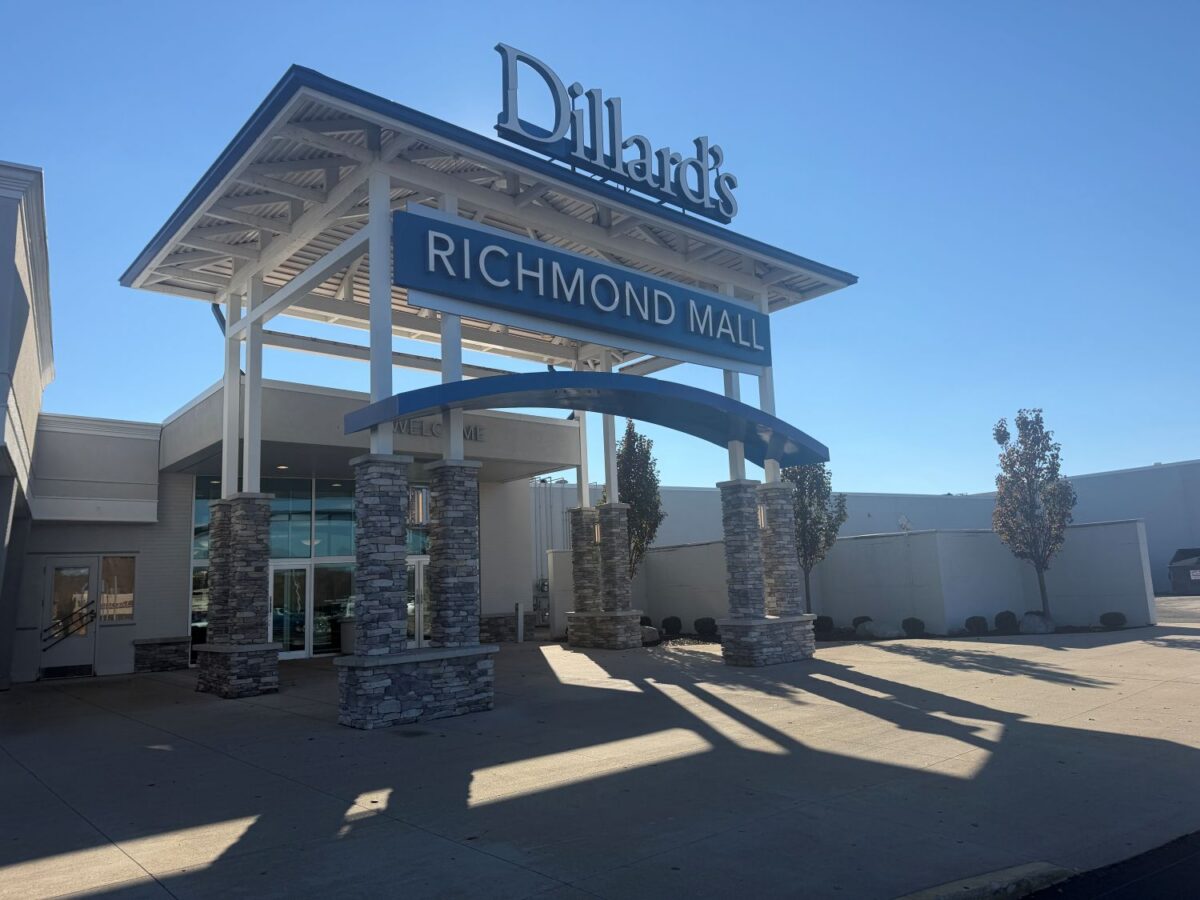
As the busiest shopping season approaches, Richmond Mall has staged Santa’s seat for family photos. However, more and more of its storefronts are vacant.
A decade after the nation’s first mall opened in 1956, Richmond Square Mall welcomed shoppers with anchor stores JCPenney, Montgomery Ward, Woolworth and Kroger, driving foot traffic to other options. Throughout the next three decades, a variety of retailers filled 3801 National Road E., from KB Toys and Waldenbooks to Man Alive and American Eagle.
Today, anchor stores Dillard’s, Dunham’s Sports and the newly added Ashley Furniture support just seven businesses and three eateries on the property.
Several factors have contributed to the decline of the country’s once popular shopping ground. According to Reena Jari’s 2026 article, “The Death and Reinvention of American Malls,” online retailers made shopping from home more convenient by 2010. And top-tier malls competed with less extravagant options. Things worsened when 2020’s pandemic all but halted foot traffic and revenue. Jari writes that while grocery stores and restaurants rebounded, malls suffered from a permanent change in shopper behavior.
Since 2008, 200 malls have closed across the country. Richmond’s Sears and JCPenney leaving in 2013 and 2020, respectively.
An Eaton, Ohio, couple visiting the Richmond Mall on Nov. 17 said they frequent the mall once a year, opting to mostly shop online. They drove to Dillard’s for personal clothes fitting and sizing — something online shopping doesn’t offer.
A Richmond woman said she visits the mall every other week, gauging prices until seasonal deals arrive. But the former JCPenney employee’s perspective is bleak.
“It’s sad,” she told WWN, reminiscing about the Pretzel Twister that closed earlier this year. “Makes you wonder if it will still be here within a year.”
Richmond’s once-bustling mall property is not alone. Thirty-one years after opening its doors, downtown Indianapolis’ Circle Center Mall closed in 2025. And this year, Muncie Mall was closed and demolished by its owner, Hull Property Group.
However, in recent years, malls nationwide have seen a steady increase in value as they have adapted a new economic model and welcomed younger shoppers. According to the Wall Street Journal, studies show younger generations are returning to malls, with shoppers ages 18-24 buying 62% of total general merchandise purchases in stores last year, compared to 52% by shoppers ages 25 years and older. Successful malls have also invested in opportunities that consumers cannot get from the internet. Tenant space is not just for stores, but events, such as farmers markets and influencer-hosted entertainment.
While Circle Center Mall shuttered, Hendricks Commercial Properties plans to revitalize the area into mixed indoor and open-air venues, according to a 2025 WTHR article. And Indiana Public Radio reported Hull Property Group plans to replace Muncie Mall’s 25 acres with new retail operations and possible apartments.
While it’s unknown if Hull has similar plans for Richmond Mall, which it acquired in 2015, optimism remains.
A young Hartford City shopper perusing with her Connersville friend said adding a Rue 21, an eyelash salon and more food places could draw more people.
Ashley Furniture owner, Greg Masters, said he’s happy to be in Richmond, citing the mall’s cleanliness and perfect location. With the support of the community and Mayor Ron Oler, he sees great things happening in Richmond’s future and wants to be part of bringing the mall back.
A version of this article appeared in the November 25 2026 print edition of the Western Wayne News.
