

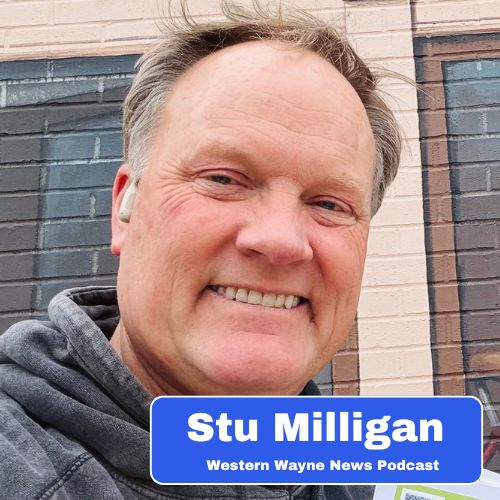

For Richmond native Stu Milligan, bicycles are more than a hobby. They’re a way to connect people to their community. In this episode of the Western Wayne News podcast, Stu reflects with Kate on growing up in Wayne County, building a small business from the ground up, and turning a personal passion for cycling into years of grassroots advocacy aimed at making Richmond more connected, welcoming and alive. Enjoy!
Transcript
Stu Milligan: I’m Stu Milligan, bike advocate and owner of Lakeview Shade and Screen.
Kate Jetmore: From Civic Spark Media and the Western Wayne News in Wayne County, Indiana, I’m Kate Jetmore. As a native of Richmond, Indiana, I’m excited to be sitting down with some of our neighbors and listening to the stories that define our community.
My guest today is Stu Milligan, a native of Richmond. The youngest of Tom and Claire Ann’s three children, he is the last of the Cobles and Milligans residing in Indiana.
He is a self-appointed Bicycling Advocate in the area, founder of several local bike riding efforts, and staunch defender of the City’s Bike Loop. He is also active in statewide biking initiatives.
Stu owns and operates Lakeview Shade and Screen, which was founded in 2012.
He is a Wayne County GOP Precinct Chairman, and serves on the board for the Richmond Shakespeare Festival and SPUR (Richmond’s first Green Club).
Welcome, Stu. Thanks so much for joining me on the podcast.
Stu Milligan: Thank you for having me.
Kate Jetmore: So tell us about your history in the area. What brought you and your family to the community?
Stu Milligan: Well, both of my grandparents moved to Richmond for work, one government-related, state, and the other for his medical practice. And then my parents grew up here, went to Richmond High School. And then my sisters and I, we graduated from the Richmond school system as well.
Kate Jetmore: Okay, so your roots run deep, and I think you’re saying you were born here?
Stu Milligan: Yes, and I was, I can claim Spring Grove as my hometown, which is, if you’re from Richmond, Wayne County, Spring Grove is a small incorporated island within the city of Richmond. But it was home to Reid Hospital, and that’s where I was born, and what’s now referred to as Old Reid.
Kate Jetmore: Right.
Stu Milligan: Not the new Reid.
Kate Jetmore: Right, right. Do you have any stories from those early years that kind of came down through the generations from your grandparents, from your parents?
Stu Milligan: Sure. Just being from Richmond and having both sets of grandparents always able to attend my ballgames was extra special.
So, you know, football games within the Municipal Park Stadium over on the west side of Richmond was fun. Only one grandparent was hardened enough to do that in the rain and the cool of October and November.
Kate Jetmore: He sounds like your number one fan.
Stu Milligan: Yeah. And then Little League at the Boston Airport Diamonds, which are now no longer. However, we started playing Boston Little League at one location and then another diamond set, another set of diamonds was built.
And that was always fun watching parachuters, and trying to remember to look for the fly ball.
Kate Jetmore: Yes. Did you go to Boston?
Stu Milligan: I attended Boston as a kindergartner and first grader. And then Garrison was built, where probably you went, right?
Kate Jetmore: Yes.
Stu Milligan: And then I completed that through sixth grade. And then went back to Boston for what was the junior high system, completed seven through nine. And then high school at Richmond when it was just the 10th through 12th.
Kate Jetmore: Okay. Okay.
Stu Milligan: I graduated in 1983. So I turn 61 this month.
Kate Jetmore: Well, happy birthday.
Stu Milligan: Thank you.
Kate Jetmore: Happy birthday. And I know your business is about 14, 15 years old. You’re the owner of Lakeview Shade and Screen.
Stu Milligan: Correct.
Kate Jetmore: So tell us a little bit more about that. What do you do and how did your business get started?
Stu Milligan: I started Lakeview Shade and Screen while working for a company as a territorial sales manager that manufactured window shades as well as projection screens, hence my name, Lakeview Shade and Screen.
At the time, I had a little side hustle going on where people said, well, I need some shades. So we were able to buy a few shades and I installed them.
And then I thought, shoot, you know, I’m investing in some tools. I might as well incorporate my side hustle.
And I did that in 2012. However, I did leave my employment from that company that I worked as a sales manager in 2016.
And then I took my side hustle full time. And that was a leap of faith.
Kate Jetmore: And how’s it going? I know when you and I were scheduling this call, you were, I think, down in Kentucky installing some shades.
So it sounds like your, you know, like your range is quite notable.
Stu Milligan: Yeah, being self-employed and the only person in my organization. So I’m a one-horse barn and a one-person team. I was fortunate to, I’m fortunate to get some bid opportunities from local general contractors.
And through one of the general contractors, I was connected to a design firm out of Cincy. And that design firm doing a local bank also was doing banks for a Kentucky-based bank.
So I have grown to work with that design firm as a subcontractor to them. Some design firms contract subs and others just contract a general contractor who then contracts subs. And there’s sort of a hybrid. But that’s why I was in Kentucky.
My, my greatest claim is that I had a friend who had a place in Vail. So I worked out a deal where I took some shades, installed them, and stayed for free in their condo.
Kate Jetmore: Oh, nice. That’s my kind of business deal.
Well, Stu, everyone who knows you knows how much you love bikes. I’d love to talk a little bit about your work as a bike advocate. How did you get started in that role? And what kind of things have you learned in the process?
Stu Milligan: Well, it was purely by accident. I moved back to Richmond in 2013. And having been recently divorced and I’m not taking care of the kids, I had visitation, I had a lot of spare time. Fortunately, I spent that on my bike seat and not a barstool.
Kate Jetmore: Right, right.
Stu Milligan: So just to fill the time, I started riding my bike a lot. And I learned… Facebook was kind of new to me at that point. So I learned through different organizations in Indiana of state, statewide.
So there’s a group out of Indy that hosted rides. They do an Indy night ride, where you ride from the Fairgrounds down to the Monument Circle, and you pass through the Art Museum, Butler Campus, even Crown Hill Cemetery.
There is a ride to the 500 where you can ride your bike and park it nearby and walk to the race.
They also were involved with the well-known Hilly Hundred, which is a 2-day ride in Bloomington. And I learned of that when I was at Indiana as a student and always wanted to do that.
And so I’ve done that a couple of times. And then local rides, the Reid Ride. Your dad did the Reid Ride.
You may have done it with him. I think he actually had maybe your nephew with him. Once or twice.
Kate Jetmore: Yeah, and my son.
Stu Milligan: Yeah. Oh, maybe that was your son then.
Kate Jetmore: Yeah, and there are several different, he’s kind of the anchor, and then several people have done it with him in the extended family.
Stu Milligan: Yeah. So I did local rides like that. There’s the Cardinal Greenway that does a fundraising ride. And the kind of most unique ride, well, second most unique ride, is one called GOBA, which is Greater Ohio Bicycle Adventure.
And it’s a 5-day ride spread over seven, and it’s about 250 miles.
Kate Jetmore: And is it across the state, or is it different, like from point to point in the state?
Stu Milligan: Sometimes it’s a circle. Sometimes it’s a point to point. The two times I did it. One circled Columbus, the city of Columbus.
And the other time, it kind of went from Miamisburg and Brookville, Ohio, down to Miami and Miamisburg, Oxford, Ohio. So that was unique.
But the ride I’m most proud of is after my sophomore year, I had to come home accomplishing something. So I called my parents, they picked up some of my items, and then I rode home in a day from Bloomington.
And that’s also my farthest ride, 131 miles.
Kate Jetmore: Wow, very cool. And that actually answers a question that was coming to me, which is, when you moved back to Richmond in 2013, was this a new hobby?
Was it something you were just discovering? It sounds like it was something that had kind of been with you for many, many years, but then kind of blossomed after you moved back to Richmond, and found yourself with some extra time.
Stu Milligan: Yeah, specifically about Richmond and biking and the advocacy that you asked about. I have done a few different things, but the biking from a kid through living out in the country on Farlow Road and in Boston Township, you couldn’t really ride the hills to school, you know, because it was an 8-mile ride or something. And the weather’s crappy during a school year to try to ride to school anyway if you live out.
But when I moved back to Richmond, having done the rides I described, I thought, you know, Richmond has some opportunity, great trails. I want to maybe do something local to give a little bit, one, to sort of get more involved in Richmond because I had been away for 20 years. And then I thought there was a need to do, to conduct local rides, not, not just to ride by myself, but actually to host rides.
And that kind of comes from my grandparents and my parents, they hosted a lot of either church fellowship things or political party events or big weddings or whatever. So that’s kind of in my blood to throw a party.
So I created a group called Richmond Rose Pedals, and that name was suggested by a good friend of mine named Terrence Metz, and he’s on the Shakespeare board with me. He goes, hey, you ought to call yourselves the Richmond Rose Pedals.
So immediately I thought, ah, the Richmond Roadrunners is a black motorcycle gang in Richmond. And I borrowed their badge, that yellow, and sort of that yellow badge that you see or you have as a backdrop for me. Don’t tell them, but I borrowed that without permission.
Kate Jetmore: My lips are sealed.
Stu Milligan: And then as a joke, I had a friend, Pam Fraizer, who’s involved with Civic Theater, and I’ve done Civic, I should have mentioned Civic Theater involvement through the years like you. Not to your level, but I have enjoyed being in the cast of several shows since the 90s at Civic Theatre.
But she drew… She’s a graphic artist, and she drew a bicycle chain guard that kind of looks like a motorcycle tank, and then, in a funny way, put the crank and a pedal on the logo.
So we were Richmond’s baddest biker gang with the name of the Rose Pedals.
Kate Jetmore: Exactly.
Stu Milligan: Yeah, of course, remembering the Rose Festival activities that Richmond used to hold.
Kate Jetmore: Sure.
Stu Milligan: So I grew that to nine rides, April through December, and your dad actually rode a couple rides, and the first ride was a Santa ride.
And that was really kind of just a witty, sort of tongue-in-cheek, sarcastic effort of me to make fun of the, to pinpoint the local dislike of the newly created city bike loop.
So right when I moved back in 2013, and then through, I think, 2018, they were building this brick pathway about two miles connecting downtown Main Street to the Depot area and then into the Gorge Park in Richmond.
And in that, people just said, no one will use this. So the Santa ride was an effort to show that people in Richmond will believe in Santa before they will believe a single person rides a bike on the bike loop.
So I bought, I think I bought eight brown t-shirts for reindeer, two t-shirts, one t-shirt for Santa, and two t-shirts for elves, green.
So I had red, green, and brown shirts that I passed out to people, and I didn’t get all 12, but I got about eight, and we did the first Santa ride.
And I did that several times, and then later I got people along the bike loop to give a, like if it was a restaurant, they gave a $15 voucher for that purpose, and that was a gift I would give a rider. And I got a lot of restaurant vouchers and different gifts. And it was a lot of fun.
The most popular ride, however, was my Dilly Bar ride. So it was called Handlebars and Dilly Bars, and one day I had a ride and thought people showed up and had fun. I thought, what’s another ride? And I know, like you know, there are three Dairy Queens in our hometown, so I rode all of them and had a Dilly Bar at each one, and it’s only eight miles, so the Dilly Bar ride was created.
Kate Jetmore: Yes.
Stu Milligan: Your dad and Cheri actually sponsored that one year, because I would have, I have an expense per ride to print posters.
And how do people know I was an advocate for biking? It’s probably because I went around every month for nine months a year, six years straight, asking to put my ride posters up.
And Pam Fraizer from the Civic Theater connection, she did all my ride posters. And it really made me look like I knew what I was doing.
Kate Jetmore: Well, it really did, Stu. And I have so many memories of those… I didn’t realize it was six seasons.
Stu Milligan: I think I invited you.
Kate Jetmore: Oh, for sure. I’m sure you did. I’m sure you did. I actually want to turn now to talk about the relationship between cyclists in town and people who are in cars.
So there have been several efforts over the years to get drivers in Richmond and throughout Wayne County to be more aware of cyclists and pedestrians and more respectful of cyclists and pedestrians. So where do you think we’re at with that effort now? And what do you think should happen next when it comes to that advocacy effort?
Stu Milligan: I think more and more people are using a bicycle for alternative transportation. One, for choice. And those commuters will, you know, they have a car, they can afford a car, but they prefer to ride into work. And those commutes are probably five miles or less.
You have the recreational riders, which was kind of what I was doing with my Rose Pedal rides.
And then you have people that rely on a bicycle because that’s their only mode of transportation other than walking.
Kate Jetmore: Right.
Stu Milligan: And so, for the recreational riders, Richmond’s pretty good because they have a rail-to-trail called the Cardinal Greenway.
We have this bike loop. There is a bike route located in Richmond. Actually, the first one was done by a cousin of mine. Actually, my mom’s, yeah, no, a cousin of mine who’s older, he did it as an Eagle Scout project in the 70s.
Kate Jetmore: Okay.
Stu Milligan: And it’s, remnants of that still exist. But today, people with bigger cars, speed limits, less in Richmond, they’ve removed some traffic lights. So just, intersections are a little more risky for a non-car-using person.
So there’s a term called Complete Streets, which creates speed bumps or plantings, things that kind of slow traffic down, narrowing wider streets to make them slow down. Also, other efforts are crosswalks, and then what they call bump-outs, that makes it safer.
Kate Jetmore: Right.
Stu Milligan: But Richmond really needs what’s called a Vulnerable Road User focus, and with the Complete Streets initiative, which calls for more than just car use of our public streets, the vulnerable road users need to have some protection.
And in Richmond, I’m part of a group led by a couple of friends, Barry Kramer and a woman who moved from here recently. Her name is Elisa Worland, and she created a steering committee for safer bicycling and for safer streets for pedestrians as well.
That effort is called Bike Walk Richmond. I think they’re going to rename it. And we are trying to get people within the city administration to plan and consider bike lanes. Not the infrastructure, what do you see downtown called the bike loop, but just lanes. Wayfinding or signage. Maybe selecting or suggesting a certain street that’s better to go east-west through town, as well as north-south through town, where people are used to seeing bicycles.
A lot of it with cars and bicyclists on the same street is distracted driving, as well as bicyclists behaving like cars. They need to follow the same lights and signals and wait their turn at four-way stops, so there’s an education that goes both ways. Cyclists need to be friendly to cars, and cars need to be friendly to bicyclists.
But it’s a cultural change, bigger cities, maybe college towns, maybe more defined subdivisions have maybe more bicycle infrastructure. But Richmond, having its streets laid out, you know, in the late 1800s, you know, where bike paths weren’t built first.
Kate Jetmore: Right. Yes, exactly. Exactly. I will say one thing Richmond really has going for it, and this is spoken as someone who lives in a place where it is very, very hilly. And Richmond is generally, I mean, the city of Richmond, not so much the outskirts where you grew up, for example, but the city of Richmond is pretty flat, it’s pretty cyclable. And that’s not nothing.
Stu Milligan: That is true.
Stu, you strike me as a person who really, really cares about this community, who cares deeply about this community. I’m curious, how do you describe it to people when you meet them, who are not from around here?
Stu Milligan: Well, following the intent of this conversation about bicycle advocacy, I do promote it to people across the state as a bicycle tourist destination.
We have mountain biking through Hayes Arboretum. We have trail riding 50 plus miles from Richmond, north of Muncie, all one continuous paved trail. We have the downtown urban loop.
So you’ve got long-distance trail riding on pavement for road bikes. You’ve got an urban route for just sort of casual biking for fun or errands.
And then you have like a more harder core sport of your mountain biking at Hayes Arboretum. And then in between there, we’ve got some pathways in our gorge park and a little teeny segment on one of the rivers that converge into Richmond that create the East Fork of the Whitewater River. There is a small 7- block trail.
So I also talk about Richmond’s, in a way, renaissance that I’ve seen since moving back, and that is some of the buildings turning over to new ownership and new places being established.
And most recently is a wonderful thing called Revitalize Richmond, and I’m not part of that, but that’s one of the organizations or efforts locally. And it involves a lot of grant money awarded from Lilly Pharmaceutical to Earlham in an effort to take a smaller college with a smaller town and to make a bond much tighter.
And it used to be called “town and gown”. That was a way to say the importance of the college and the town together.
Kate Jetmore: Ah, interesting.
Stu Milligan: But there’s several million dollars, like $30 million, and even twice that, I think, for another grant that’s being used in our downtown to make living spaces along our historical Main Street, which was the National Road, which put Richmond on the map in the 1800s, when Richmond was kind of at its zenith. In the late 1800s, early 1900s, Richmond was an industrial, cultural mecca, where even Cincinnati people were jealous of it.
Kate Jetmore: Yeah, for sure. Stu, I love listening to you. You so clearly love your community and are invested in the community.
And I just want to thank you, not only for agreeing to be on this show with me, and doing this interview today, but for your voice in the community and all the efforts that you’re making.
And I want to encourage you to continue making those efforts, especially, you know, when it comes to your passion, which is biking.
So thank you so much for being here today. And I want to wish you all the best.
Stu Milligan: Thank you very much for having me. I enjoy your podcasts.