

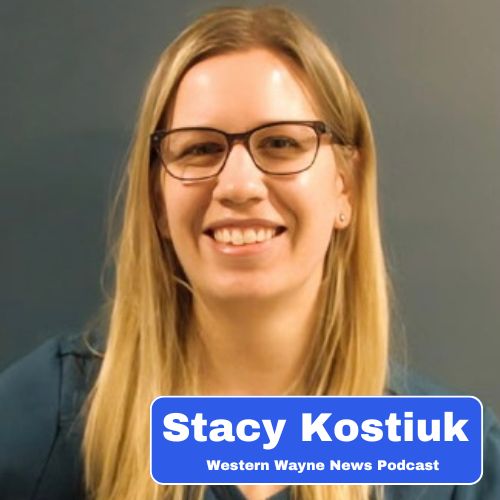


In this episode of the Western Wayne News podcast, veterinarian Stacy Kostiuk joins to have an honest conversation about pet care and animal welfare in Wayne County. Kostiuk shares how her childhood love for animals guided her to a profession caring for nature’s various creatures. She opens up about the joys and hard truths in building a healthy community for the animals we love. Enjoy!
Transcript
Stacy Kostiuk: I’m Dr. Stacy Kostiuk, a veterinarian with Animal Care Alliance.
Kate Jetmore: From Civic Spark Media and the Western Wayne News in Wayne County, Indiana, I’m Kate Jetmore. As a native of Richmond, Indiana, I’m excited to be sitting down with some of our neighbors and listening to the stories that define our community.
My guest today is Dr. Stacy Kostiuk, who grew up in Illinois and earned her Doctor of Veterinary Medicine degree in 2009 from the University of Illinois College of Veterinary Medicine. After practicing in the Chicago suburbs, she moved to Southwest Michigan, where she lived for seven years. Dr. Kostiuk joined Animal Care Alliance in December 2022, and she is dedicated to providing compassionate, high-quality care to the community. Outside of work, Dr. Kostiuk loves spending time with her husband, three daughters, and their two Irish Wolfhounds.
Welcome, Stacy. I’m so glad you could join me on the show today.
Stacy Kostiuk: Well, thanks for having me and thinking of me.
Kate Jetmore: Well, we learned a little bit about you in the intro, but I’d love to know a lot more about your journey as a vet.
So what can you tell us about what drew you to veterinary medicine and also what ended up bringing you to the community?
Stacy Kostiuk: Sure. Well, I don’t know if I’ve ever had a single moment that in my life where I thought I’m going to be a veterinarian, but I always knew that I wanted to be with animals.
As a child, we had so many different animals growing up. Horses, dogs, cats, birds, reptiles, gerbils, hermit crabs. And I found myself trying to rescue wildlife.
In hindsight, I don’t think any of the animals I rescued truly needed rescuing. But baby bunnies, baby birds, I would try and help them, and whether or not they needed it, I was there.
Kate Jetmore: Right. And where was that, Stacy? Was that in Illinois?
Stacy Kostiuk: That was northern Illinois in Durand, a very small town, about five minutes from the Wisconsin border.
Kate Jetmore: Okay.
Stacy Kostiuk: I took horseback riding lessons, so I was an involved equestrian through college. I did 4-H. I showed my barn cats, and somehow my barn cat became a, like, reserve grand champion somehow.
And then, you know, in high school, my first job, first real job, was working at PetSmart, worked at Petco in college.
When I went to college, I, for some reason, thought I wanted to do research on birds as my career.
And so I did summer programs. Helping with research on house wrens. I did projects trying to figure out what was affecting incubation times of house wrens and trying to work out techniques on removing some albumen from fertilized eggs to see if the amount of albumen wouldn’t thin the egg, if that had any effect on incubation time.
And then somehow, again, I wish I knew what all of a sudden caused the pivot, but, you know, it’s just, I’m going to vet school. And there wasn’t a moment that it happened, but it just seemed like the natural progression of what I wanted to do with my life.
Kate Jetmore: Mm hmm. Mm hmm. And why, why birds? It seems like such a specific focus for research. And also, it sounds like the kind of birds that you were focusing on were very much, you know, something that you were seeing in your backyard rather than wanting to kind of go to the rainforest and do research on that kind of population.
Stacy Kostiuk: You know, I don’t know why birds, really.
The time in my life growing up that we had birds was very short and I was quite young, but I do know that working at PetSmart, they sold at the time the African gray parrots and like the umbrella cockatoos and interacting with them was so interesting.
And I think the intelligence in birds is what kind of drew me to the bird research. And in terms of why I was doing research on house wrens, I just kind of fell into that because the neighboring college that… I went to Illinois Wesleyan, and down the road from Illinois Wesleyan is Illinois State.
And there was a well-known researcher there that had this whole house wren kind of colony that he monitored and students did summer programs through them.
So I just went over there and started up.
Kate Jetmore: Okay, that makes sense. And is there a pet from your childhood that kind of stands out to you when you think back on your love for animals?
I know you just said there were so many, but is there one that kind of stands out in your memory?
Stacy Kostiuk: Oh, yeah. I mean, that would probably be our cat, Magic. So I am the youngest of three, and I wasn’t planned.
And so there were a few years between me and my older sisters. And I think as a consolation prize to getting a younger sister, they each got a cat.
So Magic and Fluffy were around when I was born. We lost Fluffy early, but Magic stayed around through my senior year of high school, I believe.
And he was just the best cat. He loved to be held like a baby. So you’d just kind of carry him around in your arms.
If you were laying on the couch, he would lay kind of between your head and the couch cushion. So he was just a good boy, so that was my reserve grand champion cat.
Kate Jetmore: You know, I was going to ask you this question at the end of the interview, but when I introduced you, I mentioned that you have two Irish wolfhounds, and now you’re talking about this incredible cat that was around your entire childhood.
So are you a cat person or a dog person?
Stacy Kostiuk: Well, in the home, I’m more of a dog person only because I developed cat allergies. So in the house, it’s probably not a good idea.
And my husband is also allergic. So both of us are allergic to cats. We did have cats in our adult life prior to having kids.
And that’s when I really got my allergies… or, my allergies really flared up. And I remember the allergist was like, you know what I’m going to tell you?
And I said, well, the cat’s not going to stop sleeping with me. So we can just figure out what we’re going to do.
So since those two cats have passed, we haven’t had any more. So in the house, I’m a dog person.
In the clinic, it depends on the day. Sometimes…
Kate Jetmore: Depends on the cat?
Stacy Kostiuk: Depends on the cat, depends on the day. You know, sometimes I’m tired and I just want cats that are on the table that are easy to look at.
And then sometimes you get the ones that don’t want to be there and they have lots of pointy claws and pointy teeth.
And you know, maybe I’d prefer a few more dogs that day.
Kate Jetmore: Stacy, how do you handle your allergies in the clinic? I’m assuming you wear a mask and maybe that’s enough or…?
Stacy Kostiuk: You know, it’s not too bad. So, you know, with some antihistamines and like Singulair, I’m pretty well controlled.
The only time it bugs me is if I get scratched or bit, then I have a bit more of an exaggerated reaction.
But luckily, it’s nothing really airway related. It’s just all skin irritation and itchiness.
Kate Jetmore: Okay. Okay. Now, I just wanted to ask you, I think I asked you this earlier, but how did you end up coming to the community of Richmond?
Stacy Kostiuk: Yes. So that is my husband’s fault. And no, it was a great decision.
So he was looking for a new position and he is a physician at Reid, and the community was so welcoming and so kind when we came down to interview.
And it was exactly what he wanted in a job, and vets are needed anywhere. So I knew I would be able to find a position.
So we came on down and we haven’t looked back.
Kate Jetmore: Oh, that’s wonderful. That’s wonderful to hear. Well, let’s do turn now to what you’re doing as a vet in the area.
What are some of the things that you’ve witnessed and some of the things you’ve experienced since you got to the community, especially around animal welfare issues?
Stacy Kostiuk: Sure. Well, one thing that I think anyone driving through town can see is that there are a lot of free roaming cats and a fair number of free roaming dogs.
So Wayne County has a poverty level that’s nearly double the national average.
And that often means that people maybe can’t afford the vet care that they need, in particular, spaying and neutering their pets.
So it’s very easy for a population to get out of control.
I think we are also lacking in veterinary services. And I feel like that is a common trend throughout the country, except for maybe some major urban areas.
But there is a website, it’s a veterinary care accessibility website, and they go county by county throughout the country and kind of assign a score to each county.
And so Wayne County is a 32 out of 100. And 100 is being… care is very easily accessible. So 32 puts them in a difficult category.
So difficult to access care in Wayne County. And we don’t have enough vets, or enough vet clinics, I think, to handle the pet population that we have.
Kate Jetmore: And what does that mean for you, Stacy?
Does that mean that your agenda is just packed every day?
Stacy Kostiuk: I am never not busy. And I think that’s true for any vet clinic. I think we are all just booked out all the time.
Kate Jetmore: Yeah. Okay.
Stacy Kostiuk: And then within Wayne County, and again, it’s kind of a nationwide problem, but we just have a little bit of lack of municipal support for animal welfare.
The county has definitely stepped up. They have a contract with the HELP Shelter, which is a private shelter, and they recently really upped their contribution to their contract to help make the financial burden of caring for all these stray animals easier for the shelter.
And the city has done some good things in the past as well, but I think most municipalities are struggling for money and are trying to figure out the best way to use their money, and animal welfare is an easy one that can go by the wayside.
Kate Jetmore: Yeah. How much of the spaying and neutering issue has to do with resources and money, as you said, and how much of it has to do with education?
Like, do people know that they should get their animals spayed and neutered?
Stacy Kostiuk: I think it’s both. I do feel like I have conversations with clients that perhaps have older dogs that are unaltered.
And especially for the female dogs, the risks are a lot more real and tangible if you don’t spay them, so they can get a higher rate of mammary or breast cancer.
And then after heat cycles, a few weeks after their heat cycle ends, they can increase their risk of getting something called a pyometra, which is an infection in their uterus.
And I’ve had several owners that didn’t understand that those were risks. And especially when finances play a part in what they can do for their pet, that… those diagnoses can add a lot of financial burden to that pet owner.
So education is key. Male dogs, we don’t really have horrible diseases that come with staying intact. There are things that happen to them, but it’s usually easily reversible with neutering, whereas the females, there’s a real chance of death.
But the males staying intact, just that increases their drive to run off and roam and then increase their risk of, say, getting hit by car, or being unwanted on someone’s property.
Kate Jetmore: Right.
And then, of course, there’s the elephant in the room, which is just reproduction. I mean, we’re just seeing these spikes in numbers when it comes to those free-roaming cats and dogs, as you said.
Stacy Kostiuk: Yeah, if you’ve ever seen the chart of how much one cat and her progeny can create, it’s mind-boggling.
Kate Jetmore: Wow, wow. Well, what are some of the most common misconceptions and misunderstandings in your work? I’m wondering if there’s sort of one main thing you wish more people understood?
Stacy Kostiuk: Yes. So, you know, we are in it for the love of animals. We wouldn’t do it otherwise. That being said, I am very fortunate to work in a non-profit situation.
And, you know, our motto is “accessible veterinary care”. And we work very hard to keep prices low and offer our clients payment methods and payment plans that traditional vet clinics may not offer.
However, that comes with us having to do heavy fundraising, grant writing, reaching out to businesses for support, and your traditional veterinary clinic, that’s not how they operate.
And so, you know, it is a business, and they do need to make a profit. We’re not trying to price gouge, and we’re not trying to, you know, fund our vacation homes. We’re trying to live a life and help pets.
You know, even conversations with relatives that have had experiences with ER, and they would comment on prices. And I said, well, you know, they need to pay their building rent, they need to pay their supplies, they have staff there that are trained, highly trained, that are there 24-7, and that costs money, and they have to recoup those costs and make a little bit so that they can earn a living.
Kate Jetmore: Right, absolutely.
Stacy Kostiuk: Doctors, human physicians, and veterinarians, we both go to four years of college, four years of medical and veterinary school.
Veterinarians have the option of doing residencies, whereas human physicians, it’s pretty much mandatory. But we still have that same eight years of schooling, and we still have the same student loan debt that physicians do, but we earn a fraction of their salary.
And so it’s hard on us, and, you know, veterinarians have a high suicide rate, I think, because of that financial burden of wanting to help every animal and knowing that sometimes they can’t.
Kate Jetmore: Yeah.
Stacy Kostiuk: And then kind of on the reverse side, maybe a misconception that us vets have. And I admit that I was one of those vets as well.
But we always thought that, you know, having a pet is a privilege. And if you’re going to get a pet, you need to be able to take care of it.
But we’ve learned that, you know, so many people, even in the middle class, an unexpected bill of $400 can really set you back and change your situation.
And sometimes a person’s pet is all they have. It’s their companion and maybe they’re not going to seek an oncologist for chemotherapy and maybe we have to change up how we do a few things so that we can fit within their budget.
But, you know, they can still have a pet and deserve to have a pet. And we need to maybe have a little bit more empathy and a little bit more flexibility with our payment options, and just be open minded that, you know, if they can’t afford an orthopedic surgery, they’re not bad people and shouldn’t have a pet.
Kate Jetmore: Right, right. It’s so interesting to hear you talk about the mental health aspects of veterinary medicine, both maybe what you observe in the animals you treat and their owners and that relationship.
And even maybe in yourself, as you said, you know, you can’t help every single animal. You can’t solve every single problem.
Can you say a little bit more about that part of your practice and maybe how you approach it? Maybe a little bit about how you take good care of yourself so that the energy that you’re working with and dealing with is sustainable?
Stacy Kostiuk: Sure. You know, a lot of people, kind of as a corollary, a lot of people always say that euthanasia must be the hardest part of my job. And for the most part, I don’t find that the hardest part of my job. Now, the emotional aspect of seeing an owner grieve over their pet can be very difficult. But I find that euthanasia is a gift that we can give our pets if they’re suffering, and it is an act of love.
I find it a little bit harder when I see a pet that I believe lacks quality of life, and the owners are having trouble letting go.
And that one is certainly harder on me to then send that pet home to know that there’s going to be some undue suffering.
You know, we develop our own coping mechanisms. I think a lot of us have a bit of dark humor, where we just have to, if you don’t laugh, you cry.
You know, our clinic, we are a tight-knit group. So we’re always bringing in food for each other.
We’re just there for each other and certainly coming home to my family, exercising, reading, kind of those times to just relax definitely help.
Kate Jetmore: Yeah. Thank you for sharing that. And I just want to follow up on one other thing you said that I had never thought about before, and that is that in a veterinary clinic, there’s staff there 24-7.
Of course there is, because there are animals who are staying there, right? So is there always someone there?
Stacy Kostiuk: So in most general practices, there’s not going to be someone there 24-7. So more specifically, your emergency settings. And so I was just saying that they probably have, the ERs have higher pricing because of their 24-7 availability.
Kate Jetmore: Okay, okay.
Stacy Kostiuk: Again, Animal Care Alliance is a bit unique because of our nonprofit status and because we’re always trying to be creative in helping people with their pets.
And so I have a lot of my staff members going above and beyond what is expected and required of them.
I have a staff member right now that drove a cat to another vet’s to get a feeding tube put in that is owned by someone else and is currently caring for it and hopefully will be reuniting them with the owner.
And she’s doing this with very little compensation for her time on providing this 24-7 care. And, you know, it’s not sustainable, to be honest.
And, but you sometimes get a case that really tugs at your heartstrings. And again, because we are a nonprofit and we rely on grants and fundraising, and not solely just clinic revenue, we have the ability to be a bit more creative.
Kate Jetmore: Right, right. Well, again, around the issue of animal welfare in Wayne County, I’d love to know what some of your biggest hopes are for the next couple of years, as well as some of your concerns.
Stacy Kostiuk: Sure. Now, most people who are familiar with Wayne County realize that we have Blue Buffalo, Hill’s and Purina plants here in our county limits.
And so I would love, and what I am somewhat working on, is to create kind of a comprehensive welfare plan that we can then start implementing.
And go to these larger companies and ask for more support financially and show them, hey, we’ve done this on a small scale, and this is our results and our outcomes.
Can you help us upscale it to something more, that will have more impact? And those types of programs would be our Trap-Neuter-Release Program.
So targeting colonies of cats and spaying and neutering them, vaccinating them, treating minor medical conditions, and releasing them back to where they came from.
And through mass sterilization, we want to aim for at least 75% of the colony to be sterilized. We can then stabilize that population, and then it’ll gradually get smaller through attrition and natural death.
So we’d like to scale that up. We’d like to make a more robust, subsidized spay-neuter program, so those that can’t afford the traditional price of spaying and neutering their pets can receive some financial help to get it done, so we can stabilize that population, and so those animals don’t end up on the streets.
I’d also like to create a pet resource center that is tied in with a shelter, but most pets that are getting owner-relinquished to a shelter, that owner doesn’t actually want to give up their pet.
Over 80% of those owners don’t want to give them up, and so if we could work with them to figure out what they need to keep the pet in their home, that is a small cost compared to the cost of housing and medically clearing them and getting them ready for adoption, and it’s much less stressful on the pet, and obviously much better for the owner and the pet to stay in that home.
I also would like to improve microchipping or some sort of identification program. Wayne County, or at least the City of Richmond, has a pet licensing requirement that is not being followed by any means.
I think one year I checked, there were maybe 48 animals registered. So if we can up that and pair it with a microchipping initiative, that way there’s a better chance of if those pets get out that they have a way to be brought home much more easily.
Kate Jetmore: Right, right.
Stacy Kostiuk: We have a lot of passionate people for animal welfare in Wayne County, and I think we’re doing a better job of working together and coming together.
So I am optimistic that real change is going to happen, and I think real change will happen whether or not we have municipal support.
I hope we will, but I think we’re also finding ways to get it done without the support, but obviously it would be much easier if we could be included in budgets, but I know that’s difficult.
Kate Jetmore: Right, right. Yeah, people coming together. Sometimes it’s as simple as that. Well, Stacy, I want to thank you so much for being here with me today.
I loved learning more about you and your practice, and I want to wish you and your family all the best.
Stacy Kostiuk: Thank you so much for having me.