

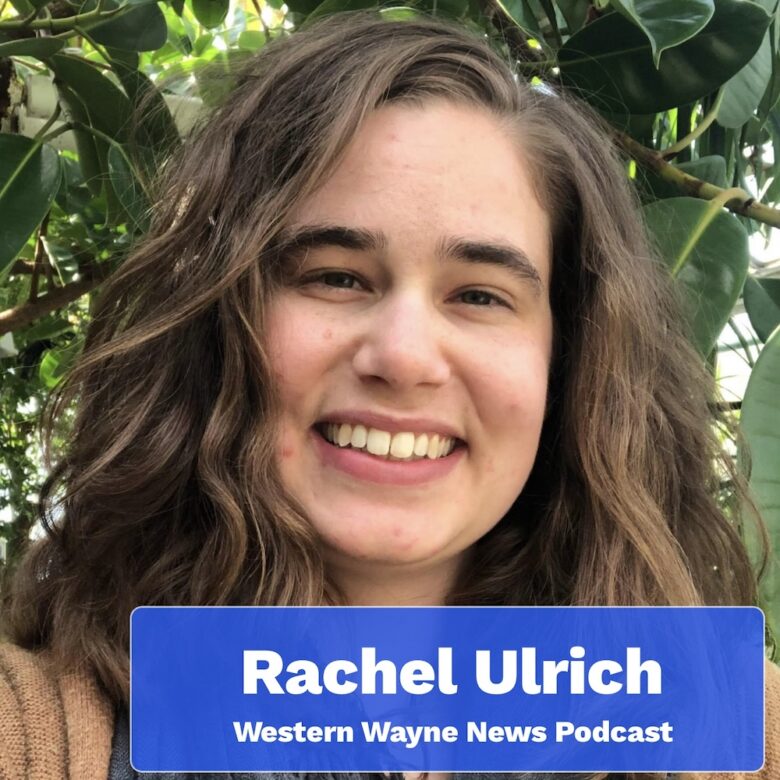

Throughout her time in different educational and nonprofit settings, Rachel Ulrich has built her career around a simple commitment: staying rooted in Wayne County while helping students succeed. In this episode of the Western Wayne News podcast, she shares with Kate what it’s like to build a meaningful career in a small community, why she believes Richmond punches above its weight in vibrancy and opportunity, and how young professionals can find their place in Wayne County. Enjoy!
Transcript
Rachel Ulrich: I’m Rachel Ulrich, academic advisor and success coach at IU East.
Kate Jetmore: From Civic Spark Media and the Western Wayne News in Wayne County, Indiana, I’m Kate Jetmore. As a native of Richmond, Indiana, I’m excited to be sitting down with some of our neighbors and listening to the stories that define our community.
My guest today is Rachel Ulrich, a native of Richmond and 2011 graduate of RHS. While in college, she returned to Richmond over the summers to work with kids in the community, first as a JUKO camp counselor and then as a Girls Inc. program leader. Rachel now brings over 10 years of experience working in education and nonprofit settings. She returned to Richmond to study at Bethany Seminary, spent three years working at the Joseph Moore Museum, and began as an academic advisor at IU East this past June. Rachel cares deeply about making education accessible to all students. She loves living in Richmond and has been happy to call this community home since moving back seven years ago.
Welcome, Rachel. Thanks so much for joining me on the show today.
Rachel Ulrich: Thank you for having me.
Kate Jetmore: Well, you are a graduate of Richmond High School and of Manchester University in Northern Indiana. Tell us a bit about growing up in Richmond and the years you spent away from the area.
Rachel Ulrich: Yeah, so I honestly loved growing up in Richmond. I grew up in this really sweet little spot next to what was Parkview Elementary at the time.
And so it was kind of nestled in this area where you had a lot of parks, you had Mary Scott Park and Clear Creek Park and you had the pool, just all sorts of little playgrounds and like learned to ride my bike in the Seton parking lot, that kind of thing.
And there were a lot of neighbors, a lot of neighbor kids in that neighborhood. So just it was kind of a neighborhood where a lot of families were starting out, like it was maybe their first home, they maybe were raising young kids.
And so there were just a lot of kids playing outside and I had a lot of great friends in that neighborhood and… So I really had a good experience growing up in Richmond.
Kate Jetmore: I feel like I can sort of hear it. I can hear the kids laughing and calling out to each other down the block.
Rachel Ulrich: Absolutely. Richmond has a lot of great stuff for families. I mean, we have such an active parks department and just lots of community events, you know, through the library, all kinds of things. So it’s a fun place to be a kid. There’s a lot going on that, you know, at least if you’re attending those things or tapping into those things, it’s a fun place to grow up.
Kate Jetmore: And did you go to Parkview?
Rachel Ulrich: I did. Yeah, I went there through third grade. And unfortunately, Parkview closed after that point. It was kind of a cost-cutting situation.
And so I went to Westview after that and then spent the last three years of elementary school at Westview Elementary.
And a lot of us who had gone to Parkview ended up at Westview. So we still knew a lot of people when we made that change. Yeah, so that was a change as a kid.
Kate Jetmore: And then what?
Rachel Ulrich: Oh, after Westview?
Kate Jetmore: Yeah.
Rachel Ulrich: So I actually, I did the Logos Lab program for middle school. So I got bused across town.
And that was a really great experience. The teachers in that program were so fantastic. And a very creative environment, I was a really creative kid. So getting to have so many creative projects where you got to do what you were interested in and be kind of artsy in how you did things, it was just a really good environment for me that way.
Kate Jetmore: Was that a 2-year program or a 3-year program?
Rachel Ulrich: It was a 2-year. It had been 3-year and it had recently switched to two years around the time that I started.
Yeah. And then I went to Richmond High School after that, which was a very big shift from Logos. Those are very different environments in terms of the, you know, how big they are and that kind of thing.
Kate Jetmore: Right, right. And how was your time at RHS?
Rachel Ulrich: You know, I think it was pretty good on the whole. I’m not sure I always appreciated it as a high school student.
I think at the time I was told by a lot of people, like, oh, just wait for college. Like, high school isn’t necessarily that fun, but college is a lot better.
So I think my, which is kind of true, but in… And I think, you know, looking back, I maybe could have enjoyed the high school experience like a little more.
Kate Jetmore: So you were kind of treading water a little bit?
Rachel Ulrich: A little bit. But I kind of had a change in tune heading into my senior year. I think it was heading into my senior year where I was like, you know, this is my last year here.
I’m just going to make the most of it. And so I was more focused on being involved in the things that I most wanted to be involved in and just kind of savoring that experience for what it is.
And I think it’s probably a pretty common high school thing to maybe, you know, be a little over it when you’re in high school.
But yeah, so I look back and I’m like, oh, you know, there were a lot of great things there that, you know, maybe I didn’t totally appreciate at the time. But yeah, I had that experience.
And I was very involved on the high school newspaper staff. That was a big thing for me then. And I worked really hard on that and had some other kind of things that I did in the community.
Kate Jetmore: What about your time away from Richmond? Can you tell us a little bit about your years at Manchester University and what came after that?
Rachel Ulrich: Yeah, so I left for college and I think I kind of wanted to get out of town at that point. Not that I’d had like a bad experience living in Richmond, but I was kind of feeling that itch to like branch out and be somewhere else.
And so, yeah, went off to college. And then after college, I actually did a few years of full-time volunteering. And so there was a volunteer service program called Brethren Volunteer Service that was connected to the faith tradition I’d grown up in. And I did that for a year. So I was a teacher’s aide at an elementary school for a year in Roanoke, Virginia. And that was very challenging, but also really impactful in a lot of ways. I learned a lot that year.
And then I did a different volunteer program where I was in Georgia, that was a little more focused on refugee resettlement. And I was primarily teaching English classes to folks who had just arrived in the U.S.
And so it was kind of a challenging time to do that. That was actually… that overlapped with the first Trump administration where a lot of families were blocked from the U.S. And so that was a somewhat rocky time to be kind of working in that area. But that was also a very impactful learning experience as well.
Kate Jetmore: Yeah, and such important work, even if it’s, you know, at a particularly tough time for doing that kind of work.
Rachel Ulrich: Mm hmm. Yeah.
Kate Jetmore: So, Rachel, about seven years ago, as we said in your intro, you decided to return to Richmond. Tell us how you came to that decision and what it’s been like since you came back, especially as a young professional, as you shape your career and build connections in the area.
Rachel Ulrich: Yeah, so I came back in early 2019. And part of what prompted that was that I started up as a student at Bethany Seminary. I actually started in a certificate program there and then ended up folding that into a master’s. So I was in more of a full-time student mode when I first started.
And then I ended up completing that degree, and I wasn’t exactly sure where I was going to be after I finished that degree. I wasn’t sure if the job search was going to take me elsewhere. But I really did want to stay in the local area, so I prioritized searching in the local area.
And I ended up at the Joseph Moore Museum. And so I was feeling drawn towards working with college students, but also being able to serve the local community at the same time. Those are both things that I find really meaningful. And so working at the Joseph Moore Museum was this really nice kind of niche job where I got to do both. Because the museum employs a lot of college students.
The goal is to have it be a student run museum as much as possible. So they have that kind of that learning experience. And so I got to work closely with students, but also be doing something that, you know, is a free museum for the community.
And so that was what really basically, prior to this past June, that was about three and a half years there.
And yeah, I just recently switched to working here at IU East. So I’m getting to continue kind of that combination of working with college students, but also serving the local area. So I found another job where I get to keep doing that.
Kate Jetmore: Yeah, it sounds like you’re finding… Well, first of all, I find it so interesting and worth mentioning that you’re so clear about what you want, you know, you want to be in the local area, you want to be working with college students. So it seems like that’s always the first step, right? Knowing what you want, not only what you don’t want.
Can you talk a little bit about, you know, what the experience is like building your career in a place like Wayne County or Richmond in your case?
Rachel Ulrich: Yeah, that’s a great question. I know when I’ve been job searching, it has often felt a little stressful just because I think whenever you limit your job search to a really specific area, it does limit your opportunities. And that’s not just a Richmond thing. That’s probably an anywhere thing.
So both of those, the last two job searches left a lot of ambiguity and, you know, and wondering like, oh, is this going to pull me away from the area? Or is it, you know, am I going to end up being able to stay? And kind of luckily, I’ve been able to stay.
But that was a little bit stressful, because I don’t actually really want to move. I really do like living in Richmond.
But it’s been a good place to be growing as a, as a young adult. And I’ve been lucky to have some really great colleagues along the way who are just some really lovely people and also really care about students and care about the community.
And so I’ve been able to learn a lot from the people I’ve gotten to work with. So it’s been good.
Kate Jetmore: Yeah. You know, it seems like your reasons for staying local… I don’t know what they are. You’re welcome to share them if you want to.
But, you know, you are a native of Richmond, so I would guess that, you know, roots, family, history, all of that is a strong draw.
Do you happen to know what it is that either has brought your colleagues to the area or what’s kind of keeping them here?
Rachel Ulrich: In terms of colleagues, that’s a great question. I think it’s a little different for everybody. I think being in higher education, a lot of people move for the job.
And so some people that I’ve worked with at both Earlham and IU East, they’ve moved specifically to the area for the position. I think at IU East, there’s more people who lived in this area originally. There’s just a little more of a local feeling that way.
And so there may be folks who already lived kind of in this region, at least.
I think at Earlham, you have more people who have moved to the area specifically for the job at Earlham, and they may be coming, you know, from a completely different part of the country or world for the job.
So it’s been a little different depending on the person. And some people stay because they have families, you know, if they have kids in high school, they maybe don’t want to uproot them, that kind of thing.
Kate Jetmore: Yeah, that makes sense. I guess it depends on what moment you’re in in your life as well.
Well, Rachel, as, you know, part of the team at the Western Wayne News, I would love to know where you get your news these days and how you stay connected to what’s happening in the community.
Rachel Ulrich: Mm hmm. Yeah, well, I honestly think the Western Wayne News is a great source for news for the local community. I’m really appreciative of it because I think having that, having really thoughtful coverage of stuff that’s local from a local source, I think is really valuable. And it’s just not quite the same when the news coverage is coming from, you know, a completely different location.
So I’m really grateful for you all and your thoughtfulness around, you know, covering things in the community and sharing what’s going on. So I think that’s one of the best sources in terms of knowing about stuff in the local area.
I also like to follow a lot of, like, nonprofits in the community on social media. I kind of got into that when I was managing the social media at the museum. I paid really close attention to what different people were doing and the kinds of events they were posting and the kinds of things they were up to. And so that’s one way I’ve kind of stayed connected and… that and just going to things.
Kate Jetmore: Yeah, being active in the community.
What about your students? Are you at all aware of where they’re getting their news and kind of in what format?
Rachel Ulrich: That’s a great question. I have a little less awareness of that, to be honest, because it doesn’t really come up in advising appointments too much.
I would suspect it depends a lot on the student. And there are probably some who are very, you know, tuned in to things that are going on and they, you know, they’re watching the news in various places.
And there may be some students who really are not paying much attention at all. So it probably depends a little bit.
So, yeah, I’d be curious. I’d be curious to learn more from them about, you know, where it is that they find things out.
Kate Jetmore: Yeah. I mean, things are changing. Like, you know, when you were younger, when I was younger, like you would see people actually reading a newspaper or actually reading a magazine, like in the doctor’s office waiting room or at the dentist or wherever.
It’s so unusual now to see someone holding a newspaper or a magazine. I think it’s fair to say we’re all on our phones quite a bit, and so I guess the question becomes, well, if you want to, you know, find out what’s happening in the community and you’re consuming that information on your phone, where are you going to, you know, consume that information? You mentioned social media. You also mentioned the paper. So I guess, you know, we’re all sort of trying to figure out what’s going to happen.
What does the next generation need? What kind of sources do they need? What kind of format do they need when it comes to reaching them with the news?
Do you have any thoughts on that? Do you have any thoughts on what you think might work, given what you see in the university environment?
Rachel Ulrich: Yeah, I do think online is the primary way that probably people access. I know for me it is, you know, if I’m looking at a Western Wayne News thing, for example, it’s online. If I’m looking at a, you know, really any news article, it’s probably on my phone. And I would be… I would suspect that a lot of students are similar. They probably depend more on online things.
I do think social media is a big thing these days. And not so much Facebook for younger students, but like Instagram is, I think, still one of the main ones.
Yeah, I don’t know if I have a super obvious or clear answer, to be honest.
Kate Jetmore: Yeah, I don’t think any of us do. And I think that’s why it’s such an important question. Because it’s one thing to sort of have that observation or that opinion that, people don’t do things the way they used to.
Right. They absolutely don’t. So where are we all headed and how can we shape that as a community, you know?
Rachel Ulrich: Yeah. Yeah.
Kate Jetmore: What do you see, Rachel, when it comes to Wayne County, what do you see as the greatest challenges and opportunities in the area?
What do you wish there were more of, or what do you wish there were less of in the community?
Rachel Ulrich: I think one of the biggest challenges, and this has been a big challenge for a while, but there are a lot of economic struggles in this community just in terms of, you know, people being below the poverty line, struggling to make ends meet.
That’s been the case, you know, like I said, for a while and continues to be the case. I also think, I think we have a lot of really amazing organizations and institutions in this community that work to serve people.
And I also think a lot of folks feel pretty strained. I mean, I know even as an advisor, I feel like there’s one of me and a lot of things that need to be done that it’s really hard to give as much attention to people as I’d like, you know, or to provide as much of my energy as I’d like to a lot of things because I’m spreading my efforts over, you know, a whole caseload of students.
And I’m sure there are a lot of people in the community who feel similarly. So I think a challenge is just that there’s a lot of needs in the community and not always an ideal amount of resources to meet those needs in terms of, you know, funding or staff or that kind of thing.
And I know higher education is really feeling that right now in terms of funding and staffing and, you know, we’re a little spread thin sometimes. And I would imagine that other people in, you know, various nonprofits feel the same way. So I think that’s a challenge.
But in terms of opportunities, I mean, something I’ve always loved about this community is that there are a lot of people who just really care about the community, and really like to work with other people to do things for the community. And there’s just a lot of vibrancy. I mean, it’s not a big city, but for being so small, we have an awful lot going on.
And I don’t know if people always quite see that or appreciate that totally. But I think for the size that we are, there is a lot to offer and a lot of people who are, you know, bringing their passions and interests, whether it’s being involved in the community theater or I don’t know if you’ve heard of Oblivion in town, but it’s this new sort of art store, creative space, third space that is just open to the community to come and you can make art, you can chat with people. And those kinds of things are pretty cool.
And, you know, I think the fact that so many people just kind of have, you know, a vision for how they want to be involved or how they want to engage and kind of lean into that community experience of it.
I think that’s a really great thing about what I see happening in Richmond and I think there are a lot of opportunities in the way that, a lot of opportunities when people kind of lean into that thing that kind of sparks their imagination or sparks what they’re passionate about.
Kate Jetmore: Yeah, yeah. I’m curious as to your opinion or your insights about people out there who are feeling it. You know, they are feeling strained or stressed or just stretched so thin day after day.
And, you know, maybe they’re not making use of the resources that are there or they’re not participating in these activities that you’ve described.
Do you think it’s because they’re not aware or that they don’t feel welcome or…? What do you think about that?
Rachel Ulrich: That’s a great question. And I could imagine it really varying depending on the situation of the person. I do think that sometimes people just don’t know about something that’s available.
And so, you know, kind of getting the word out. Maybe there are barriers that make it more challenging, whether it’s transportation or something, maybe, like you said, maybe it could be a matter of just not feeling like, you know, you quite belong in that space for some reason.
Yeah, I guess I suspect it’s a variety of factors, and it’s hard for me to kind of pinpoint one thing.
Yeah. But I do think it highlights kind of the importance of listening to people’s experiences and the, I think the more personal stories we hear about people’s experiences, the more insight we gain into, you know, what makes for a welcoming space or what makes for kind of what people in the community need.
Kate Jetmore: Yeah. Oh, I couldn’t agree with you more. And Rachel, I want to thank you so much for joining me on the podcast today. I loved learning more about you and your work, and I want to wish you and your family all the best.
Rachel Ulrich: Thank you so much. You too. It was a pleasure to be here.