

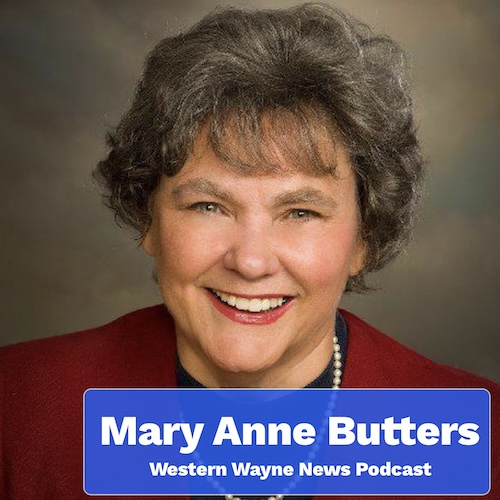

Mary Anne Butters has spent a lifetime insisting that government work in the open, and that ordinary people use their voices. A journalist turned public servant, Butters moved from the newsroom to city hall, from advertising executive to Wayne County commissioner, carrying with her a deep belief in transparency, equity, and civic responsibility. In this episode of the WWN podcast, she reflects with Kate on growing up in a family steeped in political activism, her unexpected path into public office, and what she learned after 12 years in that role. From shining light on backroom deals to urging citizens to show up, speak up, and run for office themselves, Butters offers a frank, personal look at power, protest, and what it takes to keep a democracy alive. Enjoy!
Note: This conversation was recorded in November 2025.
Transcript
Mary Anne Butters: I’m Mary Anne Butters, community advocate and former Wayne County Commissioner.
Kate Jetmore: From Civic Spark Media and the Western Wayne News in Wayne County, Indiana, I’m Kate Jetmore. As a native of Richmond, Indiana, I’m excited to be sitting down with some of our neighbors and listening to the stories that define our community.
My guest today is Mary Anne Butters, who’s the daughter and generational granddaughter of Wayne County Republican activists, including the founder of the party, Underground Railroad conductors, and a suffragist. Her career as a journalist began in Richmond, but extended around Indiana and indeed throughout the U.S. In 2012, she filed to run for county commissioner and served three 4-year terms, before retiring this year. Mary Anne has been married to her husband, Tom, for 60 years, and they have three children and five grandchildren.
Welcome, Mary Anne. I’m so happy you could be with me on the show today.
Mary Anne Butters: Well, thank you, Kate. A joy to be with you.
Kate Jetmore: Let’s start by getting a sense of your history in the area, which is obviously a rich one. Walk us through your professional career, if you would, and just give us the broad strokes when it comes to the various roles you’ve played.
Mary Anne Butters: Actually, my very first job was as a waitress at Welliver’s Smorgasbord in Hagerstown.
Kate Jetmore: Oh, my goodness.
Mary Anne Butters: I was absolutely amazed as a 14-year-old at the vast sums of money I could pick up in tips off the table.
It was actually 20 years before I made as much in an hourly rate as an advertising executive in New York City before I matched the wages I made at Welliver’s Smorgasbord. So from that beginning as a 14-year-old, and I went to work on the day I turned 14, my first real job was as a reporter for the Richmond Palladium-Item.
And after graduating from IU with a minor in journalism and a major in political science, I landed a job at the Indianapolis Star, where I became the abuse editor.
I became enthralled with all of the human sufferings from mental health to drug abuse to child abuse to domestic violence and did in-depth series of mental health hospital conditions, did a wide range of in-depth series on all the various human sufferings there were in the world.
And after seven years of that, and also… I was somewhat critical of the boy wonder mayor, young Richard Lugar, who was in his thirties at the time.
And even though things were certainly on the rise in Indianapolis government, I was somewhat critical of how they could be much better.
So out of the blue, after seven years as a reporter, I got a call from Mayor Lugar’s chief of staff saying, Mary Anne (who I had known… I’d known his chief of staff at IU) Mary Anne, are you going to hide behind that typewriter and tell us what we’re doing wrong over here? Or are you going to come join us and help us do something about it? Well, my first reaction is this typewriter is kind of a nice buffer from reality here.
So, but of course I could not say no. And so I joined Mayor Lugar, who I admire greatly to this day, and made the transition from journalism to public service and had a fantastic year and a half with the mayor, putting all of my writings into action in a wide variety of public service jobs, and he even made my top priority the ratification of the Equal Rights Amendment.
I would wake up in the morning and say am I actually being paid to do this? As a founder of the Indiana Women’s Political Caucus with Democrat Virginia Dill McCarty, who later became U.S. Attorney and candidate for governor. I was the Republican founder and she was the Democrat founder. We became successful in ratifying the Equal Rights Amendment. Indiana was in fact the very last state to ratify the Equal Rights Amendment.
We also made great strides in Lugar’s administration in child care. And in improving wage equity in city employment for women and minorities, which were, shall we say, there was a great gap when I first started, and I unleashed a deep dive into some real inequities in city government employment.
But at the same time, as a birthright Quaker, Vietnam was raging and Vietnam took a terrible toll on my generation. And as a birthright Quaker, I certainly support the need for patriotism, but I’m not a pacifist. My way of objecting to the war was to object to the draft, because I do not believe government should…
I think government should enhance people’s quality of life, and the worst thing you can do is be intrusive into a citizen’s way of life, and there’s nothing, nothing, absolutely nothing more intrusive than to snatch a young person from their home and send them into war to take the life, and worse, to lose their life on behalf of their country.
So I became very active as a volunteer in the Citizens Advisory Council for the All-Volunteer Army, and being so active in that, I caught the attention of the national advertising agency that won the huge contract to market the All-Volunteer Army while Vietnam was still raging. Talk about a marketing challenge.
Kate Jetmore: Yes, yes.
Mary Anne Butters: So, just as I was drawn to my career with Dick Lugar, the ad agency for Army recruiting gave me an offer I could not refuse.
And so I made the leap into the private sector and went to work for the ad agency for the All-Volunteer Army.
Kate Jetmore: Oh, amazing. And Mary Anne, I actually wanted to get back to asking you about how you got to New York, because you referred to that earlier in our conversation.
Now, I’d love to pick your brain about your time as an elected official and ask you what it was like to run for office, especially as one of the only female candidates.
Mary Anne Butters: Right. After many years in the advertising business and as an observer of human behavior, I came back to Indiana due to aging parents and started volunteering as a reader in kindergarten in my hometown, where I graduated from Hagerstown High School, and I noticed the kindergartner’s shoes had deteriorated over time. So I did some research and found that poverty in Wayne County had taken us to the third poorest county in the state of Indiana, ranked 89th.
And we were first or second in unemployment back in 2012. And so it was poverty. And also, I discovered that a lot of business was being done in the dark in county government.
So without even checking with my husband, Tom, I happened to be in Richmond and I filed for commissioner one day and had a lot of opponents.
But I had 11 yard signs and a little bit of radio and defeated three men. And there were no other women in either county council or county commissioner.
So out of the ten in the legislative executive body of the Wayne County Government, I became the only woman.
Kate Jetmore: Amazing.
Mary Anne Butters: It was a tough, tough race, and it was pretty tough because my first action was to really declare war on doing business in the dark, because a lot of decisions were being made outside of public meetings.
So I cast a bright sunshine on county government.
Kate Jetmore: And how did that go? What was the result of that? It sounds like you went into the race hoping to shed some light on these sort of backroom deals.
What did that look like when you started shining that light?
Mary Anne Butters: Well, I had the law on my side because it’s against the law to have decisions made outside of public meetings, and our county attorney was very helpful.
We had the public access counselor come from Indianapolis to acquaint us all with exactly what the law is. I think some of the elected officials were not aware of exactly what the law is and early on I had some great, great success.
Also, I personally sponsored eight job fairs. Our unemployment was 10-12%. We in Fayette County had the highest unemployment, and we jump-started employment.
And so we had some early successes, but I was not one of the boys, never was one of the boys, and not that I really tried to be.
You’ve heard of Uncle Tom’s in a racial setting. I never tried to be an Aunt Tabby Cat. I’m a feminist and proud to be a feminist and tried to encourage, and I did encourage women to run for office in county government.
And so before I left, there were two women in county council. I tried to get other women to run for commissioner, but there are currently two women on council and all three commissioners are men.
And it was tough. I had some successes and some failures, tried very hard to get some of the measures passed, but some were successful and some were just as delayed.
Kate Jetmore: Mm-hmm. And several terms as county commissioner. What’s it been like after leaving office?
Mary Anne Butters: Okay, I’ve taken on some hobbies. I’ve had a lot of offers to be a volunteer for a lot of nonprofits where my heart is still continuing with so many, many wonderful nonprofits in this community.
My guilty pleasure is the Richmond Women’s Club, where your father is going to be a guest speaker at the Women’s Club. And I’m also active in the Women’s History Club.
And also, I’ve become active in the, well, the People’s Movement to try to save our republic. And one of the great successes I learned as a public official that elected officials who are doing their job actually listen to the people.
And one example as an elected official was the protest against wind turbines moving into Wayne County. The vast majority of the people objected to that and there’s a great success now with the people of Indiana objected to a special session to redistrict in favor of eliminating both Democrat U.S. Congressmen. But the people spoke up and I was active in that movement. And so now the special session that was announced has been canceled that would have eliminated both Democratic Congressmen.
I just think it’s important that people understand that their voices matter. And so few people actually call, text, write, speak to their elected officials.
Voices have great impact on elected officials, and if people just only knew how impactful their voice can be, they would speak up more loudly and more effectively, and with measured tone.
Kate Jetmore: Yes, yes. As a former elected official, and as a citizen, and as a Republican, as you said, what would you like to say to anyone out there who’s listening, who does feel, you know, “I’m not happy with how things are going. If only my elected officials would listen to me.” What would you recommend that they do, or how would you recommend that they express their dissatisfaction?
Mary Anne Butters: Well, I personally believe that even though I am an active Republican, and believe that the party can come back to its Lincoln-like beliefs in human dignity and equality for rights for all, I think our current president is challenging Republican principles. And so I have become active in the protest movement through marches and protests and clever signs, the No Kings movement, etc, because people are making a difference throughout America.
I strongly recommend people do speak up and show up to let their feelings be known about the demolition of the East Wing, if that concerns you, or if the unconstitutional actions of deploying active-duty military to our cities, helicopters having uniformed personnel rappel down into people’s residences.
The draconian actions of our president are a great threat to our republic, and I urge people to take a stand, because this is not my party’s beliefs that are being acted on out of the White House today, and I urge people to take a stand and speak up, because people can make a difference.
I know as an elected official, every time I would have a concern expressed, it makes a great difference.
Kate Jetmore: Thank you. Thank you, Mary Anne. You’ve said that so clearly and in such a helpful way. You do refer to yourself as an advocate, and I know you’ve been an advocate for public access laws in the past, specifically.
You’ve already shared a little bit about your thoughts on the current political climate. I welcome more of those if you want to share them.
What about when it comes to transparency and further opportunities for citizens to engage, maybe beyond protest?
Mary Anne Butters: Active engagement in public meetings. It was heartbreaking to see major policy being decided without any public participation.
The Western Wayne News is a fantastic source for knowing when public meetings are being held, whether it’s a zoning meeting that can greatly affect your property values for one thing, or if it’s a public meeting of a city council, a town council, all of the county council and commissioners meetings are announced.
Whether you read Western Wayne News online, or as I do, hard copy, and all the other community engagement opportunities that are bountifully prepared and presented to the public in the Western Wayne News.
The service that your paper provides is a great invitation to making a difference in public policy that greatly affects one’s life.
The wheel tax, for example, that I fought for 12 years. I think our county officials had no choice because Indianapolis General Assemblymen forced the counties into that. But having it less regressive and having people with brand new Escalades pay more wheel tax than those of us with 15-year-old vehicles should pay less, or 30-year-old vehicles with bald tires.
Kate Jetmore: Right, right.
Mary Anne Butters: And people are given an opportunity at these public meetings to speak. Not to go on for hours, but elected officials welcome the opportunity to hear from their constituents.
I think people do not understand what a voice they have. And while I was not happy with all the public policy decisions made during the 12 years I served, I do believe that Wayne County is very well managed.
It’s fiscally sound, even though we’ve had rough times. Wayne County is on the right track in many, many ways.
I think it could be much more transparent. The funds that we received due to COVID from the federal government, those decisions were made with less transparency than they should have.
The public meetings that were held around the county, people were given a chance to speak, but they were not listened to.
So there, people need to follow up, you know, so a public meeting was held, but when people spoke out and said, this county must have more priorities given to the welfare for animals.
That call and that appeal was pretty well ignored. And there remains a great need for Wayne County to prioritize the need for the welfare and care for our domestic animals.
Kate Jetmore: Right. That actually leads me to another question. You’ve already sort of half answered it, which is why do you think people don’t attend these meetings or don’t speak out?
Is it because they don’t know, they’re not informed, they don’t know where to find out when and where the meetings are taking place?
Or, as you’ve said, is it sometimes because people know where the meetings are taking place, they show up, they stand at the microphone, they make their voices heard, and then they feel ignored?
Mary Anne Butters: Well, in the case of if you’re an animal advocate, you certainly have been ignored in this county, but you can keep everlastingly at it.
And one way to overcome that is to bring someone that you’re comfortable with, a friend, a relative, someone you really like that can bolster your courage and prop you up a little bit before you stand and speak.
And I also recommend before you do speak at a public meeting that you write it down and do not speak extemporaneously, as I am here right now, perhaps if I’d written down my exhortation to how to affect public policy.
I mean, I played a role in getting that special session canceled. That’s been my hobby upon retirement to get engaged in saving our republic that’s under great threat.
You know, I’m not in public office, but my hobby is saving our republic from Donald Trump. You know, I don’t crochet, but I can sure as heck protest.
Kate Jetmore: Thank you. Thank you for that. And, you know, what I hear you saying overwhelmingly is that our republic, our democratic system is a conversation.
It’s I talk, you listen, you talk, I listen. We try to meet each other in the middle. And, you know, there is a very eager, I think, in many ways, a very eager generation that is coming into their own.
And I’d just love to hear, Mary Anne, what advice you may have for young people out there who might be considering running for office in the future.
Mary Anne Butters: All you have to be is 18 years old to run for office. Most offices, not president, not senator, but pick a party. And, of course, I recommend you pick the Republican Party and restore it back to its mental health that it deserves. We’ve been overtaken by a cult that is dangerous.
Please, if you believe in human dignity, if you believe in protecting the rights of those whose rights have been trampled, pick a party and become active in it.
Run for precinct committeeman. It costs absolutely nothing to file for office. I think people think it costs money to run for office.
I had 11 yard signs and a tiny bit of radio. You don’t have to have rich friends to run for office. The people that endorsed me were people who were out of work and stray dogs, not big pocketbooks.
People who love dogs tend to walk a lot, right? So we went door to door with our dogs and dog treats. And you don’t have to be, I mean, I had to wait till I retired to have time and to actually run for office, but I’ve been affecting public policy all my life, but you don’t have to be partisan. Also, you can affect public policy by going to meetings, by actually calling and talking to people on the phone, actually talking on the phone.
Kate Jetmore: Imagine.
Mary Anne Butters: I know, it’s archaic and, you know, not cool, but it can really make a difference.
Kate Jetmore: No, but I love it. It’s actually human beings talking to each other. Imagine.
Mary Anne Butters: And that’s, you know, it can be fun, actually, to make new friends and get all those social media friends mobilized.
A social media campaign can be very inexpensive if you want to run for, I don’t say school board. You know, because, you know, that’s a different path and it’s so limited in the public policy it affects.
But public policy when it comes to a town council, a city council, it can affect every aspect of your life from what you pay in taxes to how your community is zoned, whether or not you can have a 500-foot windmill in the property right next to you that can greatly affect your property value.
There are so many aspects of your life that can affect your life, your well-being, your future, that you can have a voice in by making those decisions for others.
Kate Jetmore: And what can you share firsthand about how it affects your personal life? I mean, I hear you saying you can really help people if you serve as an elected official.
And, you know, it’s a very, in many ways, very generous thing to do, especially on the local level. What are the pros and cons, in practical terms, of serving as an elected official?
Mary Anne Butters: Well, one of the areas that I was most engaged in was recovery from substance abuse and the absolute joy of finding someone who had been suffering from substance abuse, turning their lives around to becoming productive and getting their lives, their wives and husbands, and partners back and getting custody of their children restored and becoming productive and healthy, getting their health back and finding that people can recover from the depths of substance abuse.
That was one of the most rewarding aspects of public service. Another is just seeing that people can make a difference in expressing their point of view and turning my point of view around.
I’ve had citizens change my mind, and they just light up when they realize that sitting down with me for 20 minutes and, you know, I can be opinionated, but I can also have my mind turned around when the facts are presented. That’s joyful.
And it also, however, during COVID, and those were some of the darkest days, as we were losing so many people every week, you know, losing so many people, I was astonished at how violent people became when we asked them to wear masks and to stay away from crowds.
There were some good times and many, many rewards from being an elected official, but there were also some very frightening times as to just how vicious people became when we tried our very best.
Our health department, starting at the very top, gave so much of themselves to save lives in this community, but the threats that came down upon them… I even had death threats because I advocated for getting the vaccine, for wearing a mask, for being cautious, because people were dying, neighbors were dying, and we knew how they could stay safe.
So you do take some risks, but it’s very much worth it when you see lives being saved and lives being turned around.
And seeing… One thing I did, I ran for office because of poverty and opening up government to shining light on decisions being made.
One of the reasons I ran is that government was rewarding economic development grants to companies that were paying $8 an hour.
You know, what we were doing was promoting poverty by giving taxpayer dollars to companies that were paying poverty wages.
But before I left office, we would not even consider awarding an economic development grant to a company that paid a dime under $20 an hour.
So that is knowing that we were no longer promoting poverty, but promoting a living wage, promoting a good life, and creating an environment in which government makes lives better.
Kate Jetmore: Well, thank you so much, Mary Anne, for all your work as an elected official, and thank you so much for taking the time to have this conversation with me.
I loved getting to know you and learning more about your work, and I want to wish you and your family all the best.
Mary Anne Butters: Thank you. You as well.