

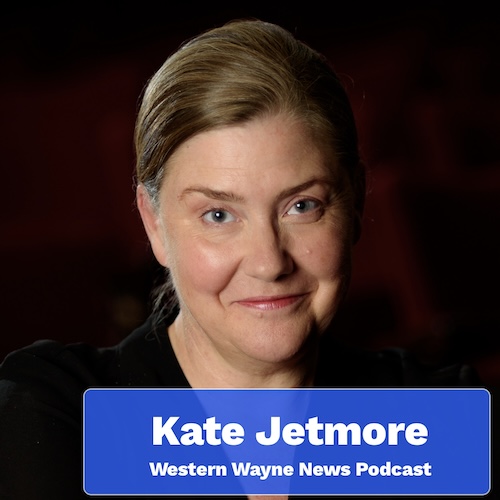

Kate Jetmore grew up in Richmond, left for New York and then Spain, and spent 25 years abroad before deciding to come home to Wayne County as the new executive director of Richmond Civic Theatre. In this special “farewell for now” episode, Kate sits down with Chris Hardie to mark the end of her run as host of the Western Wayne News Podcast, reflecting on why firsthand stories matter, what three years and nearly 60 conversations taught her about the community, and what the future of local podcasting might hold. Enjoy!
Transcript
Chris Hardie: From Civic Spark Media and the Western Wayne News in Wayne County, Indiana, I’m Chris Hardie, and I’m here with a very special guest who needs little introduction. as she has been the host of the Western Wayne News Podcast, Kate Jetmore. Welcome, Kate.
Kate Jetmore: Thank you, Chris. Thanks so much for having me today.
Chris Hardie: I’m excited to be talking with you, and we’re at a huge milestone in the life of the podcast, and you and I thought it would be a good idea to sit down together and take a moment to talk about what that is and how we got here and what it means and what’s ahead. So uh it’s exciting emotional stuff and we have a lot to cover. It’s an honor to be looking back and talking with you today.
Kate Jetmore: Yeah, it is absolutely and I can’t believe it’s been th over three years since you and I sat down and had coffee at Roscoe’s and talked about Well, what would this be if we actually did it? If we actually were to create a podcast for the Western Wayne News, what would that look like? And it makes me it give me gives me sort of chills to think about the fact that um, you know, we had some ideas We tried them out. Uh there was one that kind of stuck and we went with it. And we created, I think, over 60 interviews during that time. Yeah. And, you know, as a as a kind of a creative process to look back and think, you know what? This is how this is how human beings do this. They just have an idea and then they act on it. And then the idea is a thing that exists in the world, you know?
Chris Hardie: Absolutely. Well, and I know you and I did a conversation, I think it ended up being about halfway through the last three years. Um, and I would encourage anyone listening to this to maybe go back and listen to that because that was our kind of first real check-in on the air, so to speak, about How’s this going? And what is this thing that we’ve created and and you know what does it become and what does it mean? Um so that you know that was a good reference conversation to to do a little self-promotion for an episode there.
Kate Jetmore: Sure, sure, exactly.
Chris Hardie: Um But we’re talking today because you recently made the decision to come back to Wayne County and live here and work here and Uh that uh means lots of change for you, for the podcast, for uh your family, and uh you know, wanna hear about what that decision was, what that change is, and and how it’s going so far.
Kate Jetmore: Yeah, well, thanks for asking. I mean It is a lot of change. It is big change. And I can fill you more in on that a little bit more. But at the center of it, there’s a really calm knowing. It all feels very aligned and um kind of right in the chute and when you are acting in a way that’s that’s aligned in that way those big changes feel maybe less overwhelming than they would be otherwise so there’s a lot of trust there and a lot of faith that this feeling that I’m having is leading me in the right direction.
So For people who haven’t heard the podcast before or who don’t know me, I grew up in Richmond. I left Richmond to go to New York City when I was 18. um to get my degree at NYU and ended up being in the city for about 12 or 13 years and then have spent the last 25 years in Spain. So my move back to Wayne County is a move back to my hometown of Richmond, but it’s also a move from a very different culture where I’ve lived for 25 years back to the United States.
And I’ll just speak to the elephant in the room. I’ve had many people ask me, wow, really? Like there’s so much going on in the United States right now. Like it that’s so interesting that you’ve made this decision right now. And I just want to say out loud that my decision actually has to do with that. I am proud of being an American citizen. I identify with that part of myself. And I feel like now is the time to stand up for who we are as Americans, as citizens of this country and say loudly and proudly what we stand for and what’s important to us. This is a time I think when we get to define what that is.
Chris Hardie: Well, and your uh career has spanned various forms of of storytelling. Uh and you know the podcast has been a piece of that. Your your new role as executive director of Richmond Civic Theater is is a piece of that. And I think it’s safe to say on your behalf that your storytelling has been focused on what are people’s stories? What do they believe? What do they stand up for? um bringing that out into the open and um so it’s not surprising but it’s still you know heartening to hear you say that how important it is to to bring out what who we are, where we come from, what we believe, uh, what we aspire to in the world, right? That that those are things we we can connect over, we can build bridges and and foundations around. Um and I and I think that was a part of, you know, that was a part of the podcast. Is is that uh you know, I just want to ask, is that part of what you’re getting to do or hoping to do at Richmond Civic Theatre as well?
Kate Jetmore: Well, Richmond Civic Theatre is, you know, its own thing, right? It’s already doing what it does. It’s so well organized that we already have decided what our shows are gonna be for the 27-28 season. So there’s a lot happening at RCT that I don’t have my uh fingers in, you know, I’m I’m the new member of the team and I’m just kind of getting in there and seeing how I can help um but not sort of spearheading a lot of new ideas at the moment. I do have ideas, so stay tuned.
But yes, I mean when you think about the theater absolutely stories are at the heart of it. Whether those are fictional stories that you’re seeing enacted in front of you on the stage or enacting yourself in front of an audience. Or if you are a volunteer on a production, onstage or offstage, maybe you’re doing costumes, maybe you’re in the box office.
But what I love about RCT is that no matter how you choose to participate You are in contact with other human beings. You’re in the same physical space as other human beings. You’re doing something as a volunteer and coming back over and over as a volunteer. Which says to me that people are having a good time. I mean, you don’t do something like that if it’s not fun, if it’s not bringing joy into your life.
Chris Hardie: I don’t want to um give our podcast more credit than is due, but I th I think I heard you say at some point that the conversations you got to have as a part of hosting the the Western Way News podcast um played some part in in your decision or just in your understanding of the place you’re coming back to. Just wondering if you could say a little bit more about that. What w were there were there particular stories? Was the the experience overall just talking to so many Wayne County people that you’re like, oh I gotta get back there or like what what what uh role did it play, if any, in in that decision for you?
Kate Jetmore: Well, all of all from what you’ve just said, I think it ac absolutely did play a role I think it was quite subtle and kind of under the surface, right? You know, like a a duck swimming. You don’t really see what its feet are doing. Yeah. Um, but they’re getting it where it’s going, right?
So Part of part of my experience on the podcast, a very, very powerful part of my experience on the podcast, was yes, I was scheduling people for these interviews, sitting down with them, creating the questions, talking to them. But more than anything, what I was doing was listening to them and hearing what people had to say. Here’s a thing that’s working. Here’s a thing that’s not working, but here’s what we’re doing about it. Here’s a thing that we’re hoping to do, here’s a thing that I do because my parents did it and my grandparents did it, and I really hope that my kids are watching me do it.
That is something that I just find so inspiring. And I think that, you know, when you talk about stories, and even more more powerfully than stories, our behavior, right? The things that we do as citizens of this community, as members of this community. You weave all that together and it is who we are. That’s our culture and that’s who we are as people who live in Wayne County, whether you’re sort of from here or uh a transplant who’s come here for whatever reason. All of those things come together in this beautiful, unique way. to show us who we are. Yeah.
Chris Hardie: Well, and I was thinking too about the the number of times, excuse me, that you and I talked about the importance of of making the conversations with guests um not just a a pitch for their their program, their project, their organization that they work with, right? And it’s You know, obviously those things are a part of their identity.
And if someone, you know, spends so much of their time and their waking hours working on a project or for a nonprofit or even for a business, like that’s that becomes a huge part of who they are. But you and I really wanted to get at, okay, who who is this person? But you know, first and foremost, like who are they as a resident, a citizen of of Wayne County? Like how like what’s that story? How did they get here? Why did they stay here?
And you know, sometimes we had to work, I mean you you did the work. You you had to work pretty hard to say like no no don’t don’t go into those talking points. Like let’s pull back and look at and look at you. So What what did you notice? Because I, you know, you were just saying how important what we do here, how it becomes who we are and and our identity in the community. How did you think about teasing apart those different um strands of of an identity of a person when you were talking to them for the for the podcast.
Kate Jetmore: Mm-hmm. You know, I don’t know how consciously I went about that.
Yeah. I am a student of life. I’m a curious person. I always have questions for people. You know, whether I’m sitting at breakfast with someone or sitting next to them at the movies. Um I I wanna know why people do things and Oh, that’s so interesting. Why didn’t you choose this other thing? Or, you know, what do you miss about that? Or what are the hard parts about that? Or the easiest parts about that? Um, and so I think in a lot of ways those questions came quite naturally to me, which is, you know, maybe why I was a good fit to be the host of of the show.
And and you know, people, I think when you when you ask people questions on that level, what makes you tick? What do you find exciting? Um, it sort of leads them naturally to talk about these more kind of human aspects and get away from the bullet points and the talking points.
Chris Hardie: Yeah, yeah. Well, I just I just I think it’s been so important and I’ve said to you before and I’ve said even on this podcast before that um you know telling people stories and bringing out you know who they are, what are the things that they that they care about. Where do they come from? Um, how do they think about this community? I I just can’t say enough how important that work feels.
And you know what we do at the newspaper is a version of that where we’re we’re telling the community, you know, here’s here’s what happened uh at a meeting at a community event at a school board gathering, you know, uh at a sports game and um what what you’ve done is is a version of that. And and I and I think you know we live in a time where people take for granted that there’s connection and that there’s you know common understanding about uh what the world is and who we are in it. And I and I don’t think we can take that for granted as much as we used to.
So being able to –
Kate Jetmore: Yeah.
Chris Hardie: So being able to bring these stories out and just say, oh, like That person’s doing something amazing or that person feels like me in this in this way and not like me in this other way and just like, and that’s all okay. Um it’s been so great.
Kate Jetmore: Yeah, and I’ll just add to that, you said the words, um, you know, here’s what happened, right? That’s where the newspaper’s coming from. Here’s a thing that happened. Here is what was said. Here is how the vote went. And I think that um one really important way that the podcast complements what the newspaper does is, first of all, all local, right? We’re talking about Things that are happening in Wayne County in our communities that directly affect us.
But the other thing that I hear you saying and that I was really focused on with the podcast was, What is your firsthand experience? What did you see and how did you experience it? Because I think part of what’s happening in this media environment is that people are, you know, it’s like second, third, fourth, fifth hand recycled news. And it just is so far removed from from our reality. Yeah. You know, I think we need to hear people say what they experience firsthand and then we believe them, first of all. If you saw that and you told me you saw it, then I believe you. And then you can go from there.
Chris Hardie: Yeah. Yeah. Well, and I can only hope, I mean, our our community needs that more than ever. You know, communities everywhere need that more than ever. And whether it’s through media or podcasting or in-person conversations or uh a a play or a musical production or whatever it is, you know, that that brings us together. Uh I just think we can’t we can’t get enough of that.
You and I have talked about the challenge of of kind of um quantifying the impact of something like a podcast, right? I mean we we’ve talked about um you know what happens when we put an episode out into the world And we can see things like uh the number of times it’s downloaded. And we can see things like, you know, when it’s shared on social media. But I wonder, you know, what what have you heard from guests? Um People you’ve talked to in the community, people you talked with when you were thinking about coming back to the community about you know what what the podcast and and your work there has has meant to them or uh to the community, you know, at large.
Kate Jetmore: Mm-hmm. Well, it’s interesting when you create something and then you just sort of launch it out into the void. I mean, as you said, yes, there are stats out there. You can see, oh well, people are listening because we do have those download numbers, right, but you don’t know who, you don’t know exactly how or in what environment, right?
First of all, one thing I love about podcasts is that they enter into your system through your ears. It’s a voice is a very specific thing, a very personal thing. And he and I mean I have earbuds in right now. That’s that’s so intimate to put something in your body and hear someone else’s voice. So in that sense, I think podcasts in general are a very powerful thing. Um I have heard from people in unexpected ways. You know, I’ll be talking to someone who never has given me any indication that they’re even aware that I host this podcast and they’ll say, oh, I heard such and so conversation. I loved that one. And then they’ll sort of compare it to another one that they’ve listened to.
So Those moments really come as a surprise to me because I think it’s easy to think, well, if so and so were listening to the podcast, I would know But you know, our lives are busy. We don’t always let everyone know what we’re doing and what we thought. So to get that feedback can be um, you know, a wonderful and unexpected surprise.
Chris Hardie: Yeah Well, and I love uh one of the things I like about podcasts, in addition to what you said, is you know, there there can be this like delayed long tail effect, right? Like sometimes folks will let episodes accumulate on their device or just in their f in their feed, so to speak. And you know, contrary to what we might want to see with you know big announcements, big splashy things out in the community or news articles like seeing seeing it kind of circulated and reacted to there might be a conversation with a guest that sits there for someone for several months. They don’t they don’t listen to it.
And then they come back around to it and and they’re like, okay, I’m gonna listen to this conversation now. And it could hit them at just the right time and in the right way and and make a difference in their understanding of who this person is, what’s happening in the world, what that story is, what it means to them. And I just love that because it doesn’t, you know, we it doesn’t require that immediacy. Certainly there there are podcast shows that that are very timely. I think we’ve we’ve tried to make ours a little more timeless.
Um And I love that you know these conversations are are gonna be available online um to for people to find, you know, hopefully forever uh as an archive. Um because it’s it’s it is timeless wisdom and and uh understanding that’s that’s out there. It’s it’s pretty cool.
Kate Jetmore: Yeah, I mean I maybe it goes without saying, but I sort of place podcasting in the same space. in my mind and in my heart as radio. I absolutely love radio. I’ve always loved radio. And podcasting is like on on demand radio, right?
It’s like it’s like Netflix and TV. It’s it’s on your TV, but you can access it whenever you want and you can access it over and over again. If you have that favorite conversation, that favorite episode you can go back, you can share it with other people. Um, I mean, I’m a fan, in case you can’t tell, there’s so many things to love about podcasting.
Chris Hardie: I want to check in too about just the state of of podcasting in the community because again, we you know we can get some sense of impact and and interest. Um I you know my just kind of personal take is podcasting is not a a widely used medium in Wayne County I think you and I had that question when we started this experiment. Like, is the is this something people will figure out how to listen to? Will they bother?
We’ve seen some trends of You know, if we post an episode and post the transcript of the conversation at the same time, we’ll see some online reactions that are like, you know, great read or great article. And and we’ve wondered out loud, like Are people even hearing the audio? Like, do they know there’s an audio component to it? And that’s maybe just more of a uh, you know, where where is Wayne County when it comes to an understanding of what podcasting is and what it’s for? Um I’ve I’ve seen you know some some podcasts um pop up locally that you know some of them take off and some of them kind of come and go.
What I don’t know, what’s your sense of of podcasting as as a way people take in conversations and information in the world, especially locally, but just in general right now? Like what what’s the state of podcasting according to Kate?
Kate Jetmore: According to Kate. Well I feel a little bit um bashful because I don’t know a lot about what’s going on with podcasting in Wayne County. I’ll give you my sense. My sense is that there are some people who have discovered podcasting through the Western Wayne News Podcast. Maybe not as many as you and I had hoped for, but I, you know, I’m I do feel heartened by um, you know, the uptick that we see pretty consistently.
And then the other sense that I have is that um and this is a larger conversation, but the podcast that I have seen popping up all or most of them seem to have a video component. Yes. And I’m guessing that that’s because of demand. I’m guessing that that’s because Maybe you get more downloads if you’re on YouTube and you have that visual component, or maybe, you know, just statistically people are finding Well, people aren’t clicking on my content if I it you know, if it’s an audio only podcast.
You know call me crazy, but I am kind of a purist when it comes to podcasts. I don’t watch podcasts. I mean I listen to a lot of podcasts and many of them do have that visual component, but I only ever listen to podcasts. Yeah. And that’s the kind of podcast that I prefer to produce.
So how about you? What do you think about what we’re seeing in Wayne County?
Chris Hardie: Yeah, I’ll I’ll just you know start where you left off, which is to say I’m a purist as well. I think of podcasts and maybe it’s just because I’ve been doing it long enough that this is you know where it started, but I think of podcasts as audio.
The video component for me is an an add-on that in in almost all cases I find distracting and you know in some cases just annoying. And I don’t mean to denigrate anyone’s, you know, particular efforts around that, but I uh, you know, I as you were saying earlier, like there is something to me really special about being in whatever space I’m in, in my house, my car, traveling, um, and having a voice in my head and just being able to hear the words uh the conversation for what it is. I find video podcasting just a little bit performative in that way. And again, I’m not I’m not trying to say that that’s a bad thing, but it I find myself aware of you know, the the time and effort that’s gone into creating a production for visual consumption and I’m and I and it’s just distracting to me.
I think that podcasts are great for some things and not others. I mean they’re I think they’re terrible for consuming um timely detailed information, right? So uh Uh you know, that’s the reason that like news broadcasts are short, you know, when they’re on audio or you know, radio or television. Um so when when I see someone say, you know, here’s a link. to my three hour um you know exploration of this, you know, policy issue or this timely thing. I’m just like, no. I’m not gonna do it.
I know there are folks who will put it on in the background and find it helpful, but for me that’s just not a thing I can do. So that’s that’s all a little grumpy uh answer to your question, but I —
Kate Jetmore: You’re good. You’re good. I’ll tell you what, I don’t mind a long podcast. I really don’t. I like to go for a walk, I like to press pause and go back to it the next day. Okay. But Um more than that, what bothers me is when I’m listening to a podcast and it’s giving me the kind of information that I feel like I need to write down. Like I feel like I I need to take notes or else I’m gonna lose the value that’s coming at me.
And so I prefer not to listen to that kind of podcast. I really prefer you know, a conversation, uh kind of a a sense, an energy, um, a tone that can kind of accompany me as I listen to the conversation, but not so much a thing that I need to pin down or learn or remember.
Chris Hardie: Right, right. I mean, and purely from a mechanics standpoint, I mean podcasts I think um have taken off um In in you know, as a thing people do when they’re doing something else, right? Like if you’re doing the dishes, you’re driving, you’re commuting. And and I just don’t know that in in uh Wayne County where you know any given commute is you know two minutes to maybe fifteen minutes long. You know, there’s there’s just maybe not as many opportunities for folks to say, you know, what can I th what can I throw on in my vehicle that will accompany me on this on this commute. You know, that just doesn’t happen as much. Um, you know, hopefully, yeah, going for walks, uh exercising, whatever.
I mean there’s there’s opportunities there, but for one reason or another it it feels like Um we’re we’re just as a community a little behind in uh uh adopting podcasts as a as a thing to do.
Kate Jetmore: Um yeah. Yeah. I also hear a little like chicken and egg in what you’re saying. It’s sort of like Uh sorry to say it, but the bike path. Like there are people who don’t like the bike path and maybe that’s because they don’t really understand the bike path. They certainly aren’t using it. Maybe they don’t have a bike. But if you don’t ever have a bike path, you’re not going to have people who are using a bike path. People with bikes aren’t going to know that they’re able to use that bike path.
So it’s like Do you do you build the thing first? Do you teach people first? I mean it’s hard to sort of when you’re working with a circle, it’s like, well, where do you enter that?
And so what I hear you saying, and I feel the same way about podcasting is You know, living in Wayne in a place like Wayne County where you don’t, you know, luckily you know you don’t have this long uh commute where you have to sort of fill that that time, right? But there’s also it’s like, you know, it’s nice to have stretches of time. It’s nice to have those moments in your life where you’re doing something like walking, for example, and you have a podcast in your ears What if people know that, oh, there’s a podcast? How can I create a moment in my day where I’m doing something like taking a walk? where I can listen to that podcast. So it almost like creates, I want to believe, it can create that tendency to create um A little more space, a little more, you know, kind of take the temperature down in your day.
Chris Hardie: Yeah. I’ve certainly experienced that. You know, if I find a really good uh audiobook And I’m just like, oh, when’s the next opportunity to hear, you know, 15 minutes here, 20 minutes there? Um and I I think uh, you know, podcasts can can fill a similar similar role as well.
You and I were intentional about kind of picking a 20 to 30 minute length for the the Western Wayne News podcast episodes. Just looking back a little bit, do you do you feel like that was a a good length? Too long, too short, anything you would you would change about that and have you know the experience you have now?
Kate Jetmore: You know, it’s kind of like your child. Like if you look at your child and you think, oh my gosh, she’s perfect. She’s perfect. And that’s kind of how I feel looking back at the episodes we’ve created. We aimed for 20 minutes. There were some that came in at 15, 17, others that came in at almost half an hour. So uh I felt I always felt so grateful for that, you know, kind of creative license.
But I thought twenty minutes was a a pretty good length to aim for. And I felt like it was um it was a fit for most guests. Because some guests come on and they have a lot to say and they’re very comfortable and you know they could you know 20 minutes is not nearly enough. But some people come on and it’s it’s a hard thing for them to do, you know, their kind of personality and they d they don’t feel sort of as comfortable with a with a microphone, with having so much attention on them. But 20 minutes is not a huge ask. You know, it’s not like 45 minutes or an hour.
Chris Hardie: Right. And and hopefully folks understood. I think you did an amazing job of of bringing people to a place of comfort around this that you know it was it was just a space for them to say who they are and what they’ve been thinking about. There was no you know prepared speeches. There were no uh high high stakes answers. They weren’t being grilled or uh there were no gotcha moments. I mean we we kept it I think human to human, very authentic, very personal.
And and you have uh a a great talent for seeing where a conversation goes, uh just accepting that for what it is and follow you know following the path as opposed to uh forcing a conversation into a certain format or structure and uh just want to commend you again on that because I think it it has made the show what it what it was
Kate Jetmore: Oh thank you, Chris. That means a lot to me.
Chris Hardie: We sat down when you were finalizing the decision to to come back and uh join RCT. And said, okay, what what happens with the podcast now? And I I think we, you know, both of us I know wanted to find a way to to make it all work, but of, you know, eventually came to clarity, I think, that, you know, to be in a full-time executive director role and you know other ways that you’re just a part of the community and involved and and contributing and um spending time with family that that to also be hosting the podcast didn’t didn’t feel like a good fit or just feasible.
And so um part of this conversation is is marking that that decision to say, you know, we’re we’re kind of winding down, wrapping up. the Western Wayne News podcast as it as it has been. I said to you like I don’t want to close the door completely on you know there not being a a next phase or next era of the podcast
But we haven’t figured out what that is yet. We’ve teased some thoughts uh around uh the room and with the team about uh, you know, what would it mean to do a similar format with a different host or a completely different format or uh something more newsy, something more timely. And Uh really that’s going to come down to to resources and time and priorities uh in in some scenarios, you know, finding a sponsor, finding funding.
Maybe this is not a fair question for you, but like what are your hopes for the future of of this podcast, or or maybe just, you know, continuing on podcasting in the in the community in general, like what what do you want to see? What do you want to listen to?
Kate Jetmore: Mm-hmm. Well, first of all, I have absolutely loved being the host of the Western Wayne News podcast. In case I haven’t said that, I want to say it loud and clear.
And so while it’s not a fit right now, I I also would like to not completely shut that door. And whatever ideas come to the table. If I fit into that in any way, I hope you’ll reach out to me. I know um you mentioned, you know, maybe something more timely, maybe something newsy I know at some point in these last three years we talked about something with kids. I think that would be a great thread to pull on.
When it comes to podcasting and you know my current position, first of all, I’ll say that I still do have my first podcast, which is called The Listen Podcast. And you can find that at thelistenpodcast.com. And what I’m doing throughout 2026 is interviewing my dad, uh, David Jetmore, um, in his 80th year.
We are doing one interview per month and it started out just being a daughter wanting to pin down her dad’s stories and voice and um And pretty quickly I realized, oh, I gotta put this out there. There’ll be people who will want to hear this. So feel free to look that up. Just next week, we’re gonna be launching uh the 9th conversation in that series. I try to drop them the last Tuesday of each month.
And then when it comes to RCT, there is an incredibly rich history at RCT. Um, I mean I know some of it and I think I know a lot more than most people, but there’s so much I don’t know. And I’m trying to figure out what the best way is to tell that story. And I think it might be Uh maybe, maybe through a podcast. You know, maybe it’s a series of conversations with people who we won’t have forever who still have those memories. Um but I don’t know.
I’m still I’m still thinking about that. If you have any ideas, I hope you’ll reach out.
Chris Hardie: Well it sounds fascinating. And I and I you know I just in general love the idea of yeah, using the audio format to record uh preserve you know stories and memories and you know in the case of your dad just like his life and experience and and to bring that out and and to do that for uh an institution uh or for you know parts of the arts community which I know you’ve been doing in other formats as well.
I mean I just love it and I hope I hope it continues and I hope yeah I hope we can like find ways to to get those as widely distributed as possible because they’re um I think you know s the kinds of stories people say they want to hear more of and Uh we just gotta get them get them to click play or find the thing. You know, find the link and and get it the link.
Well, I know uh that we’ve kind of reached uh a moment here where it’s not goodbye, it’s see you later. And uh I just want to thank you again for the the time and passion and energy and care that you’ve put into the Western Wayne News podcast.
You have made it what it is and crafted it around the words that we kind of use when we were first talking about this: authentic, human level, real, personal, and and you’ve you’ve crafted this thing around those ideas and made it possible on as I you know, even just today like scrolling through the the list of um episodes and the the faces and names of people Um what an amazing you know range of conversations that that you’ve had in that time and uh what an amazing contribution to the the history and and kind of record of this community’s life.
So thank you. Thank you, thank you. It’s really, really wonderful.
Kate Jetmore: Oh, Chris, thank you so much. I I didn’t expect this conversation to end with such a wonderful and heartfelt thank you. And I really, really appreciate it.
And I want to thank you for including me in this project. It’s really meant something so powerful in my life.
Chris Hardie: Listeners, stay tuned. Keep us in your feed and we’ll be back a bit later with an update on what’s next for the Western Wayne News Podcast.
I’m Chris Hardie, and as Kate always said at the end of her episodes, we wish you and your family all the best.