

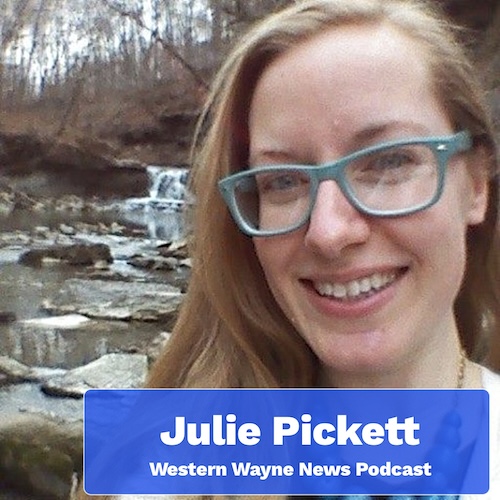

An actor, software developer, and tireless volunteer, Julie Pickett has spent more than two decades weaving together technology, theater, and community in Wayne County. In this episode of the Western Wayne News podcast, Julie reflects on how studying at Earlham College, working at DoxPop, and finding her voice at Richmond Civic Theatre shaped her path, and why investing in teens and connection is the work that matters most to her now. The conversation with host Kate Jetmore touches on staying, serving, and building the kind of community you don’t want to leave. Enjoy!
Transcript
Julie Pickett: I’m Julie Pickett, actor, singer, and software developer with DoxPop.
Kate Jetmore: From Civic Spark Media and the Western Wayne News in Wayne County, Indiana, I’m Kate Jetmore. As a native of Richmond, Indiana, I’m excited to be sitting down with some of our neighbors and listening to the stories that define our community.
My guest today is Julie Pickett. A graduate of Winchester Community High School, Julie attended Earlham College to study Math and Computer Science. She began working for Doxpop in Richmond immediately after, and has remained for over 20 years. By 2016, Julie was involved in most theater productions at Richmond Civic Theater, where she currently serves as Technical Chair of Hair and Makeup, and Co-Chair of Costuming. She also volunteers with Stage One Youth Theatre and with the Drama Club at Richmond High School.
Welcome, Julie! I’m so glad you could be here today.
Julie Pickett: Well, it’s so lovely to be here. It’s nice to chat with you again, Kate. It’s been ages.
Kate Jetmore: It has. It has. I want to start with your early years in Richmond. How did you end up in the area, and what were the factors that led you to decide to stay and really put down some roots here?
Julie Pickett: Honestly, the first big reason that I came to Richmond, Indiana was to study at Earlham. I grew up in Winchester. I lived both in town and then I lived north of town, kind of out in the country for my whole upbringing.
I graduated from Winchester Community High School in 2000, which seems an unbelievably long time ago, comparatively. And the entire time I was at Winchester High School, I was very interested in justice. I was very interested in politics. I was a big part of model legislature and I was very, very driven by liberal ideas and I think I was a little bit unique amongst my peers in that regard.
And Earlham was a place that I knew about. I had a family friend, several family friends who had gone to Earlham, many of my parents’ friends, though my parents themselves did not attend college. They had several friends who, you know, had, had obviously gone to college from, in various places around East Central Indiana.
And the friends of theirs who had gone to Earlham were just, they, I was drawn to them. I just thought they were so smart and so thoughtful and so kind. And I, it just really drew me to the school and I planned my entire four years of high school. I really looked to Earlham and that was, that was my big goal.
Like when I, when I got out of high school, I really, that’s where I wanted to be. Those are the people I wanted to be around.
And it was really the only school I like fully applied to. So I’m, you know, probably very fortunate that that worked out for me.
Kate Jetmore: Yes.
Julie Pickett: Otherwise, and you know, I could have, I could have gone to Ball State, could have gone a number of places in the area. But I was very happy to be at Earlham. When I went there, you know, I felt like it was really my community. I fit in. I had a wonderful time there.
But I also went through a lot during those years. From 2000 to 2004 was, you know, those were, you know, 9-11 happened during that time. A number of kind of really impactful things happened in my very young adulthood while I was at Earlham. And it was a, it was a very, I think, good place to experience a number of those kind of major world events, and to be able to contextualize them and process them and kind of feel like I was doing something to help.
You know, we were big on organizing and protesting. And, you know, we thought a lot about these things. We talked a lot about these things. And those were the people I wanted to surround myself with. And so it was, you know, a really good place for me to be.
And I was extremely fortunate as soon as I graduated, I was hired by a group of Earlham grads who were working on a project to put public records online and make them searchable. And that was my background, particularly in the title industry. That’s where my mother and my grandmother had run a title company my whole life. So I was very familiar with the, you know, the courthouse with that type of searching with those types of data.
And so, coming out of Earlham into this group of people into basically a position where I get to support government in a way that is very familiar to me. I’m, you know, it all worked out so, so well. I’m so extremely fortunate. And so, I walked from Earlham into, you know, a career space, where I was surrounded by the same types of people, and I mean, who would leave that if they had been given the option to stay?
Kate Jetmore: Right, right.
Julie Pickett: I really, like, I was so, so lucky. I think, you know, from a young age, I was able to kind of, like, really spot the community, like, spot the place in the world I wanted to be, and I think I got very fortunate that that’s, you know, that is ultimately where I ended up.
Kate Jetmore: Yeah, I hear so clearly in what you’re saying that it’s not only what you’re doing, it’s who you’re surrounded by and kind of what the values are and what the energy in the room is.
I know that you’re very involved in the community, you know, beyond what you’ve shared about where you went to school and where you work and have worked for many years. What are the various ways that you participate in local activities, and what drives your involvement?
Julie Pickett: That’s a tough question. It’s hard to say. I mean, how do you know what drives you when you just… that’s a really tough question, Kate.
I don’t know what drives me. I’m genuinely not, I’m not sure I can explain what drives me to do these things.
Kate Jetmore: Well, maybe you can talk a little bit about what it feels like.
Julie Pickett: Yeah. Clearly I’m driven to do the same types of things no matter where I go. So there’s, there’s something in there internally that is just, there’s a compass. There’s a very clear compass in there. And what I’ve been driven to do basically in all of my volunteer experiences in Richmond just keeps driving me towards a certain age range of youth programs.
I just, I get so concerned about the teens in our community. And I started volunteering at Richmond Civic Theater many, many years ago. Really I was, you know, I was fortunate in that, you know, where I work in my career, I work for Ray Ontko and Sharon Ontko, and they are extremely involved people as well.
They’ve always encouraged us to serve on boards. As an employee, they’ll donate to your organizations on behalf of the company if you, you know, if you go out and do particular types of service work and board work and volunteer work. And so they’ve always promoted, you know, they’ve always encouraged us to be out in the community and volunteering and making use of our time in that way. And so I’m very, very lucky. And I am involved in a lot of the same spaces that Ray and Sharon are.
And so, they really encouraged me to get involved at Richmond Civic Theater. And while I was there, I’ve been just, I think that just people come to the theater to connect with others.
I think that we could create art at home and that’s fun and that’s wonderful, but creating art as a group is a very different feeling. There’s something really special about coming together and trying to, as a group, put yourself in someone else’s shoes and interpret someone’s emotions and intentions. And you have to very deeply empathize with all the various characters and the different stories that you’re putting together. And something about experiencing that with other people, with other people who are touched in that same way, there’s something really special.
And there’s a very kind of like warm kinship and, you know, there’s just a special kind of warmth and delight that kind of comes from that group experience. And you can tell from the second you walk in, you can almost exactly tell who needs to be there.
I definitely went through a lot of periods in my life where I was at the theater because I needed to be there. You know, I was going through a hard time. I was going through, I mean, I went through, you know, a very serious and emotional divorce process. And, you know, through that, I stayed very in touch with the theater. I did a lot of work there.
That’s, I mean, my work got very intense, my volunteer efforts, you know, during that time, because something about being able to give of yourself is very healing, particularly like when you see, when you’re surrounded by people who have, you know, emotional needs, like they very much need that connection. And when you can give that to them, something about the act of giving and like helping is just very healing to the self.
Kate Jetmore: Yeah, absolutely.
Julie Pickett: And so, I spent a lot of time there. And then the other thing that happens is I feel it’s very important once you work up to receiving bigger roles there and being a little bit of a role model and a leader in that way, I think it becomes even more critical to be seen volunteering in a lot of ways, to be helping others, to be in the background doing the things that, you know, may seem a little less glamorous.
Kate Jetmore: Yes, absolutely.
Julie Pickett: You can’t only take the glamorous jobs. That’s not fair.
Kate Jetmore: Right, right. Oh, how interesting. Yes, absolutely. And you, as I was hearing you talk, I was hearing and feeling the word connection in myself. And then you said the word connection and it made me think a little bit about, you know, what things were like during the pandemic, during the lockdown, when we had this sort of imposed non-connection and isolation, and what we all learned through that.
The other part of connection is that it’s a very, very important part of community.
Community is connection. I’m wondering if you can put any words on what role the theater plays in the community of Richmond.
Julie Pickett: That’s a perfect question. And I think it goes back to the folks who really need that connection. I mean, I think that I have to be there in good times and bad, because there are times where I desperately, you know, need that assistance from other people.
But I have to be there to give that back. You know, I have to be there in the good times to be able to, to offer that. And I, and I think that that’s a microcosm of any community, isn’t it?
Kate Jetmore: Yeah.
Julie Pickett: I mean, you are not a member of this community unless you’re connected to it in some way. And then the other thing that really just assaults my heart sometimes is, you know, the folks who really seem to need and desire and treasure that connection the most are the teens, the teen volunteers. And that is, that is specifically what has driven me more and more and more to volunteering with the youth theater.
I cannot tell you how shocking it is to me to show up, you know, just, I’m only there once in a while, you know. I’m helping these kids. I trust, I’m devoted, I’d do anything for these Stage One kids. But, you know, I can show up and help three times with a single show. And those kids remember every single kind thing and kind word you have ever said to them, near them…
You know, it was one of the great joys of my life to be able to play the Wicked Witch in a show where the Munchkins were my absolute favorite people. I had so much fun terrorizing and being mean to those kids on stage because we had so much fun backstage.
And I know, like, I love those kids so much. And because I know that they can tell and because they give me that energy back, it made it so much more fun to be able to play with them and tease them on stage.
Kate Jetmore: Right, right, because you had that backstory.
Julie Pickett: Yes, it added so many more layers of that. My grandma came to see the show twice, and she said, you are having so much, way too much fun being mean to those kids.
I was like, I am like, I’m gonna snatch Charleigh’s little nose off. She’s so cute. You know, these girls, these little kids, I mean, the Royer girls, oh, my gosh, they’re so precious. I mean, I just want to put them in my pocket every time I see them. And they’re so happy to see you.
Kate Jetmore: I had the absolute pleasure of being in the audience to see you playing the Wicked Witch. It was also so much fun to watch you on stage in Mamma Mia, and I’ve seen you in other shows as well.
It’s clear that you love it, so I think all of us listening to you are getting chills talking to you about it. And so there’s no need to sort of explain what it is you feel, but I guess I’d love to hear what your hopes are for the future of local community theater.
Julie Pickett: I have a lot of hope for our community theater and our different community spaces. I will say we have some fantastic educators at the high school who have built up the Red Devils drama program, which has absolutely just, it has just rocketed into the stratosphere over the last couple of years. I’ve had a heavy hand in helping with all of their shows as well.
Jaclyn Bartlemay and Archer Bunner are the two leads, the two educators that are leading that charge. And it’s been really cool to see these two different, completely different groups of teens. There’s a, you know, a group of regular teens at the Stage One youth program. And then there’s also this group of kids at the Red Devils drama club. And we’ve seen them mix together in these really fun ways. Those kids, like, they’re coming together, they’re lifting each other up. They’re, it’s so amazing to watch. We have to, you guys, these kids are doing great things. That’s my hope, is that, you know, I see the way these kids just light up when they are given these materials.
So this spring, the drama club at the high school is doing Frog and Toad, or A Year in the Life of Frog and Toad, and that was a show that they chose themselves. So Jaci and Archer gave them a number of shows, and the kids read them, and this was the one that they just thought was really fun.
Which is, that in itself gives me hope, because I know that the Stage One managing director has been trying to do Frog and Toad for years, because it is, it’s a wonderful story and it’s a wonderful script, but it’s not flashy and special. And so he’s, so Stage One is really jealous of the high school right now, because they’re getting to do this really heartwarming, touching show that the kids themselves have taken enormous ownership of.
They want to, they… in the last two years, these kids have gone from, you know, just kind of having no idea what they’re doing to, you know, now they want to help design the sets. They’re, they have all these ideas, they want to help me now with costumes, really strong thoughts about, you know, how their character’s feeling here or there, and they want to talk about and work through all these things. And it’s so special to see kids this age, you know, really latching on to this and taking ownership of it and just, cause they’re our future leaders.
And that’s, that’s what I, the whole time I’ve been at Richmond Civic Theater, that’s what I’ve seen. It is so easy to work with this particular age range and to build those kids up into leaders. Because, like, if they’re there and they’re, you know, there’s that special age, that, like, late teen, where they’re really, they’re so capable. And they’re, they have so much energy and like, it is a very special joy of mine in that I’ve been the hair and makeup chair at Richmond Civic Theater for so long that I’ve trained up all of these younger folks and now I get to go and serve on their hair and makeup crews.
Kate Jetmore: Oh, I love it. I love it. And you know what I hear you saying, Julie, is that these kids already have the energy. They already have that light, that bright light shining. And it’s our job as adults to support them in that and make sure the light doesn’t go out, because it’s already there, right? It’s not like you have to figure out how to light it. It’s already there. All we have to do is foster it and reflect it.
Julie Pickett: We’re just boosting. We’re just taking these kids and we’re taking what they already have and they need that boost from us. And if you are in a position where you can ever give that to them, like that is so magical.
And that’s what builds community. That’s what builds future leaders. That’s what keeps our theater community growing and moving in the right direction. And I see that, I’m seeing it all across town. So I have a wonderful hope for this community and for these kids in particular.
Kate Jetmore: Oh, I love that. Well, when you find yourself describing Richmond to people who aren’t familiar with the community… I mean, here’s a conversation between you and me talking about Richmond. We both are familiar with Richmond. We both love Richmond.
But what about when you’re talking to people who aren’t familiar with it? What do you choose to highlight and what do you wish more people knew about the area?
Julie Pickett: So I’m in a particular position in my career now where I’m doing a lot of going around and speaking. As you might imagine, being on stage, that has also really benefited me in my work life, and so I do a fair amount of speaking, either impromptu or planned engagements on behalf of DoxPop, and I’m really lucky in that most of our work is focused in Indiana, and we’re an Indiana-based company where we do our work here, we’re located here, and that is a little bit unique in the space that we’re in, in these government services, and so this is so wonderful, because I get to go out and promote both DoxPop as a community partner, and then I get to brag about other community partners on a regular basis. So when I go out to conferences and conventions, my favorite thing to do is to bring local door prizes with me everywhere I go, all over the state, and so one thing I’ll do is I’ll go to Warm Glow. I’ll go to the candle outlet there, and I will, you know, I’ll choose something lovely from Warm Glow, or I need to start also going to the Uranus Fudge Factory, and I think that combo would be such a killer door prize for my table. Like, no one’s going to be able to beat that.
But then when I go and give these gifts away to other people from all around the state of Indiana, you know, I’m standing in a room with, you know, 200 people. They’re all from Indiana. And then I get to brag about our community.
And so the things that really drive me and the things that I’m lucky to be able to say about our town are things like, you know, back at the beginning of my involvement in the community in general, I served for nine years on the board of Girls, Inc. And Jackie Carberry from Warm Glow was a wonderful partner to us. She was always there when we had questions about marketing. She helped us a lot with that. She helped us with our gala events. This woman once dropped off 200 Girls, Inc. branded candles with a special scent that she had designed for us for us to hand out to every attendee at our annual gala.
So when I say that we have some amazing community partners in this town, I cannot brag about it enough. I mean, my own boss, Ray Ontko, literally started and underwrote an entire Shakespeare Festival for what, a decade? Like, how does our town, how do we get to have these things? How do we get to have our own symphony orchestra? I mean, that is an absolute treasure for a place our size.
The fact that we have, you know, in a town our size, the fact that we have, you know, multiple higher education institutions. And, you know, IU East has grown so much in my time here in particular. And I think it’s really become an institute that the community can and is really, can be and is really proud of.
And, you know, and that’s just all come about, just because of individuals in this town who have cared enough to do something outside of themselves, to reach out to their neighbors, and to do something positive for the growth of this community. And I think it’s really easy to see the individuals, you know, who are just stepping up and doing that kind of all across the board.
And maybe I’m lucky in that I get to run with this particular, you know, kind of creative theater group. And those people in particular seem to be the type who are always out there making waves and making those connections. But I certainly count my lucky stars. If that’s just luck on my end, then I will take it gratefully.
Kate Jetmore: Yes, yes. And it is the people. And, you know, a community is its people. And you are one of those people.
So, Julie, I want to thank you so much for sitting down with me today. I loved learning more about you and hearing about all your projects and your passions and I want to wish you all the best.
Julie Pickett: Thank you so much. This has been a great time and it’s nice to catch up. Hopefully we’ll have to we’ll have to chat again soon.