

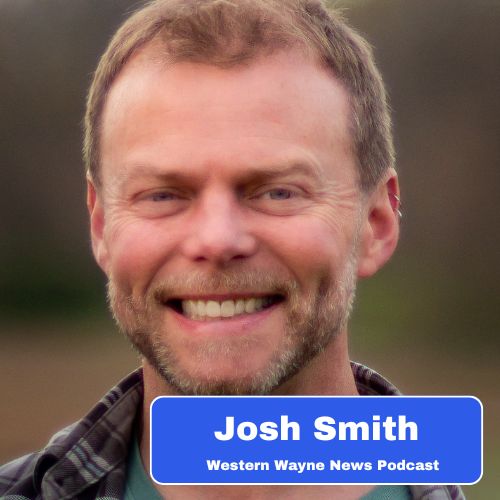


Josh Smith has spent nearly three decades documenting the people and moments that define Wayne County, first as a newspaper photographer for the Palladium-Item and now as a freelance photojournalist who works with Western Wayne News and other clients. In this episode of the WWN podcast, he reflects on the craft and ethics of visual storytelling, the evolution from film to digital, the impact of AI, and why the best photographs aren’t just beautiful, but tell the truth about a moment in time. Enjoy!
Transcript
Joshua Smith: I’m Joshua Smith, and I’m a photographer.
Kate Jetmore: From Civic Spark Media and the Western Wayne News in Wayne County, Indiana, I’m Kate Jetmore. As a native of Richmond, Indiana, I’m excited to be sitting down with some of our neighbors and listening to the stories that define our community.
My guest today is Josh Smith, who’s most likely recognized as a local camera guy. He’s a husband, a dad, a fan of nature, art, and music, especially Dave Matthews band, a teacher, marketer, and church youth director. He shot for the high school paper and yearbook and worked at a camera store while attending college. An internship at the Palladium-Item led to capturing local stories as a newspaper photographer for almost 30 years. These days, he continues to create photos for Wayne County as a freelance photographer.
Welcome, Josh. Thanks so much for joining me on the show today.
Joshua Smith: Oh, it’s good to be here. Thank you.
Kate Jetmore: Give us a peek into your history in Wayne County. Did you grow up here?
Joshua Smith: No, I did not. I grew up in Wisconsin. It’s on the southern end of Wisconsin. It’s right in the middle between Chicago and Milwaukee, right on Lake Michigan.
Kate Jetmore: Oh wow. And when was that moment, I assume in your childhood, although I might be wrong about that, when you first became interested in photography?
Joshua Smith: I think I remember it being on vacation, I think it might have been to like Mackinac Island, and asked if I could, you know, grab my dad’s camera, just a little point and shoot and take photos. I think there was like a musket, like battle reenactment thing going on, and I was determined to catch a photo of the smoke, you know, coming out of the… barrels of them. So I don’t know, maybe 10? I’m not sure. There’s actually a photo of me taking the photos with the little point and shoot that my dad took with his real camera.
Kate Jetmore: Oh, wow. And I have to ask, did you get the shot?
Joshua Smith: I believe I came pretty close. You know, back then it was film, so you had to wait to see, but I don’t know how many photos I took, but…
Kate Jetmore: Yeah. And what did it look like from there? I mean, did your parents foster that interest? Did they identify it right away, or was it something that you were exploring at school with teachers?
Joshua Smith: I mean, I think it wasn’t like a jump in all the way right away. It was kind of just messing around with it sometimes. And I played, again, with my dad’s other cameras. He was fine with me using, like, his SLRs and stuff. And then I started, that was back when there was, you know, bookstores and things. So I’d go and look through the photography magazines. And then, yeah, then I took like a darkroom class in, I think, middle school and then kind of kept going from there. Yeah. Yeah.
Kate Jetmore: Well, I actually had planned to ask you about this a little later in our conversation, but maybe this is a good time to ask you about the changes that you’ve seen in technology.
I mean, you’re talking about darkrooms and film and, you know, a point and shoot versus an SLR. What can you say about those changes that you’ve observed in your profession?
Joshua Smith: Okay. Yeah. That’s, it’s a lot. Cause now, nowadays, like a lot of photographers I meet, they’ve never used film at all. And they, they got into it by using their phones or whatever, and then going from there. But yeah, like I started with, like I said, with point and shoot film cameras and then used my dad’s SLR. Um, and then eventually got my own, um… But yeah, it was a lot harder to learn by trial then, because you weren’t, it was take the picture and then not see it till at least a day, usually longer, you know, unlike digital, where you get to change a setting and see immediately how it’s affecting the picture.
Kate Jetmore: Right.
Joshua Smith: So yeah, it was seeing film and then in the, at the Palladium, we didn’t switch to digital until, I think it was like 2001. So, so that was like learning that side of it. And of course, digital then was not as good as it is now.
Kate Jetmore: Mm hmm. Well, before we turn to the Palladium-Item, as you mentioned, just give us an idea of how you got from Wisconsin to Indiana. Can you kind of walk us through what that looked like?
Joshua Smith: Sure. Well, I went, I was in Wisconsin. And decided during high school that I wanted to do photography as a career. So I looked at colleges and I ended up in Winona, Minnesota. So, yeah, went to Winona State in Minnesota to study photojournalism. I think my actual major was Mass Communications with an emphasis on Photography. But yeah, that gave me a lot of opportunities to shoot professionally as a student because I worked for the PR department and I worked for the city paper there. That was a daily. So. So, yeah, after graduating, I was looking for internships, you know, the next step. And I applied several places and did a phone interview with, um, the managing editor at the time, Tim Johnson, and Steve Koger. And we did a, uh, just a regular, just phone interview. And a while later they asked if I would come down to do a three-month internship.
Kate Jetmore: Wow. I had no idea that it was actually the Palladium-Item that brought you to the area.
Joshua Smith: Yeah. I had never heard of Richmond. Um, well, maybe a little bit, cause it turns out my, the pastor at my church back in Racine, um, was from Richmond. So, um, when I accepted the internship, um, like I said, it was supposed to be three months. Um, and my parents remembered that the pastor grew up here. So they reached out to him and connected me with a family that let me live at their place for free. Cause I was like what do I do for three months? Like sign a lease or whatever. So, so that was, that was great.
Kate Jetmore: And was that straight out of college, Josh?
Joshua Smith: Yeah, a week after I graduated college. I just packed up my little car and drove here for the first time.
Kate Jetmore: Wow. What an adventure. And what did that look like when obviously those three months turned into something longer?
Joshua Smith: So, yeah, I think it was like two months into it. The Palladium, most of the time I was there, had two staff photographers. And then every summer we had an intern. But then that fell away. But one of the staff photographers, she decided to leave for another job, like two months into my internship. So they, we just kind of kept rolling how we were. And then at the end of the, towards the end of the internship, they were like, hey, do you want to stay? So I was like, yeah, sure. Why not? So, yeah, I thought I’ll, I’ll do that for a couple of years and see. And then, I’m still here.
Kate Jetmore: Mm-hmm . And how many years were you with the Palladium?
Joshua Smith: I was like a month short of 20 years when several of us got laid off.
Kate Jetmore: Yeah. Wow. That’s a big chunk of a person’s life.
Joshua Smith: It is, yeah.
Kate Jetmore: Almost 20 years. Wow. I know now you do something similar for the Western Wayne News. I’d love to know what that’s like and how it compares to what it looked like when you were working for the Palladium-Item.
Joshua Smith: Yeah, that’s interesting. I think, well, the Palladium was a daily. So that was, you know, regular deadlines. But also we shot, you know, for stories that were upcoming in the future. But often I didn’t know. I had a regular shift, but I rarely knew what I was doing that day until I came in. And I usually worked like 2:00 till like 10 or so. Because I shot a lot of the high school sports and things.
Kate Jetmore: Is that pretty typical for, you know, to be more of a second shift, or not necessarily?
Joshua Smith: It’s probably like the other photographer… I was the, there was two of us and he had been there longer. So he, he worked first shift normally, but we did, we did rotate weekends. So I did get every other weekend off. So, but yeah, I think probably he covered the stuff in the morning and then I’d come in and do afternoon and then usually evening sports, but he did some of that too. So I think probably pretty typical.
Kate Jetmore: And what does it look like at the Western Wayne News? As you said, it’s a weekly rather than a daily.
Joshua Smith: Yeah. So there’s obviously less assignments, like less space for photos being just, you know, the one edition every week.
Kate Jetmore: Yeah.
Joshua Smith: Um, and I think it’s a little bit different as far as what they’re looking for to put in the paper every week. Such limited space that you’ve got to maximize what you can do. But also, the staff there is pretty flexible with my time. So they’ll usually give me some ideas of, hey, these are the things we’re thinking of, you know, does it work in your schedule? And then if it does, we’ll agree on like a top choice and I’ll do that one. Sometimes I’ll shoot maybe two or three things for them in a week. And then there’s some weeks where they get photos from somewhere else and they don’t need me.
Kate Jetmore: Oh, interesting. Okay. I was sort of assuming that you were the only photographer working with them, but it sounds like you’re not.
Joshua Smith: Yeah, no. And I think they have, they have a few that shoot mostly high school sports for them. I haven’t done any, well, I’ve done a little bit of high school sports for Western Wayne, but mostly like regionals or something like bigger basketball games.
Kate Jetmore: Okay. Well, when you were talking about your training. You mentioned specifically that you studied photojournalism, and I’m curious how a person approaches photojournalism as opposed to sort of, more generally speaking, photography. Can you share a little bit of that insight with us?
Joshua Smith: Yeah, so I was mostly interested in photojournalism because I knew I’d be out taking photos, not like in a studio, just, you know, taking portraits and stuff all the time.
I wanted to be out there, which that was really the best part of the job is every day was different, being able to be a part of the community and seeing different things and that access to things. But photojournalism is, you know, has more of a document as it’s happening kind of approach rather than a, hey, let’s make this look good kind of an approach.
Kate Jetmore: Right.
Joshua Smith: So, yeah. Yeah. Like, I’ve been doing it long enough that I knew, like, ethics were a big part of the education for it. And when digital started creeping in, like, there was a lot of issues with people like, oh, I can easily remove this. That’s, you know, making the photo not look as good. And with photojournalism, it’s pretty strict that you don’t do that.
Like, even telephone poles or, you know, things that don’t really matter, but you just, you don’t want to cross that line.
Kate Jetmore: Can you be more specific about what you’re sharing, what you mean when you use the word ethics? What is that line that you’re not crossing?
Joshua Smith: Well, like I said, you want to, to show it, like, as it’s happening, whether that’s good or bad. We had a lot of discussions in class, like, if someone, if you’re taking a portrait or a picture of someone at an event or whatever, and they have, you know, they… they’d spilled ketchup on their shirt. Before you took the photo, it’s like, do you remove it? You know, just to save them some embarrassment, then you’re kind of crossing the line even a little bit that you’re changing the scene.
Kate Jetmore: Yeah.
Joshua Smith: But then there’s also that issue that, oh, you’re changing the scene because you’re choosing when to click the shutter and where to point the lens.
Kate Jetmore: Yeah, there’s also how you sort of compose the photo through your lens, right? You can choose to aim just at the face and not the ketchup stain, right?
Joshua Smith: Yeah, exactly. Or choose to show, you know, if you’re taking photos at an event and there’s six people sitting together and no one else sitting there, if you focus on that six, it could make it look like it’s crowded.
Kate Jetmore: Exactly.
Joshua Smith: So, I mean, it’s things like that to try to just represent things the way they are.
Kate Jetmore: Yeah. Is there anything you want to share about how AI is affecting your field?
Joshua Smith: Yeah, luckily it hasn’t like affected me a whole lot personally, but I know it is like creeping in there. I think I feel pretty safe because again, AI can’t recreate an entire moment. It can kind of create its own moments, I guess, but it won’t, you know, if I’m taking photos at the fair or whatever, it won’t be able to recreate everything that’s happening. Especially not realistically.
Kate Jetmore: Right.
Joshua Smith: But it is scary how it can be put out there and it is hard, it’s getting harder to tell what’s, what’s AI and what’s not.
Kate Jetmore: Yeah. And I, I guess my question also springs from that ethical debate, you know, is it, is it ethical, ethical to be feeding a series of prompts into AI and saying give me a photo that looks like this, which is now possible.
Joshua Smith: Right. I think I’ve had discussions with my family about this a little bit, too, and on different photo groups. And I think a lot of it does come from, if you’re honest about it, I mean, I guess it is like an art form. I know for newspaper, if we created a scene, we were supposed to label it as an illustration, not present it as, oh, I took a photo of this as it was happening.
Kate Jetmore: Right.
Joshua Smith: I made this happen. So I think it should be similar. I think it should be very upfront that it’s a created thing, not a real thing.
Kate Jetmore: Mm hmm. Well, as we all know, you know, not it’s not just you, it’s not just me. Everyone is walking around with a camera in their pocket these days. And lots of those photos are showing up on social media, for example. I’m curious, in that environment and in that context, how you would say, what is the thing that sets your work apart?
Joshua Smith: Hmm. Feedback that I’ve heard from my clients or from people I’ve taken photos of or for, they have said that I can capture those moments, especially like in a candid, you know, event kind of situation. So I think there’s that. I think with people with phones, typically are just like, oh, snapshot to remember the moment, you know, later. Where I try to, to really watch the moments and kind of pick out, you know, the ones that really try to tell the story of whatever is happening. And sometimes that’s happy things. Sometimes that’s not happy things, but…
Kate Jetmore: Yeah. Would you say that, you know, when you’re at a given event on assignment, you kind of have an idea of what it is you’re going to see and what it is you’re hoping to capture. But then you’re also open to things happening that you don’t expect. Is that what you’re saying?
Joshua Smith: Yeah. I usually try to, to, yeah, like you said, like have an idea, like be prepared for what going in, what the event could lend itself to or, and, you know, so I know which lens I might focus with, you know, on using or, or whatever. Um, but yeah, then I try to stay open to, to other things that are happening. So, but yeah, it’s, it’s kind of, that’s part of the fun of it for me is going somewhere and really like being a fly on the wall and looking for those moments that might make a good picture.
Kate Jetmore: I love that you just used the word fun, and it reminds me of this thing that happened to me once. I was in a park, and I saw this person, a painter with an easel set up, and he was so good, like super professional, and I don’t know how to paint. So I was sort of watching him, and he saw me watching him, and I tried to make this sort of intelligent comment about what he was doing, and he looked at me and he was like, it’s so fun! You know, like, at the end of the day, why are we doing this? Because it’s so much fun. So what are your favorite subjects to photograph?
Joshua Smith: Well, first, it’s funny, like you mentioned the painting, because that’s one of the reasons I got into photography, I think, is because, like, my mom and my sister particularly were good at drawing and things, and I tried, and I just wasn’t. So I wanted that creative outlet. So it is still fun for me to do photography, and I still think it’s an art form.
But my usual answer to what are my favorite subjects is sports. I like just waiting for those moments and trying to anticipate how to be in the best spot for if something happens, and sometimes you get it, sometimes you don’t, but especially baseball, I really like taking photos of baseball, even though it can get kind of boring at times. Like, not boring, but slow at times. But then that’s part of it, like, waiting for those moments in the quiet kind of a thing.
But I also like… some of my favorite assignments at the Palladium were like we need photos of Hagerstown. They were like, just go to Hagerstown and find something. And I would just explore around and find things that interested me. We did the whole series on like the towns around here. So like I just for weeks would drive to, you know, Hagerstown or Economy or, you know, and just have to find something. And that was actually a lot of my life at the Palladium was, we don’t know what’s going to go in tomorrow’s paper, go find something. And some days you’d, you know, walk across the street and find it. Other times you would drive for hours and not find anything, so…
Kate Jetmore: Yeah. It sounds like curiosity is a big part of that.
Joshua Smith: Yeah.
Kate Jetmore: You know, Josh, do you have any advice for people who are out there listening who might be thinking, oh, I’ve always wanted to try photography, whether as a hobby or as a profession, as is your case? Do you have any words of advice for those people?
Joshua Smith: I mean, really just try it, especially now. It’s pretty easy, even if it’s your phone. Learn how to use your phone camera the best you can. And you don’t have to have a professional level camera to take photos. There’s even pros that have proven that, like done a whole assignment, and then people are like, oh, what camera did you use?
And they’re like, I used my phone, or I used a point and shoot. And they’re like, what? So it’s really just knowing whatever you’re using, just knowing it and still looking for those moments. And, you know, thinking about everything that goes into the photo, everything in the lines, like, it’s not just the one part. And it’s, it’s… All of it, you know, the background and everything. So I think just going for it with whatever you have available.
Kate Jetmore: Yeah.
Joshua Smith: Yeah. And looking at other people’s work. Like I spent a lot of time looking at photo books and stuff, whether at the library or the bookstore or at the camera store where I worked, just looking at other people’s photos and learning from them.
Kate Jetmore: Are there any photographers whose names come to mind that you’d like to share?
Joshua Smith: I know like Elliot Erwitt, his photos always had like a cleverness and like a humor side to them. So that’s one of the names that usually pops in my head. Uh, Peter Turnley and David Turnley are brothers, actually from Fort Wayne. And they’ve done amazing photojournalism work, but they’ve also done amazing just like slice of life kind of work too.
Kate Jetmore: Yeah. Yeah. Well, I love the idea of, you know, going to the library and just perusing. It’s so important to remember that we still have access to books and art and, you know, photographs and paintings, as we both mentioned, drawings that you can put your hands on and explore. So thank you for that reminder. That’s important as well.
Joshua Smith: Yeah. And it doesn’t have to be just photo books. Like there’s a lot of photographers that talk about how they learned their style and technique and stuff from looking at paintings, you know, their use of color or their use of composition and stuff came directly from painters.
Kate Jetmore: Wow. Very cool. Well, Josh, want to thank you so much for joining me today. I really enjoyed getting to know you. And I want to wish you and your family all the best.
Joshua Smith: All right. Thanks. You too. Thanks for having me.