

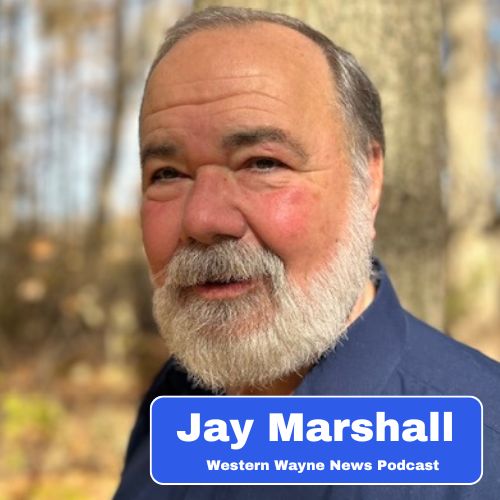


In this episode of the WWN podcast, Jay Marshall discusses his path from a North Carolina dairy farm to a life of ministry, higher education, and financial planning in East Central Indiana. Drawing on his Quaker faith and decades of professional experience, he reflects with Kate on leadership, the challenges facing colleges today, and the importance of helping people build financial plans around what matters most to them. Enjoy!
Transcript
Jay Marshall: I’m Jay Marshall, a financial advisor and lifelong Friend.
Kate Jetmore: From Civic Spark Media and the Western Wayne News in Wayne County, Indiana, I’m Kate Jetmore. As a native of Richmond, Indiana, I’m excited to be sitting down with some of our neighbors and listening to the stories that define our community.
My guest today is Jay Marshall. A graduate of Guilford College, Duke Divinity School, and Duke University, Jay has served as a pastoral minister, administrator, and educator. In recent years he has devoted significant time to understanding leadership among Friends, particularly as a response to God’s call. Since retirement from those roles, Jay offers financial advice and retirement planning to persons seeking assistance in those areas.
Jay now resides in Greens Fork, Indiana with his wife Judi, who is an ordained elder in the United Methodist Church. They view their marriage as a living example of ecumenicity.
Welcome, Jay. I’m so happy you could join me on the show today.
Jay Marshall: Thank you. Happy to be here.
Kate Jetmore: Jay, what can you share about your roots in the area? Are you from Wayne County originally?
Jay Marshall: Actually, I’m originally from North Carolina. I grew up in Chatham County, in a rural part of the state. And though I’ve been here for 30 years, I’ve been told frequently that my accent still lingers. So if you’re wondering, where’s this guy from? That’s it.
Though my story began in North Carolina, I was transplanted to Indiana in 1990. And since arriving, I’ve been rooted here in East Central Indiana.
My wife and I, we lived in Richmond, then Newcastle, then Cambridge City, then Richmond again, and now Greens Fork.
Kate Jetmore: So you’ve really been around. And what was it that originally brought you in the 90s, as you said?
Jay Marshall: It was my wife.
Kate Jetmore: Okay, okay. That sounds about right.
Jay Marshall: We met at Duke Divinity School. And when she graduated, one of the things she wanted to do was to come back to this area because she wanted to serve what was then the South Indiana Conference of the United Methodist Church. They had supported her education. She felt it was only proper that she serve in their areas.
And so that brought us here originally.
Kate Jetmore: Okay. And actually, I know I asked you to focus specifically on what brought you to the area, but would you mind if we go back a few steps and look at your roots in North Carolina? Would you share a little bit about your childhood and growing up there?
Jay Marshall: Sure. As I said, I grew up in a rural part of North Carolina, Chatham County, which was about… the area where I grew up was about nine miles outside a little town called Siler City.
If anyone outside of the area knows of Siler City, it’s usually because it was mentioned on Andy Griffith, in some of his episodes. So it has some fame from that I suppose.
I grew up on a dairy farm. I was the oldest child. I was the only son. And I grew up with lots of fresh air and a good bit of work and a curiosity and freedom just to explore the outdoors. And so that has shaped a lot of who I am and what I like to do now.
I thought when I graduated high school that I would stay on the farm. And that was my plan. So for five years, that’s what I did. And surprising things happen as life unfolds.
And I found myself wrestling with what I determined was a call to ministry. And it was that experience and all the reflection and discernment that follows something like that, that led me to leave those roots behind and go to college and start a path that took me nowhere near what I had imagined I would wind up doing with my life, but frankly, it’s been better than I could have predicted or hoped for.
Kate Jetmore: And Jay, are you from a family of Quakers, or was that a faith that you discovered on your path?
Jay Marshall: My father’s side of the family have deep roots in the Quaker faith. They’ve been in that area… Well, I’ll tell you, I learned that two of my ancestors migrated down from Pennsylvania through Virginia, came into what was then Orange County, North Carolina.
One of them donated the land that Cane Creek Meeting was founded on, which became sort of the mothership, you know, the meeting that helped set off several others.
And that was just a few miles from my house. And so that line has been affiliated with Quakers. What that means and what that looks like, changes over the generations.
But one day in my early adult period, I started visiting cemeteries in the area. There are little Quaker meetings all around Chatham County, and there were Marshalls in all those cemeteries, which I’d never known.
Kate Jetmore: How interesting.
Jay Marshall: Right. So, yeah, there is a deep Quaker connection on that side of the family. And so when I became an adolescent, I looked around, you know, I thought I needed to make the choice for myself.
But at the end of the day, this felt like home.
Kate Jetmore: Interesting. Well, I’d really love to hear more about your unique story and the path you followed from ministry and kind of through ministry to financial planning.
So how has that story unfolded?
Jay Marshall: I think of that path as sort of moving, if I were going to try and section it off into parts, it would be from pastor to dean and then to CFP, or certified financial planner.
And the thing that I would say at the outset is I consider all of them as being a form of ministry, and part of that is that Quaker influence, because Friends like to think that ministry can be anything that God has called you and equipped you for, so it’s not just a clerical or clergy sort of position.
And so, I say that because someone once asked me how I decided it was okay to leave the ministry when I left the pastorate to become dean, and it surprised me, because I had never considered that I’d left, it was just the location changed, the context changed.
Kate Jetmore: Right, that was news to you, right?
Jay Marshall: Right. I didn’t get the notice, sorry. So I never felt like I left it. But it is an unusual path, I realize.
And I guess that’s in part because money and religion are often seen as being at odds with one another.
You can’t love one and still love the other. So maybe that’s part of what complicates that. But if I think about that move and sort of the influential moments, I remember the first meeting or church, if you aren’t familiar with Quaker language, the first meeting that I served was a part time opportunity while I was still in college.
And I would go down, I’d be in college during the week and on weekends, I’d go spend at this little place called Edward Hill Friends Meeting down in Bonlee, North Carolina.
And I would go down there and spend my weekends among those people, and I received a handwritten letter one day from a person I did not know, and that person was writing to ask if I, I mean, he didn’t know me either, I don’t think, but he wanted to know if I could possibly raise any financial support for him, that he had been a minister all his life. He had devoted himself to that work. He assumed that when he reached retirement that the church would take care of him. He’d reached that point, but he did not have what he needed.
Being a student, I was not someone who had a whole lot I could help with, but I just remember that letter registering with me and thinking, well, I’m along a similar path. I’m going to make sure this doesn’t become my future.
Kate Jetmore: Uh huh.
Jay Marshall: And so that planted that seed early. I don’t know what your experience has been, Kate, but I found that in managing my own finances, which I was pretty much left to do, that there weren’t a lot of people who were ready and willing to help me figure that out unless I had a certain level of assets already that would assure them they would make whatever they thought they needed to provide that support. I’m a self-learner in many ways. I love to figure things out.
And so I just began to read and to study and to experiment. I didn’t have a lot, so I couldn’t lose a lot, but at the same time, I remember after… I made my first investment in the stock market, in mutual funds, 1987, Judy and I had just married.
We were in school at Duke. We still didn’t have much, but being married, we wanted to start to work on that and change that.
And I made my first investment in September of 1987. And October of 1987 was the stock market crash. I think I had put maybe $1,500 in, you know, so it wasn’t a lot of money, but it felt like somebody’d taken half my world.
Kate Jetmore: Right, right. Absolutely.
Jay Marshall: So I learned over the years that way. And I just think I had some dissatisfaction with the options that were available, particularly to people who were trying to climb that ladder and weren’t already there and didn’t have hundreds of thousands or millions of dollars that someone was eager to get their hands on.
And if you found a person who would help you, probably what you got were… not necessarily bad recommendations, but it was very generic.
There was no real sense of getting to know personally what a person needed or what their hopes were. And then at Earlham, while I was dean, again, here’s Quaker influence affecting my life’s direction.
Students who enrolled at the School of Religion where I was dean came from all over the place, not just Friends.
Many of them did not have a desire to go into pastoral work or even chaplaincy work. They just felt like something was up in their life and they were looking for help in figuring that out.
And ESR was a great place for doing that kind of discernment with students. And so many of them wound up wanting to… If their vision was to come into being, they really were going to have to probably start their own business, for lack of a better word.
Because what they felt called to do and drawn to do, didn’t have a ready-made organization willing to hire them, pay them a salary, provide them with benefits.
So either you get another job that pays your living needs or you don’t do it because you can’t afford it.
And so one sabbatical, I developed a program which I called Entrepreneurial Ministry, which itself was kind of controversial because entrepreneur sounds business-ish and ministry sounds like something else.
And that was part of the reason for coining that. There is a contradiction there, it seems. And as part of preparing that program, I realized that students really needed to develop an understanding of their own personal finances. And if they were going to be funding and growing their own ministry, they needed to think about some of those details that just aren’t part of a basic seminary education.
Kate Jetmore: Right, right.
Jay Marshall: So, in trying to have some credibility for that, I’d learned a lot by that point, but I enrolled in a financial planning program during that sabbatical.
I think I had to take seven courses, and at the end of it all, I earned a certificate in financial planning from North Carolina State University.
I joke, you could do that anywhere, and there were lots of places in Indiana that would have been closest.
But growing up, I tell people this was part of my own spiritual discipline. Growing up in North Carolina, for whatever reason, my allegiance as a sports fan was to the University of North Carolina Tar Heels.
Which then transferred to Duke when I went there. But I always, for reasons I cannot tell you why. I just despised North Carolina State.
Kate Jetmore: Sounds visceral.
Jay Marshall: Yes. So I thought it would just be good for me to enroll in their program and study at that school.
Kate Jetmore: Yes, yes. To dispel the demons.
Jay Marshall: So that’s what I did. That’s right.
Kate Jetmore: Well, I’d love to turn now to your time as dean, as you mentioned.
I’d love to know what observations you have about the state of higher ed now and what we’re currently watching in our schools and colleges.
Jay Marshall: Well, it’s a tough and complicated question, or maybe the question is not complicated, but the answer is.
Kate Jetmore: Right.
Jay Marshall: I, you know, I lived in that for a while, and I still watch it and care about it.
And I think there are a few factors that come to mind immediately as being part of that conundrum. One is, it’s simple demographics.
As the number of students decrease in our country, then there’s a decreasing pool of college bound students. And so just simple numbers is part of it where the schools that remain, they’re all fishing in what is now a smaller pool.
Kate Jetmore: Yeah.
Jay Marshall: And that makes the competition even more fierce. Secondly, I think there’s the matter of cost. I think the cost of a college education these days, especially if you own a smaller private or liberal arts college, it’s just ridiculous.
I think when I went to Guilford, I think my tuition for the year was $7,400. I lived off campus, and I’m not sure what that would buy me today, but it wouldn’t be a year’s education.
Kate Jetmore: Right.
Jay Marshall: So I think cost is the other thing, and on the one hand, it would seem that schools will price themselves out of business, but to account for that, then they discount the actual cost they charge.
They offset it with financial aid, and so it doesn’t generate the revenue you might expect. So demographics is one, cost is another.
Consumer expectations, I think, is one that often doesn’t get a lot of attention, but when I see and listen to conversations of what people are looking for when they go to the school, in terms of amenities, especially.
Kate Jetmore: Yeah.
Jay Marshall: It’s a much different world. When I started college, and that was not at Guilford, it was at another college where I originally started, my dorm room was in a building that had at one time been their little hospital infirmary.
My room had been a closet at one time. It was a cinder block building, or cinder block room. It had no window in my room.
And I didn’t care. It never occurred to me that I should be outraged about that, because they had cut a hole in the wall to put what would be a window unit in a normal room.
So I had an air conditioner, and I had a really dark place to sleep. I was good to go.
You’d be hard pressed to find an eager bunch of people to take a room like that today.
Kate Jetmore: Right, right, right.
Jay Marshall: So we have suites, etc. And then there’s the part where it starts to get even stickier, I think, are competing ideologies. And people may not always refer to that, but, you know, depending on where your school comes from, what traditions founded it, or if it’s a public school, you just find that there’s a different ethos, depending on where that school is coming from, and that shapes who we become, I think.
Kate Jetmore: Yeah.
Jay Marshall: I remember a classmate of mine at Duke in the seminary program, and as we graduated, I asked her, I said, so, now that we’ve finished these three years, was this worth it? Did it make a difference?
And she said, oh, heavens, yes. And I said, how? And she said, it has shaped the way I see and think about the world, you know, the way I problem solve and the way I treat other people.
And that’s exactly right.
Kate Jetmore: Yeah. Right.
Jay Marshall: And so those ideologies do that differently, and they draw boundaries differently, which creates different types of communities and loyalties, etc. And, you know, we’re just, our country is in a place that we just have lots of differences, and some of them get a little volatile at times, and I don’t know how, I don’t know what the resolution is to that, but I think that also makes a difference. And… because right after the ideology comes politics trying to have its own shape on it, and, we all have our own points of view on that, so I won’t defend one or the other or stake mine out other than to say, you know, you get your institution aligned the way you think it needs to be for the environment that we have, and then the next thing you know, a new administration comes and puts a whole different set of priorities up or minimizes some of the others, and you either are out of somebody’s good graces, or you scramble to sort of redefine yourself in ways that allow you to fit.
Kate Jetmore: Yeah.
Jay Marshall: And all that just means you don’t have time to do the main thing you’re there for, which is to provide a good education.
Kate Jetmore: Right. Exactly. Exactly. Well, I really appreciate your thoughts on that, Jay. And there’s no denying that it’s a dicey time. A lot of things are in flux, and I think we’re just going to have to keep the faith and wait and see sort of where the cards are going to fall.
Let’s talk a little bit about what you do as a financial planner, which I’m very interested in. Financial planning and thinking about the future of one’s finances can feel overwhelming.
It can even feel inaccessible to many people, whether due to the uncertainty of the world around them, as you’ve said, or just feeling like maybe it doesn’t even apply to them at a certain level, given their income or lack of wealth.
So how do you approach these challenges with your clients?
Jay Marshall: Well, with my clients, I think I like to start just by sitting down with an opening conversation and asking questions that will draw them into thinking about their own future, and what it is they want to see. And it’s really interesting how many people don’t stop to think about that question.
I guess they’re so busy keeping up with the next day’s schedule that thinking and reflecting about those sorts of questions never makes its way to the front burner.
So I like to help them begin to talk about the life and the retirement they desire.
I had a client recently. We were working through those things and part of the reason for that is I want to get a sense of what their values are and what matters, because I think those are important in helping them figure out where to spend their time or how to allocate their money or what they’re going to need to fund that lifestyle, whatever it is.
And in asking that question, the person said, Well, I know I don’t have a lot, but I don’t need a lot. I don’t want a fancy life. I just want to be able to take a little trip once in a while, and I want to go see my grandson play Little League. And if that means driving to Michigan, I want to go to Michigan.
And it was just delightful for her to finally name it, say this is it, and these other things aren’t it.
We can look at her assets. And it was easy to say, well, based on what you’ve said about what you currently need, what you think you need, we can work out a plan. This is very doable. As long as you live within your means.
Kate Jetmore: Yeah. Yeah. That’s really beautiful.
Jay, what do you wish more people knew about the work of planning for your financial future? Or would you even call it work?
Jay Marshall: You know, I don’t call it work. I like to do it. I tell people one of the perks, I guess, of working with me is I’m not doing this to make a living. I will make a little money along the way.
But if you don’t want to work with me, that’s OK, it doesn’t hurt my feelings. And I’m not out to gouge you for every last penny, because I don’t need it.
So, but what I think is important for them to know wherever they go to get help: One, I think… I like for them to begin to understand the power of time because if you’re 40, if you’re 30 and starting out, you probably still have a lot of time for this to work in your favor.
And the way money compounds over time, if you invest it well, it’s phenomenal. But if you’ve started late, then that timeframe is shorter.
And so starting where you are and sticking with it matters. So to understand that you can put it off, but it’s not in your best interest. That’s one important lesson.
The other thing I like to show people is the destructive effect of consumer debt because it’s so easy to buy on credit.
And I’m not against buying on credit. I’m against paying on credit. I like to, you know, if, if it’s not a, if it’s not a debt that’s building for you, like in a home perhaps, then it’s probably a depreciating investment you’ve made and just the effect of trying to get out from under that debt and how much more that $1,000 TV costs when it takes you five or six years to pay it off… it’s crippling.
And so if you can learn those two things, it might help you think differently about how you spend your money.
And along with that, I think helping people understand that some of the various options out there that seem appealing, they come with their own different price tags.
So if you’re going to pay for advice, make sure it’s worth what you pay. And I tell people if you can earn X amount in an index fund that charges you nothing except a .02% fee or what have you, don’t pay someone a percent and a half of your assets annually for that same rate or less. So make sure if you’re going to pay for it, they’re earning their income.
Because otherwise, over time, they’re going to take about 20% of your wealth, just a little bit each year.
Kate Jetmore: Wow.
Jay Marshall: So little things like that.
Kate Jetmore: Well, Jay, this has been a great conversation. I want to thank you so much for taking the time to sit down with me today.
I loved learning more about you. And I want to wish you and your family all the best.
Jay Marshall: Well, thank you, Kate.