

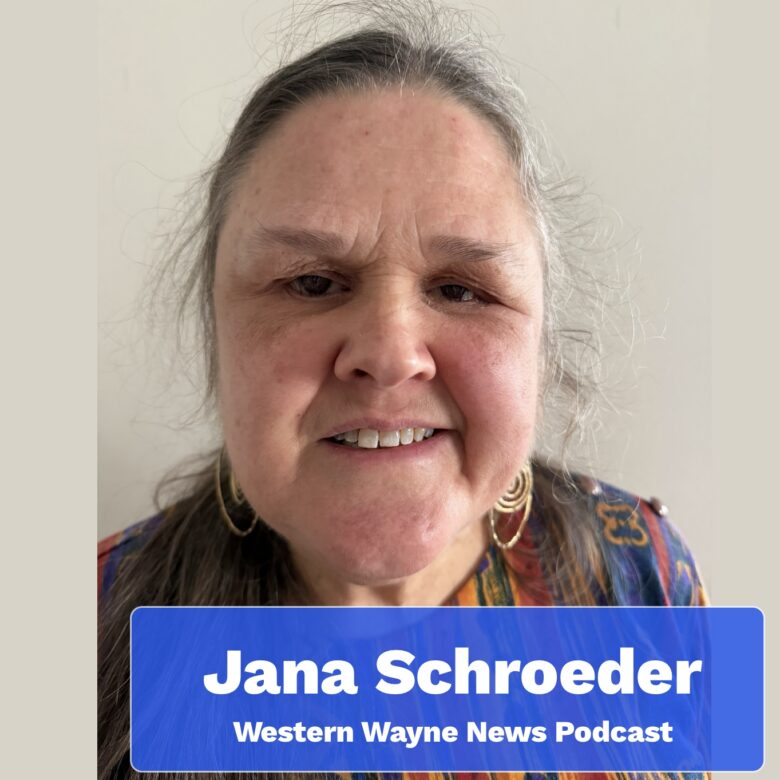

In this episode of the Western Wayne News podcast, Jana Schroeder reflects on a life shaped by curiosity about people, community, and change, and the barriers that still shape who gets to fully participate in community life. From navigating Richmond as a blind resident to building meaningful connections through her work, Jana offers a candid perspective on independence, access, and belonging. Enjoy!
Transcript
Jana Schroeder: I’m Jana Schroeder, an Earlham alum working for GivePulse.
Kate Jetmore: From Civic Spark Media and the Western Wayne News in Wayne County, Indiana, I’m Kate Jetmore. As a native of Richmond, Indiana, I’m excited to be sitting down with some of our neighbors and listening to the stories that define our community.
My guest today is Jana Schroeder. An Ohio native, Jana attended Earlham College before moving back to Dayton. Her primary employment there was with the American Friends Service Committee, a Quaker organization, where she staffed a program that advocated for a more humane and effective criminal justice system in Ohio. She then returned to Earlham where she headed up community engagement programs for 16 years. Currently, Jana works remotely for GivePulse, a tech platform that connects people with opportunities to engage with their communities. She and her wife have lived in Richmond for over 20 years.
Welcome, Jana. Thanks so much for joining me today.
Jana Schroeder: Yes, it’s great to be here.
Kate Jetmore: From what I understand, you studied sociology, anthropology, and history, and you have a Master’s in Education.
So tell us a little bit about how you decided on your field of study and what role those subjects currently play in your life.
Jana Schroeder: Yeah, well, it’s been a while since I was doing that education piece. So it’s interesting to look back on that and think about how has it influenced me.
You know, I was a student at Earlham, which is a liberal arts school. And I think I really absorbed the idea that part of a liberal arts education is that you are learning how to learn. You’re learning how to think critically.
And so it’s not maybe as important what particular major you have that you could, you know, change gears down the road and do something completely different.
So when I was picking a major, I think I was… More picking it based on what I was interested in than any idea of what I might actually work, you know, do with that.
So history, I think, was the first thing that I came to. And that was something that when I went to Earlham and started taking some history courses, I realized I loved it.
You know, high school history is more about, like, dates and wars and presidents and things like that. And what I discovered that I loved about history was the type of history that looked at people and, you know, what they were doing, sort of ordinary people or people who were doing courageous things in their time or helping to make change in their time.
And then communities of people and how communities live together and how that changed over time. And so that kind of then led me to the sociology/anthropology, which at Earlham is one department. So it makes it sound like I had all these majors.
Kate Jetmore: Okay.
Jana Schroeder: But it was one thing, and I think of those two, I was more interested in sociology, which is really looking at the cultures and subcultures within one, say, you know, your own country, whereas anthropology tends to look afield, at how people are interacting in different cultures, how cultures differ from one another and things like that.
But I was interested in, it felt to me like a continuation of the history, because it’s like, okay, now in the present, I’m looking at the same kinds of things.
Who are the communities? How are they interacting with each other? How are people trying to make change and a positive difference in their world?
So that was really why I was interested in it. Like I said, I didn’t really know what I was going to do with it. And I ended up doing a lot of different kind of nonprofit work, which is kind of the direction that I thought I was gonna go in.
And then, when I came back to work at Earlham, what I discovered there was that when you’re working in higher ed, of course, people value higher ed, and so if you want to do, kind of advance your career in that sphere, having something beyond a bachelor’s degree is helpful.
And to be honest, kind of like looking at what is feasible and what is possible for me, and Earlham offered this M.Ed. program, I could do it right there, evenings and weekends.
That was very convenient, and so that was what I decided to do, but it also did obviously tie in with what I was doing, because even though I wasn’t a teaching faculty member, I was helping students to learn about about, you know, learn through going out into the local community, serving or doing different kinds of experiences there. And reflecting on that, and thinking about how that contributed to what they were learning.
And maybe helped them think about what they wanted to do as a career, I didn’t really do that so much when I was an Earlham student and so that’s why I left, not knowing maybe what I was going to do, whereas I felt like a lot of the students I worked with were able to come to a better grip on what they might want to do as a result of the things they were able to do out in the community, experientially.
Kate Jetmore: Right, right. Well, I’m interested in your use of the word culture because, of course, we all grow up in our own family culture, right?
You know, we think of the cultures of the world, but then, of course, we can bring it in and we can look at the county we grew up in, the city we grew up in, maybe the parish we grew up in, or the meeting in your case.
But what about, what about the culture of, you know, your family and your community? Did they influence those decisions of what you would study and kind of what path you would take?
Jana Schroeder: Well, interestingly, I, so I didn’t grow up a Quaker. That was something that I learned about as a result of coming to Earlham.
I read about Quakers when I was a kid and how they, you know, like were, some of them were involved with the abolition movement and, you know, they were involved in colonial times.
And I kind of thought they’re all dead and gone, there are no Quakers. But then I found out there were Quakers in Richmond, Indiana, and some in Dayton as well.
But, you know, Richmond is kind of a center for Quakerism, but that was what I discovered when I went to Earlham.
But the other funny connection through my family to Richmond is that when I was a kid, and I don’t really know why this is, but my grandpa liked to come over to Richmond.
And so once… Maybe once a summer, we would have like a picnic and like my family and my, you know, cousins or whatever, we would all come over to Richmond to Glen Miller Park and the zoo that was there, and have a picnic.
Kate Jetmore: Oh, yes, the zoo.
Jana Schroeder: Yes. And the funny thing is that I much later when I was living here and working at Earlham, I had a chance to do some oral histories with local people and people who were, you know, around my age, all remembered that zoo.
That was like a memory that spontaneously came up for several people that I didn’t elicit in any way.
So I had kind of a little bit of a connection with Richmond even though… and so when my, it was actually my high school guidance counselor who said that she thought that I might like Earlham because I was looking for a place that was maybe a little more, a smaller school.
And so, you know, she mentioned Richmond, and I already knew Richmond from having come over here. Whereas, if I hadn’t had that experience as a kid, I might’ve been like what’s Richmond, Indiana? So that was something.
But I would say that, as far as my family, I was actually pretty different than most of my family, in terms of being interested in looking at change, social change. Looking at groups of people, people who had been maybe marginalized. That was not something that my family really looked at too much. And I was actually the first person in my immediate family to go to college.
I did have some… On both of my parents’ sides, I had an aunt and an uncle who had become teachers, so that was kind of my frame of reference, and I think a lot of people were just like, oh, she’s going to be a teacher because they didn’t really know what else people who went to college would do with that.
Kate Jetmore: Oh, interesting. Interesting.
Well, for our listeners who don’t know you, it feels important to share that you are blind.
If you are comfortable sharing with our listeners, what is it like to be a blind person living in Wayne County?
Jana Schroeder: Yeah, I mean, I think that it’s not much different than being a blind person in a lot of places.
I think that the big thing is that the size of the communities is smaller. And so even in a place like Richmond, we don’t have great public transportation.
I mean, we do have a bus system, but it stops running very early. It doesn’t go every place. Things like that. And I think those are some of the biggest barriers that people who are blind continue to face is the whole, you know, how do you get to places that you need to go? Of course, now with Uber, I guess a lot of people are doing things like that, but then that can become a more costly option for people.
So, so I think that’s kind of, to me, one of the big challenges of living in this community. And, you know, just navigating that.
As far as people, I feel like people I encounter everywhere are kind of the same. Either they kind of are super uncomfortable, and maybe they get over that and maybe they don’t. Or they are pretty comfortable from the beginning because of something, some experience, maybe not even with a blind person, but just something makes them feel like, okay, this is another person and I can relate to you. So I think that that is no different here than anywhere else that I have ever been.
Kate Jetmore: Mm hm. And it sounds like, certainly with the example that you gave of transportation, that it’s an issue of independence and autonomy.
Because, you know, I’m wondering if there are, I’m guessing that there are people in your life who are able to support you and, you know, provide transportation if you need transportation.
But maybe even when you have that kind of support, you would prefer to be able to figure it out on your own. Is that what you’re saying?
Jana Schroeder: Well, not necessarily figure it out on my own, but just to be able to go where I want when I want.
Kate Jetmore: Yeah.
Jana Schroeder: I mean, how many people, I don’t think many people who can get where they… You know, who can see and can, you know, whether it’s walking, driving, riding a bike can just go whenever they want. Maybe they don’t think about that, but that’s a pretty big difference.
If you had to arrange your life so that you were always asking somebody whenever you needed to go anywhere, that would be a big difference.
Now, when I moved here, I guess one of the things I should say is when I moved back to Richmond to take a job at Earlham, we very deliberately looked for a place to live that was within walking distance of the campus because I didn’t wanna have to, you know, worry about getting a ride.
And by walking distance to campus, that also included things like not being across National Road because even though… there wasn’t a traffic light there, even when I moved over at the entrance to the campus. Now there’s a traffic light, but it’s still not something I’d want to do multiple times a day, going back and forth across that road, where people are not used to seeing pedestrians.
Kate Jetmore: Right. Exactly.
Jana Schroeder: I think that’s another big thing that a lot of people don’t realize. Unless you’re in a larger city where there are lots of people who are walking places, there are very few people in this town who are, you know, like walking.
And most people in cars are not clued into that at all. So I don’t necessarily feel that safe. And it’s not because… like, I have skills to navigate, but I don’t trust people to, you know, obey what they should be obeying and paying attention to the fact that there might be somebody crossing the street, even if I’m doing it when I should be doing it.
Kate Jetmore: Yeah. Yeah. Well, I appreciate you sharing that. I think this is a really important part of the process to share that, you know, everyone’s safety is important. And when there’s a member of our community who doesn’t feel safe, how can we change that? What can we do to help?
Jana, let’s talk a little bit about your work, which I believe is now remote. I’d love to hear what kind of work you’re doing and how it’s changed since shifting to a remote model.
Jana Schroeder: Yeah, well, I wanted to say just briefly too about, and this relates to being blind, one of the, I’d say besides transportation or maybe even topping transportation, the biggest barrier for blind people is employment.
Kate Jetmore: Okay.
Jana Schroeder: All of my adult life, we have not moved the needle on this. About 70% of adult working age blind people are unemployed. So that’s a pretty bad record.
And my experience has been that it’s been hard to get employment. You know, even if I’m qualified, it’s really hard sometimes to break that barrier in a quick interview for people to really believe that I could do the job, and really get over… Like I said, some people come to know that, but it can take a lot of time.
And so my experience after, my experience has been that a lot of the jobs, and I won’t go into detail, but a lot of the jobs that I’ve gotten have been because of connections, or a way that people, even if they didn’t know me personally, had a reason to give me a chance or to, you know, pay attention.
And that happened with my last job when the pandemic hit, and Earlham eliminated a bunch of positions at that point.
I was one of those people. And the fortunate thing was that I had been using in my work, a platform, a digital platform called GivePulse to help the students connect with opportunities in the community and to track that work both by logging hours and writing reflections of what they were doing and learning. And I happened to have gotten to know a little bit at conferences and things, the CEO and co-founder of that company.
And he heard that I was laid off and I was applying for all these jobs and getting nowhere because people didn’t know me.
And he actually reached out to me and said, Hey, let’s talk. And we had the opportunity. And at that time, I was actually when I got laid off, the other idea I had was maybe I could totally switch gears and become a computer coder because that was something that I had always kind of thought, oh, that might be interesting.
I love computers. And would I be good at that? And when I found out there was some funding to do that at the time of the pandemic through, you know, like retraining people who’d been laid off and things like that.
And so I went through this online boot camp for coding, and I ended up flunking out of it, and I don’t think it was necessarily that I couldn’t have caught on to it, but when you are coding, you have to use a lot of different techniques and different platforms to make sure that things are accessible, you know, and that your screen is being read and things like that.
And there were lots of those adaptations and trying to learn all those adaptations on top of learning to code and in a very short amount of time, which is what the boot camp is, very intensive, it just didn’t work out.
And then when I talked with, you know, George at GivePulse, he was interested in the fact that I was wanting to learn to code and would have supported that, but I ended up going in a different direction.
And so what I do there remotely, you know, is I, the piece that’s connected to the tech is that I provide accessibility feedback to the company on the platform. So you know, testing it with the screen reader that I use to get feedback on what’s going on on the screen.
And sometimes the way people code it, it doesn’t read correctly. It might just say button instead of saying like what the button does.
Kate Jetmore: Oh, okay.
Jana Schroeder: And so I can give them feedback if there’s something that gets introduced into our platform that’s not accessible. So I do that kind of testing.
But the main thing I do is I am the success manager working with a bunch of different schools that use our platform.
So other higher ed institutions, similar to what I was doing when I was using it. So I understand what they are going through as, you know, end users.
I do a lot of kind of consulting with them, talking with them about their workflows, training them. And one of the things that I would say that’s different about working remotely, for me as a blind person, is that if you’re on a zoom call, people don’t necessarily know that you’re blind. And so I have to kind of like tell them, I’m blind.
And I think sometimes people don’t even like, it kind of like goes like, what did she say?
Kate Jetmore: Yeah. It doesn’t register.
Jana Schroeder: So they’ll be like oh, can I share my screen? And I’m like, well, I can’t see, and it’s not accessible to me, the screen sharing. So you’ll just have to tell me what you’re seeing at your end. And you know, most people are okay and make that work.
Some people get a little flustered, because it’s like, I’m used to just sharing my screen. So how are we gonna do this?
But most of the time that works out fine and feels very level. And the other thing that I wanted to say that’s been really interesting about working remotely is finding those connections.
And one that’s especially interesting, given this podcast is that, so I just because of like, what was needed at the time I came on board, we’re kind of assigned by states, but I have all of the western states. I don’t have anything around here. And so I work with people in California, and the state of Washington and Oregon.
So I was talking to this guy in the state of Washington, and we were just kind of chit-chatting before we got started, and people are always surprised, like, oh, where are you at? I thought you guys were all in Austin, Texas, which is where the company is based, and I’m like no, I’m in Richmond, Indiana.
And he’s like, Richmond, Indiana?? That’s where my grandparents lived. I used to come there all the time when I was growing up.
Kate Jetmore: What? That is so fun. Oh my gosh, it’s such a small world.
Jana Schroeder: Yeah. So like, you never know. I feel like I do that a lot in my life. I run into people and we make these connections like that, and I just love that. That’s one of the things I love about my work, is like getting to know these people all over the country.
Kate Jetmore: Yes.
Jana Schroeder: You know, just helping them however I can, but that was a special one that I was like oh, we have a Richmond connection! So now, every time I talk to him, you know, it’s like we have that connection.
Kate Jetmore: Exactly. Oh, I love it. I love those moments of serendipity and “coincidence”.
Well, Jana, as I shared in the introduction, you and your wife have lived in Richmond for 20 years now.
So what is this community like for same-couples in your first-hand experience?
Jana Schroeder: Yeah, well, I would say that, you know, it’s a mixed bag, and that’s kind of the way it is everywhere, I think.
And I think that the whole country has changed a lot since, you know, so comparing my experience, like when I was a student at Earlham, I felt like there was not so much acceptance outside of maybe the Earlham community, but in the town, you know, the town surrounding.
But I would say that was probably true in most communities, at least you know, smaller communities or communities in the Midwest as opposed to the coasts, that kind of thing.
And I’ve seen a huge amount of change over time. So, you know, I feel like, and we are, I don’t know how to say this kind of, it’s because we’re very out, you know, like we don’t hide the fact that we’re married, but we also are not like all over town.
Like, you know, I mean, we’re not sort of like, oh, there’s that lesbian couple. So I don’t mean that, but I also mean that like when we go somewhere or when we meet people, you know, it’s like if they’re going to say, because people always are like, oh, are you sisters?
Are you, you know, related in some way or whatever? And it’s like, no, you know, this is my spouse.
And sometimes people are taken aback by that, but I find more and more that people are not taken aback by that.
And I feel like it’s like one of those things. Not that I’m not worried about some of the changes that are happening right now and some of the wanting to push things back.
I think that that has implications for a lot of people and, you know, for sure. But I also feel like at least for lesbian, gay, bisexual people that I told somebody, the cat’s out of the bag.
You know, it’s like people now know people. They know friends, coworkers, family members.
Kate Jetmore: Right.
Jana Schroeder: People are not closeted like they were in the past. And so people know that they know gay people or lesbian people.
And so they can’t really pretend that, you know, they don’t know anybody anymore, which I think was… When I went to college, a lot of people were like, I don’t know anybody.
In fact, before I came out to myself, I thought that. I was like, oh, I don’t know any gay people.
But I would say, the other thing just about Richmond that’s been a little hard for us is we have not, and this is on us as well, like just like how much time we’ve had to devote and being able to figure it out.
But, you know, we don’t really have close friends who are lesbians and, you know, that’s been, I think, a little bit of a sadness for us. And that’s not to say there aren’t people who have connections like that in town, but that has been something that we have not really had.
Kate Jetmore: Yeah, yeah. It’s interesting to explore this with you and I feel really grateful to you for sharing. I mean, these are, I just think it’s so important for people and people in a community to open up to each other in this way.
And it’s, you know, it can be really rare. So I just want to thank you for your generosity today, Jana. I really appreciate it.
I loved learning more about you, and I want to wish you and your family all the best.
Jana Schroeder: It’s been great to talk with you.