

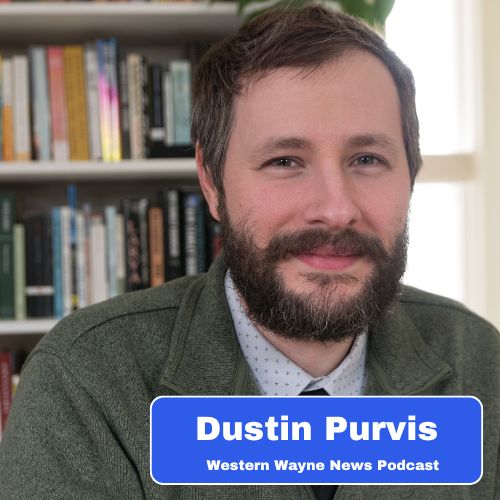

Dustin Purvis left Richmond to pursue graduate studies and an academic career, only to discover that the path home offered unexpected opportunities. In this episode, he shares how a Ph.D. in English Literature led to city planning, why he chose to build a life in Wayne County, and what convinced him that small communities can have an outsized impact on the people who call them home.
Transcript
Dustin Purvis: I’m Dustin Purvis, Editor and Production Coordinator at HWC Engineering.
Kate Jetmore: From Civic Spark Media and the Western Wayne News in Wayne County, Indiana, I’m Kate Jetmore. As a native of Richmond, Indiana, I’m excited to be sitting down with some of our neighbors and listening to the stories that define our community.
My guest today is Dustin Purvis, who grew up in Richmond. After living in several places over the course of 12 years and earning a PhD in English Literature, he returned to his hometown with his wife and two sons. He served as Richmond’s City Planner for three years before joining HWC Engineering as the Editor and Production Coordinator for its writing studio. Outside of work, Dustin enjoys reading, following Arsenal FC and the Indiana Pacers, and taking walks with his family.
Welcome, Dustin. Thanks so much for joining me today.
Dustin Purvis: Thank you, Kate. It’s great to be here.
Kate Jetmore: Give us, if you would, an overview of your story. Tell us about your early years in the area, the time you spent in other places, and then how you ended up back in Richmond.
Dustin Purvis: Yeah, so I grew up in Richmond. Both of my parents are from nearby, Dayton, and we moved here when I was young.
We lived on the east side, just about a block away from the entrance to the Hayes Arboretum, which was, you know, a lot of fun growing up.
I went to RCS. I graduated from Richmond High School, and then, like many of the people that I grew up with, I moved away shortly after graduation.
So my now wife and I moved to Indianapolis and lived there for several years. And while we were there, I got my Bachelor’s in Philosophy from what was IUPUI.
I worked at the downtown central library while we were in Indianapolis, worked at a restaurant on Mass Ave. And then after a few years, we decided somewhat haphazardly to move west.
I think we were initially thinking Pacific Northwest, and we landed kind of right on the border of Washington and Idaho, and we lived in this just really beautiful, quaint little town called Moscow, Idaho.
It’s the home of the University of Idaho, and we lived there for several years. And while we were there, I ended up getting my Master’s in English Literature and began teaching at the University of Idaho, and then we, at that point, decided to move to the other side of the country, to West Virginia, and we lived in Morgantown, West Virginia, where I got my PhD in English Literature, and I was teaching there.
And then, you know, we had our first son, and we lived in West Virginia, and we decided to move back to Richmond for what I think at the time we assumed would be a temporary move home. We had a young baby, we still had family here in the area around Richmond, and then it was also very early in COVID, and so West Virginia was going to let me teach remotely.
So it seemed like maybe a nice pit stop before we moved on to the next place to teach or whatever we might end up doing.
And we realized once we moved back that we actually quite liked living in Richmond, and we bought a house and put down roots and kind of built our small little community here and decided to stay.
So we’ve been back for about six years now.
Kate Jetmore: Thank you so much for giving us a little context for what’s to come in our conversation. I mean, I’m kind of surprised that the first question that comes to me is, do you miss the mountains?
Because you’ve named a couple of places that are sort of known for mountains, and we’re not known for that here in Indiana.
So what’s your sense there?
Dustin Purvis: Yeah, we do. I think especially where we were living in Idaho. We talk about that quite frequently. Not just the mountains, but the lack of humidity and just, you’re just surrounded by beauty and water and you’re always, you know, it was, we really loved living out there and West Virginia has its own separate type of environment and that is also a very interesting place to live.
We didn’t, I feel like we didn’t end up exploring West Virginia as much as we would have hoped to, but yeah, we do.
I think while we’re not super outdoorsy people, I think that that is a part of just day-to-day life that you kind of take for granted while you’re there, but once you move away, you do kind of just miss having, you know, the beauty of the landscape around you.
Kate Jetmore: Sure. And I think just as humans living in the world, our setting and our environment, whether it’s natural or built, really affects us on a deep, deep level.
How do you scratch that itch here in Richmond? I mean, in the intro, you shared that you like to go for walks with your family.
Do you want to share anything about that or any other kinds of ways that you, you know, satisfy those needs back here in Richmond?
Dustin Purvis: Yeah, I mean, I do think we are fortunate to have, you know, Hayes, the Cope Center. We live on College Avenue. So we’re right across the street from Earlham College. So we can walk out our door and take a walk around the campus, which is also, you know, a very nice place to walk.
And so I think we’re able to still scratch that itch to some extent. And then, you know, we’re within a short drive to, a relatively short drive to Lake Michigan and some, you know, interesting areas.
So we find ways in the area to sort of satisfy that.
Kate Jetmore: Yeah, great. Well, you shared a little bit of your academic story, and I have to know how a person goes from getting a BA in Philosophy and ultimately a PhD in English Literature to being a City Planner.
Dustin Purvis: Yeah, that is a good question. I mean, I guess the more practical answer to that is that the academic job market is such that in a specialized field, there are really only a few good tenure track positions that are going to become available each year, and you kind of need to be prepared to drop everything and move to wherever those positions are located.
So when we decided, as I was finishing up my PhD, that we were going to stay in Richmond, that kind of signaled that it was probably going to be time to reconsider my career trajectory.
So that’s kind of the practical answer, but beyond that, I tend to think of myself as someone who can become interested in a lot of different things, and so my academic work, I think, was interdisciplinary, where, yes, I was getting a degree in English Literature, but I was, you know, really thinking broadly about narratives and the environment and history and art and all of the things that kind of make up the stories that shape our experience.
So for me, when I saw that Richmond was looking to hire a City Planner, I could convince myself pretty easily that that was almost an extension of the academic work that I was already doing, because like you said a minute ago, I mean, the built environment plays such a large role in creating the conditions for people to thrive or to struggle.
So I was kind of just naturally drawn to this. The trick, of course, was convincing people at the city that, you know, my lack of any real relevant previous experience could still translate and that my, you know, enthusiasm and capability could, you know, kind of help me grow into the job.
So when I saw the position was available, I began to send emails back and forth with my predecessor at the city, Ian Vanness, who was the City Planner and the Director of Infrastructure and Development.
And we kind of hit it off and he encouraged me to apply. And fortunately, former Mayor Snow was persuaded that this was something that I could, you know, conceivably do well.
So I was hired on and I eventually became the director of the department. And I spent three years both learning the ins and outs of Richmond city government while also kind of on the side studying and learning just the field of urban planning more broadly and kind of trying to integrate myself into that field.
So, I think there’s a practical answer to that, but then the kind of more idealistic answer that it did feel natural.
Kate Jetmore: Yeah. Well, I mean, what was it like to be in that role and a role that I think is considered critical for the health of any community, the development of any community?
What can you share about some of your biggest successes in that role and some of your most challenging moments?
Dustin Purvis: Yeah. I mean, it’s a fascinating position. On the day-to-day level, it is a public office, so you never know who is going to walk in the door with a request or a problem or a set of plans that you’ve never seen before.
And so there’s a ton of daily, on-the-fly problem-solving amongst our team at the city, and that can be pretty invigorating.
I tend to be a kind of introverted person, but when I was there, there’s just always something going on, there’s always something to talk about, and that was, it makes the job exciting.
And then, you know, beyond that, it’s been, you know, a relatively exciting period for Richmond over the past five plus years, just as far as the state READI grants that are, you know, helping fund some important housing projects, Earlham’s Gift VIII Award that has sparked the Revitalize Richmond projects that, you know, really aim to bring life back to downtown.
And then there’s the important work that the EDC is doing in the Starr neighborhood and the Vaile neighborhood.
So there’s just a lot going on. And while the city planning office isn’t necessarily front and center with a lot of those things, it’s still rewarding to just kind of be in the mix and have some involvement in those projects.
So it felt like you were, you know, in that position that I was involved in some, you know, some positive changes for the city.
As far as challenges go, I think the biggest challenges for doing planning for the City of Richmond is probably similar to just what most people in municipal government are experiencing, which is related to budgets and funding and just the size of the staff that we have could certainly have been larger.
So we were, I think, limited to we really needed to always be addressing the immediate time sensitive concerns. And I think the irony of that was not lost on us that we were a planning department that, you know, it was often hard to look beyond the next week or two, which is, you know, paradoxical for what we were there hoping to do.
So I think that lack of resources and then just like the various downstream effects of that shortage of resources made the position a little bit more challenging.
Kate Jetmore: What about, you know, as we said in your intro, you no longer are the City Planner. You were in that job for three years, and then have transitioned into your new role at HWC Engineering. What’s that transition been like? And what drove that change?
How did you end up where you are now?
Dustin Purvis: Yeah, so HWC is this kind of full-scale firm that does planning, landscape architecture, engineering, and economic development for communities across Indiana.
And so I was fortunate enough to work with them a couple times when I worked with the city. They, just last year, they revised the city’s comprehensive plan, so we got to work together on that.
And they made a good impression, and I heard good things about them being a nice place to work.
But I wasn’t actually looking to leave the city. It just so happened that late last year, they created a brand-new position for their planning studio that was specifically engineered for someone with a writing background and an urban planning background.
Kate Jetmore: Wow.
Dustin Purvis: Yeah, it felt hard to pass that up. So, yeah, you know, I applied.
I had spent the last three years really digging in and trying to learn urban planning. And then, obviously, I had the background teaching English.
I had, you know, done various work with academic journals and some copy editing for literary presses. So it just felt like a perfect synthesis of these two odd interests that I have that don’t usually converge.
And so I applied and I was fortunate enough to get the position. And it’s been a really smooth transition.
I mean, I do at times miss the city. I miss the people in my office and some of the good work that we were doing.
But HWC does allow me to do more of that kind of medium- and long-term planning that I said, you know, we didn’t always necessarily get to experience with the city.
And I just feel like I’m learning so much and I’m getting to kind of flex my sort of writing and research and critical thinking muscles in a way that I didn’t necessarily always have a chance to at the city.
So it’s been a really nice transition and I’ve been happy.
Kate Jetmore: Yeah, I find it so exciting to hear about not only your appreciation for kind of the full experience and that, you know, seeing things within context and this is interrelated with that and you can’t take any one element out and just sort of look at that one element under the microscope, you have to consider it in the greater scheme of things.
But then to know that you’ve found a place where those skills and that perspective is appreciated, I also find so exciting.
Now, from what I understand, Dustin, you work remotely from Richmond on a hybrid schedule. Is that right?
Dustin Purvis: That’s right. So their main office is in Indianapolis. So two days a week I go to downtown Indianapolis and work in the office and then the rest of the week I get to work from home.
Kate Jetmore: Okay. Okay. Well, I know Richmond is trying to attract more remote workers. Is that something you’d recommend to others?
Dustin Purvis: Yeah, I think it’s been great. My wife, Rosemary, has actually been doing this for some time as well.
When we lived out West, she worked in person at an electrical engineering company in Washington State. And then when we moved, they allowed her to continue working remotely.
So she’s kind of an old pro at this. And now I’m, you know, we’re sort of sharing an office here at home.
But it’s been, you know, really great for us. You know, Richmond’s cost of living is, of course, very low relative to the rest of the country.
So we’ve been able to take advantage of that. And, you know buy a nice house and live comfortably in Richmond.
And like I mentioned, we live right across the street from Earlham. So we have this really nice environment around us.
And when we need a break in the middle of the workday, we can walk down the street, grab a cup of coffee.
So I think that Richmond certainly has a lot to offer people looking to work remotely.
Kate Jetmore: Well, what else can you share about the experience you and your family have had here in Wayne County? I’d love to hear some of the most interesting opportunities you’ve encountered and that may have even surprised you. And also some of the sticking points.
Dustin Purvis: Yeah. I mean, I guess just the fact that I was able to kind of on the fly pivot and change careers, I think is probably not something that happens very often.
I mean, it is a place where you can find opportunities. And, you know, so I think the switch from an academic career to a city planning or urban planning career is indicative of the kinds of opportunities that are available in Wayne County.
You know, I think growing up in Richmond, I think you just sort of internalize a lot of negativity about the area and you kind of measure your personal success by whether or not you’re able to get out.
And it’s been very illuminating coming back as an adult and seeing the ways that, you know, the area does kind of punch above its weight and it does have a lot of opportunities and a lot of, you know, quality of life amenities that you just, you overlook when you’re younger.
But, you know, like I mentioned a minute ago, the Arboretum and the Cope Center or, you know, the Cardinal Greenway.
And then there are, you know, of course, the art museum and the symphony and Richmond Civic Theater, which congratulations, by the way, that’s very exciting.
Kate Jetmore: Thank you.
Dustin Purvis: My wife and I, the first show we went to when we moved back was Newsies, and I don’t know if we had the highest expectations, because we just, we didn’t know what to expect, and we were just blown away by the level of talent that is in the region, and so we now have a 2-year-old that makes it a little bit harder for us to get out to the theater, but it’s certainly one of our favorite things in the community to do.
So, and it’s just, again, it’s affordable to go to the symphony, to the theater, and it’s, so, you know, I think those opportunities are certainly there.
Our older son is now in second grade at the Richmond Friends School, which is just, you know, a great school and a great community of people.
Our 2-year-old son, Louie, is at Noah’s Ark Daycare, which I think is just this overlooked gem of a daycare community within the city.
And so again, I think that Wayne County is a place where people can discover community and unexpected opportunities. And, you know, if they have the time and the willingness, it’s a place where we’re small enough where you really do have the opportunity to make a large impact on your community.
Kate Jetmore: Yeah. I so appreciate you sharing all of those details around, you know, you used the word hidden gem, overlooked, because earlier in our conversation, and this may have been the impetus, but it sounded like you were saying, you know, we had our first child, and we felt that draw back to family.
That was what was sort of, you know, reading between the lines I thought that’s what you were saying. And that may have been the initial draw, but it sounds like so many other things have actually kept you here. Would you say that’s the case?
Dustin Purvis: I think that’s exactly right. I think, you know, we initially, we just thought that this is a place that we sort of know, we have, you know, some support to come back to with a young child, but eventually I’ll get a job offer and we’ll leave.
It’s, you know, it was just a stopover. But yeah, there are things to offer here that we, that kind of caught us by surprise.
And, we were surprised by the, some of the great people that we’ve met here in the community that we just really didn’t want to leave behind.
Kate Jetmore: Yeah. Well, I think it’s fair to say that you and your family have become some of those great people here in the community.
want to thank you for, you know, the role you play in that, in that greater community. And it was so nice of you to make time for me today, Dustin.
It was really nice getting to know you and I want to wish you and your family all the best.
Dustin Purvis: Thank you, Kate. This has been great.