

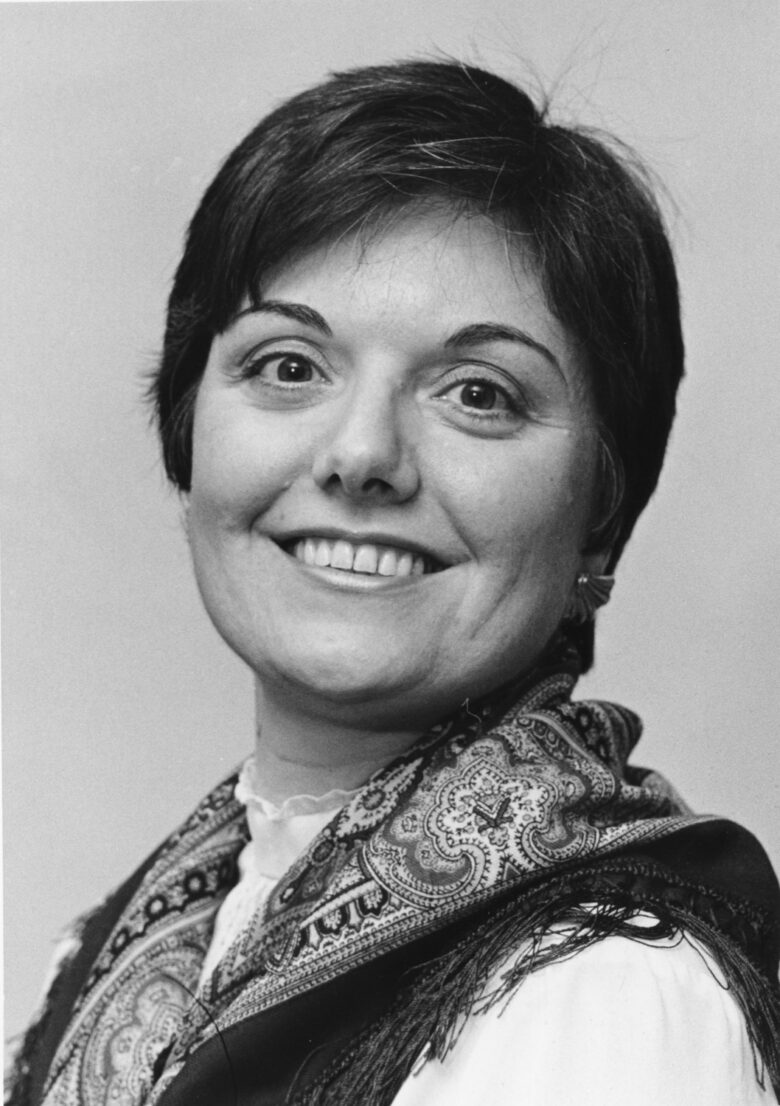
Alice Carol Almond Shrock
December 13, 1946 – October 18, 2026
Alice Carol Almond Shrock, historian, beloved Earlham College professor, and the warm, joyful heart of her family, died on October 18, 2026, with her husband and daughters by her side. She was 79.
Known as Alice, “AC,” The Mommy, Nonna, and Dr. Shrock, Alice was brilliant, cheerful, deeply loving and tireless in her dedication to the causes and people she loved. To be near Alice was to experience her curiosity and her love of ideas, travel, history, and activism, which she wove into the minutiae of each conversation and everyday life, especially in the Shrock home. Alice often invoked historian Laurel Thatcher Ulrich’s comment, “Well-behaved women seldom make history.” Alice made history, and she ensured countless other women were written into it.
Alice was born on December 13, 1946, to Alice (Calderone) Almond and Thomas Raphael Almond in Louisville, Kentucky. A treasured only child with more than two dozen cousins on her Italian-American mother’s side, she grew up surrounded by family. She was fond of her many cousins and kept her ancestors present through cherished family furniture, stories, and photographs. Her accomplished, well-traveled and love-filled life was, as one cousin put it, the embodiment of their immigrant grandparents’ dreams.
Alice was an excellent student at Louisville’s Waggener High School. She grew her talents on the cello and piano, studied music theory at the University of Louisville Preparatory School of Music, and delighted in Vivaldi, Bach and Mozart. She edited Introspect, her high school’s creative writing magazine, which she later wryly deemed “hardly a Pulitzer-prize winner.”
Alice enrolled at Earlham College in 1964, where she became known as “Ace Almond” for her top marks, and fell in love with history as a discipline. She studied off campus in Washington, D.C.; in Athens, Greece; and in Ljubljana, then part of Yugoslavia, where she interviewed women who had fought in the Partisan resistance during World War II. One summer, she had her first taste of working in politics in the Kentucky governor’s office, helping to prepare proposals on women’s and youth issues for the national party platform. The women’s plank was, in her words, “abysmally unsuccessful,” but the work inspired her to learn more about little-known women’s history and the discrimination women still faced. She graduated from Earlham in 1968 magna cum laude, with departmental honors in history and election to Phi Beta Kappa.
She met many lifelong friends in Earlham’s class of 1968, including Doreen (Peterson) Dimick and Lynell (McCammon) Bell, and one special fellow history major, Randall Shrock. Alice and Randall were just friends until their junior year, when Doreen encouraged Alice to invite Randall to a group dinner at Welliver’s Smorgasbord in Hagerstown. Over pickled herring, they fell in love, launching an exceptional professional, emotional, and life partnership that would last nearly 60 years. When Randall fell in love that evening, he became “a man on a mission to marry Alice,” and after mailing 500+ letters to one another while geographically apart, the two married in a Quaker wedding on August 22, 1970. Their one lifelong challenge was culinary: Alice’s Sicilian and Kentucky roots dictated a love for olives, pickles, pimento cheese and anything with spice and flavor, while Randall brought a milder, Hoosier palate to the relationship.
At a time when marriage often sharply curtailed women’s careers, Alice was determined to pursue her academic dreams. Awarded a Woodrow Wilson Fellowship, she earned her M.A. (1970) and Ph.D. (1974) in history at the University of North Carolina at Chapel Hill, where Randall followed her and began work on his Ph.D. Alice’s graduate adviser did not believe women were important subjects of historical study, but she proved him wrong with a doctoral dissertation entitled “Feminists, Flappers, and the Maternal Mystique: Changing Conceptions of Women and Their Roles in the 1920s.” At Chapel Hill she helped propose, design, and teach the first women’s history course in the University of North Carolina system. “Since I was not able to take such a course,” she wrote at the time, “it has been tremendously exciting to teach one.”
She went on to teach U.S. and women’s history at Centre College in 1973-74 and the University of Delaware, and produced The Lady and the Laborer, a documentary on the ideals and economic realities facing American women from 1890 to 1920.
In 1974 Alice and Randall returned to Earlham. It was Alice’s groundbreaking idea to pitch both Shrocks as a two-for-one deal: two professors working in one job. Her proposal was successful, and both taught at Earlham until retiring in December 2013. They became the first successful married couple to share a position at a college or university, and their arrangement, which endured for nearly four decades, made national news as a record. They were proud that it allowed them to devote themselves to teaching and to raising their daughters. Alice later spoke nationally on the challenges and opportunities facing academic couples.
Alice belonged to a generation of feminist scholars who transformed how we understand the past. Through a feminist lens, she taught U.S. history, British history, women’s history, museum studies, and courses in the Humanities program. Her zeal for museums was instrumental in initiating and developing Earlham’s Museum Studies program. A gracious and generous mentor to generations of Earlham students, she lit up the halls of the Landrum Bolling Center, as her colleagues put it.
She had a deep love for Quaker history, especially activist Quaker women. In 1985 she began an oral history project in which her students interviewed older Quaker women who had been activists for peace, education, and social justice, preserving their stories in the Earlham Archives. She called these women “anonymous Americans,” and writing their place into history was at the heart of her life’s work. While researching her dissertation, she wrote to Alice Paul, the famous Quaker suffragist who led the fight for the 19th Amendment and authored the Equal Rights Amendment. Paul routinely turned away reporters and scholars, but Alice mentioned that she was a convinced Quaker, and Paul agreed to see her. It may have been one of the last interviews Alice Paul ever gave.
Although teaching half-time, Alice left a full-time footprint. She eventually became Associate Academic Dean for Program Development and oversaw the Ford/Knight program that made faculty-student collaborative research central to Earlham’s mission. She helped design Earlham’s gender and women’s studies major, chaired the Affirmative Action and Faculty Affairs committees, and led the college’s Phi Beta Kappa chapter. In 1986 she was one of 328 faculty recognized nationally by the American Association for Higher Education for making a difference in undergraduate education. Even after retiring, she continued to help with Ford/Knight grants. In 2023 Alice and Randall were awarded Earlham’s Distinguished Service Award.
Together the Shrocks led Earlham’s semester in London more than a half-dozen times, hauling their daughters with them on a transatlantic family adventure. Likewise, they led Earlham’s Germany-Austria program twice, and traveled to more than 30 countries together, always returning home to the close-knit Quaker community in Richmond.
Alice’s scholarship never stayed in the classroom. In 1980 and 1981, she won a Lilly Endowment Faculty Open Fellowship, enabling her to work on Capitol Hill as a legislative analyst for the bipartisan Congresswomen’s Caucus. In particular, she worked to advance the Equal Rights Amendment alongside congressional legends Shirley Chisholm, Pat Schroeder, Margaret Heckler, and Geraldine Ferraro, among others.
In 1987 she became the first Earlham faculty member to receive a W.K. Kellogg Foundation National Leadership Fellowship, forming cherished friendships in her cohort while studying women’s leadership and public policy in countries from Norway and Iceland to Brazil, Egypt, Israel and the Occupied Palestinian Territories, China and the Soviet Union. During 1987-1988 in London, she worked in the House of Commons on the staff of Liberal Democrat MP Alan Beith, now Lord Beith, as a women’s issues officer.
She served on the board of the Indiana Committee for the Humanities, spoke to countless community groups, from the League of Women Voters to the Girl Scouts, and (to her daughters’ delight) appeared as a commentator in a 2018 PBS documentary on Quaker history. She would have loved to watch the results of the 2026 midterm elections, and you can honor Alice by exercising your right to vote.
Alice raised her daughters, Amy and Rachel, to find intellectual and emotional fulfillment in travel, to be of service to others, to find joy in friends and family, and to try new things. She was a role model for balancing career and family, so much so that when toddler Rachel spotted a bird flying off in the backyard, she announced, “There goes the Mommy bird, off to another meeting.” Alice turned every research trip and teaching post into a family adventure and learning opportunity—making the world her daughters’ classroom many times over. Alice loved the fine arts and colorful, beautiful art, and shared that love with her family. She inherited a love of opera from her mother and made special trips to the ballet with friends and family. She always arrived well prepared to understand and interpret any exhibit or performance, and she was a knowledgeable tour guide whose casual walking tour of London’s Whitehall was second to none.
London became a second home. With her family, and often her students, in tow, Alice explored every corner of Britain and Ireland. She loved walks through magical Hampstead while holding hands with her children. Each museum trip (of many) required a visit to the gift shop, where there was always a guidebook to bring home and mark with Post-it notes and a date in the front. She loved the Sunday EastEnders omnibus, a British murder mystery or documentary at full volume, the latest debate on Prime Minister’s Question Time, or staying up past “Quaker midnight” to watch the UK election results come in. And regular shopping at Marks & Spencer meant all these activities were enjoyed with a properly made cup of M&S Extra Strong tea.
With bright eyes and a warm smile, Alice was patient, exuberantly loving, and always assumed the best of people. She was naturally encouraging to others and invariably thoughtful, remembering everything about the people she loved: what they cared about, what they were reading, where they had been, and where they were headed. A voracious reader and an analog historian to the end, she routinely clipped articles of interest for her loved ones and added a “thought of you” note in her unmistakably polished handwriting—or relayed something she’d learned on Rachel Maddow the next time they talked. Her always-working brain loved researching before any trip or visit to a new restaurant. She saw a use for everything and kept it all neatly organized according to a system only she could fully decode.
As a convinced Quaker, Alice lived by the Quaker testimonies. Above all, she was dedicated: to her family, to her students, to Quaker history and to social justice. Her family never once saw her be unkind to anyone. She firmly believed there was that of God in every person, and her love embraced everyone. Alice devoted countless hours to West Richmond Friends Meeting as a member of the choir, as recording clerk, and as a member of the worship planning committee. No matter where they traveled, Alice and Randall never felt fully home until they returned to their Quaker Meeting.
Most of all, Alice delighted in the miracle of her granddaughter, Mira Alice. During the six months Mira spent in a Chicago neonatal intensive care unit, Nonna and Opa visited nearly every day, with Nonna setting a family record for carefully holding and rocking tiny Mira the longest, sometimes for three hours at a time, while Mira was connected to a web of ventilators and machines. Nonna sang Mira the same lullabies she had sung to her own daughters. She dutifully called Mira every night to read a book alongside Opa, hoping to instill a lifelong love of reading.
Alice is survived by her beloved husband of 56 years, Randall Shrock; her daughters, Amy Shrock (Victor Reyes) of Richmond and Rachel Shrock (Sean Young) of Chicago; her granddaughter, Mira Alice Esther Sean Shrock; her special aunt Elsie (Calderone) Whitten; many Calderone cousins; and countless friends, colleagues, and thousands of former students. She was preceded in death by her parents, Alice (Calderone) Almond and Thomas Raphael Almond, and many aunts and uncles.
Alice’s family, friends, former students and colleagues are welcome to celebrate her life at a Quaker memorial service at 2:00 p.m. on Saturday, December 12, 2026, one day before what would have been her 80th birthday, at West Richmond Friends Meeting, 609 West Main Street, Richmond, Indiana. A fellowship hour will begin at 1:00 p.m. in the Fellowship Room. The service will also be available by Zoom (for the link, please contact Randall, Rachel, or Amy Shrock). The family wishes to thank Elizabeth Terney and Elana Passman for their help in preparing an earlier version of this obituary. Online condolences can be made at www.doanmillsfuneralhome.com.
In lieu of flowers, memorial gifts may be made in Alice’s memory to the Earlham Fund, Earlham College, 801 National Road West, Richmond, IN 47374.