

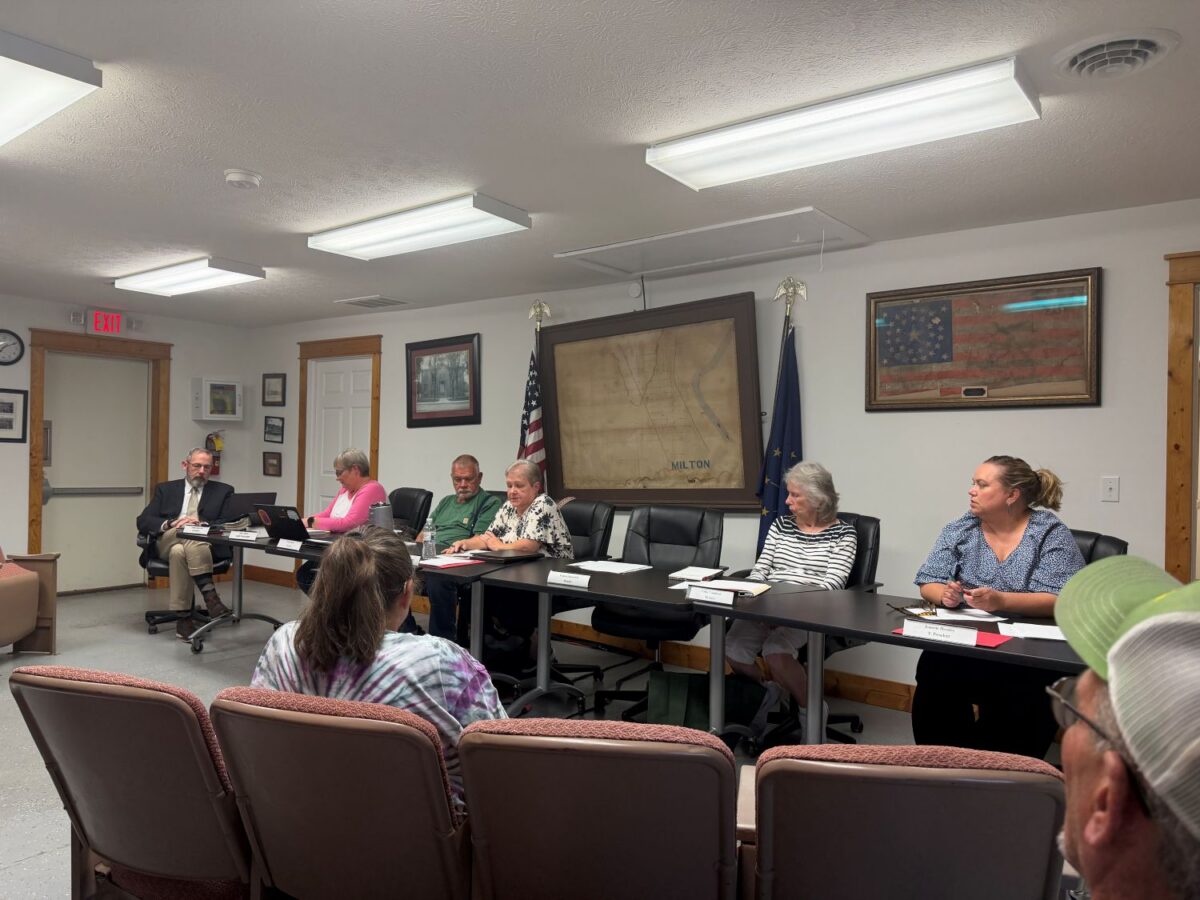
Milton council members made hard decisions with a goal of financial stability at a special meeting on Sept. 29.
With community input, the council voted 4-0 to suspend its police department, reduce employee hours and potentially donate council member salaries back to the town, through the end of the year.
The moves come after a few tough years for the town government that serves over 400 people in western Wayne County. Following two State Board of Accounts audits, several board member departures and a recent accumulation of past-due bills, council has expenditures that exceed its budget.
President Joy May said with utilities as the only income, the council is exploring cost-saving options to sustain the town through the end of 2026. She said these options were selected at an executive session conducted just prior to the 7 p.m. meeting and brought to the public for further discussion.
Indiana law allows governing bodies to hold closed-door executive sessions for a limited number of specific reasons that must be advertised to the public in advance. Discussion of budget planning is not one of those reasons, and WWN was unable to locate any evidence that Milton officials had publicized the meeting or its purpose as required.
While 2027 budget figures were not yet available due to what officials called technical issues, May provided estimates that savings from the police department would be $13-14K while suspending council pay through the end of the year would save around $4,000.
Resident Larry Harris was adamant that Milton never needed a police department, stating that Cambridge City and Wayne County police were sufficient. Under the suspension, the town marshal and another officer were to return all equipment effective immediately.
Harris also recommended having just one utility employee instead of two. Council member Jeanette Hensley was in support of making both utility employees part time, but insisted they could not be off on the same days. Council members decided that all three town employees, including the deputy clerk, should work 32 hours per week and the utility employees would work alternating days, effective Oct. 5. Town attorney Chris Armour advised that if an ordinance needed changed regarding compensation, it can be reviewed and approved at the next meeting.
Finally, Armour reiterated that as elected officials, council members cannot deny receipt of their salary. However, each can individually submit a waiver of compensation and choose to submit their wages back to the town for a designated fund. Council member Dwight Smith said he had no problem suspending his pay as he “didn’t join council to get paid” but wanted to help the town.
Other solutions, including removing employee cellphones and reducing attorney’s hours, and finalizing the 2027 budget will be the focus of the 6 p.m. Oct. 13, meeting at 101 N. Central Ave. The public may attend. As of press time, Milton had not met the state’s requirements for advertising a budget approval meeting’s date, time and location to the public.
A version of this article will appear in the October 7 2026 print edition of the Western Wayne News.
