Making repairs after serious flood damage is more complex than updating paint, drywall and flooring.
Many homes in Wayne County need substantial redesign and construction after the catastrophic Aug. 12 flooding, and some need additional work to prevent future damage.
Officials urge owners to confirm what can be done before spending funds and beginning construction.
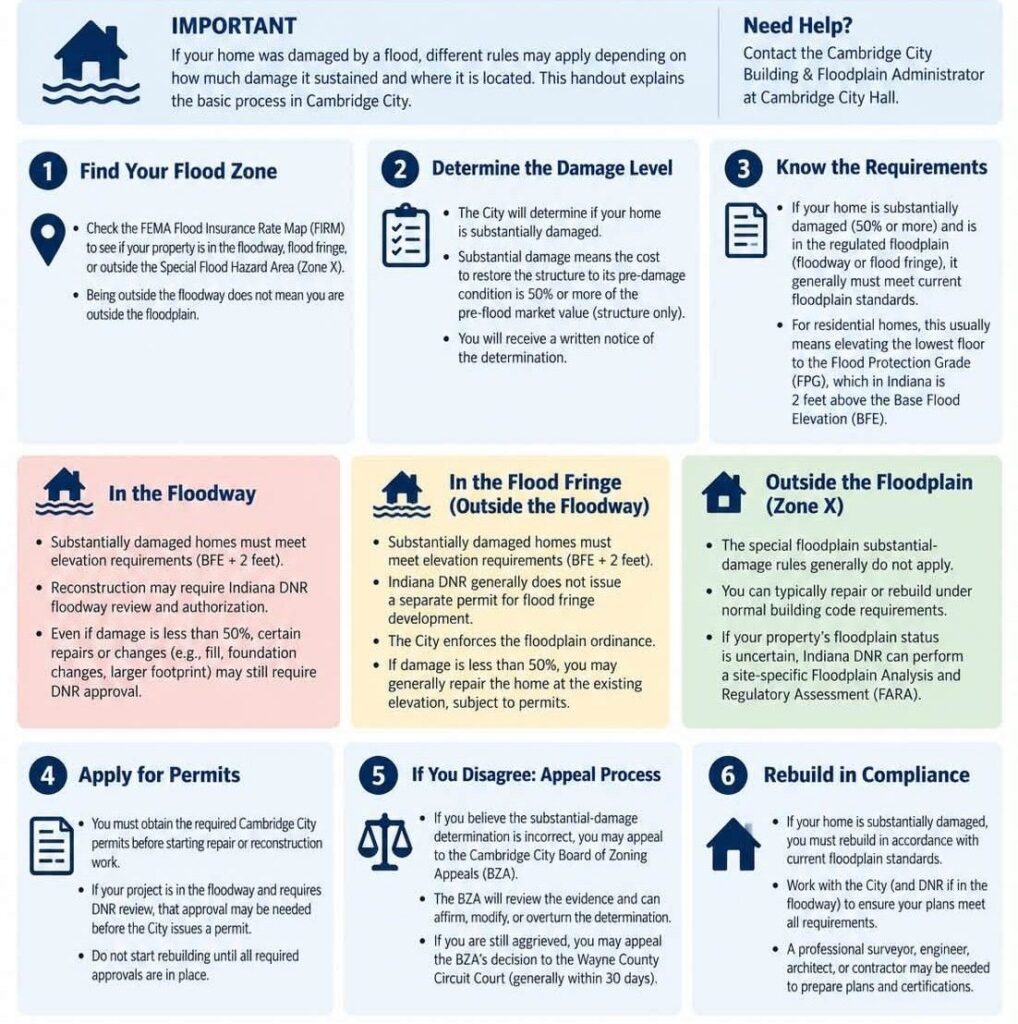
Property owners need to check the Federal Emergency Management Agency’s Flood Insurance Rate Map to see if their land is in the floodway, flood fringe or outside the Special Flood Hazard Area. Being outside the floodway doesn’t mean land is outside the floodplain.
If the property is located within the regulated floodplain or floodway, towns must complete a flood damage/substantial damage determination assessment.
Cambridge City officials announced that homes with 50% or more damage that are in the regulated floodplain might have to have the lowest floor elevated two feet above the base flood elevation.
However, property owners should not assume that elevation is their only possible option, they said in a Sept. 9 statement.
Various permits and inspections are required before work begins. Those affected by flooding are urged to contact experts including their community’s building officials and Indiana Department of Natural Resources before taking action.
Cambridge City
Depending upon the property and available programs, possible options might include:
- Repair/reconstruction with elevation: A substantially damaged home could be reconstructed in compliance with current floodplain requirements.
- National Flood Insurance Program Increased Cost of Compliance: Homeowners who had NFIP flood insurance might qualify for additional insurance benefits to help pay certain costs associated with elevation, relocation or demolition.
- Voluntary acquisition/buyout: Cambridge City is exploring whether FEMA/Indiana hazard-mitigation funding could become available for voluntary acquisition of certain flood-prone properties. No buyout program or funding is guaranteed at this time.
Participation in any FEMA-funded acquisition program would be voluntary.
Town officials say a 50% determination is an important step and not the end of the process, and that they understand that receiving a substantial-damage determination can raise serious financial and personal concerns.
“Homeowners should not make irreversible decisions based solely on receiving the initial determination,” town officials said.
They encourage affected property owners to:
- Obtain and review their substantial-damage determination.
- Review the values and repair estimates used in the calculation.
- Contact the town before beginning reconstruction.
- Ask questions about elevation and rebuilding requirements.
- Discuss possible insurance, mitigation or voluntary acquisition assistance.
- Exercise their appeal rights if they believe the determination is incorrect.
Cambridge City will continue working with Indiana DNR, Indiana Department of Homeland Security, FEMA and other agencies to identify available recovery and mitigation options for affected property owners.
“Our goal is to help residents understand their options and make informed decisions about rebuilding and recovery,” the statement read.
Permit concerns
Following previous protocol for building improvements, homeowners and businesses expecting their flood repairs will cost more than $500 must contact town hall to obtain a permit before starting the work. The town is currently waiving flood repair permit fees but is still requiring permits when applicable.
In addition to town approval, an Indiana Department of Natural Resources permit might be required.
Although town employees can’t yet directly answer calls at 765-478-3522 while the phone system is being restored, they will return voicemails.
Town officials urge property owners not to start reconstruction until the town has determined whether Indiana DNR approval is required.
Because of the large number of permits anticipated and the town’s limited staff, flood repair permits will be issued on Tuesdays and Wednesdays from noon to 4 p.m.
These procedures apply to both private residences and businesses.
A version of this article appeared in the September 16 2026 print edition of the Western Wayne News.