

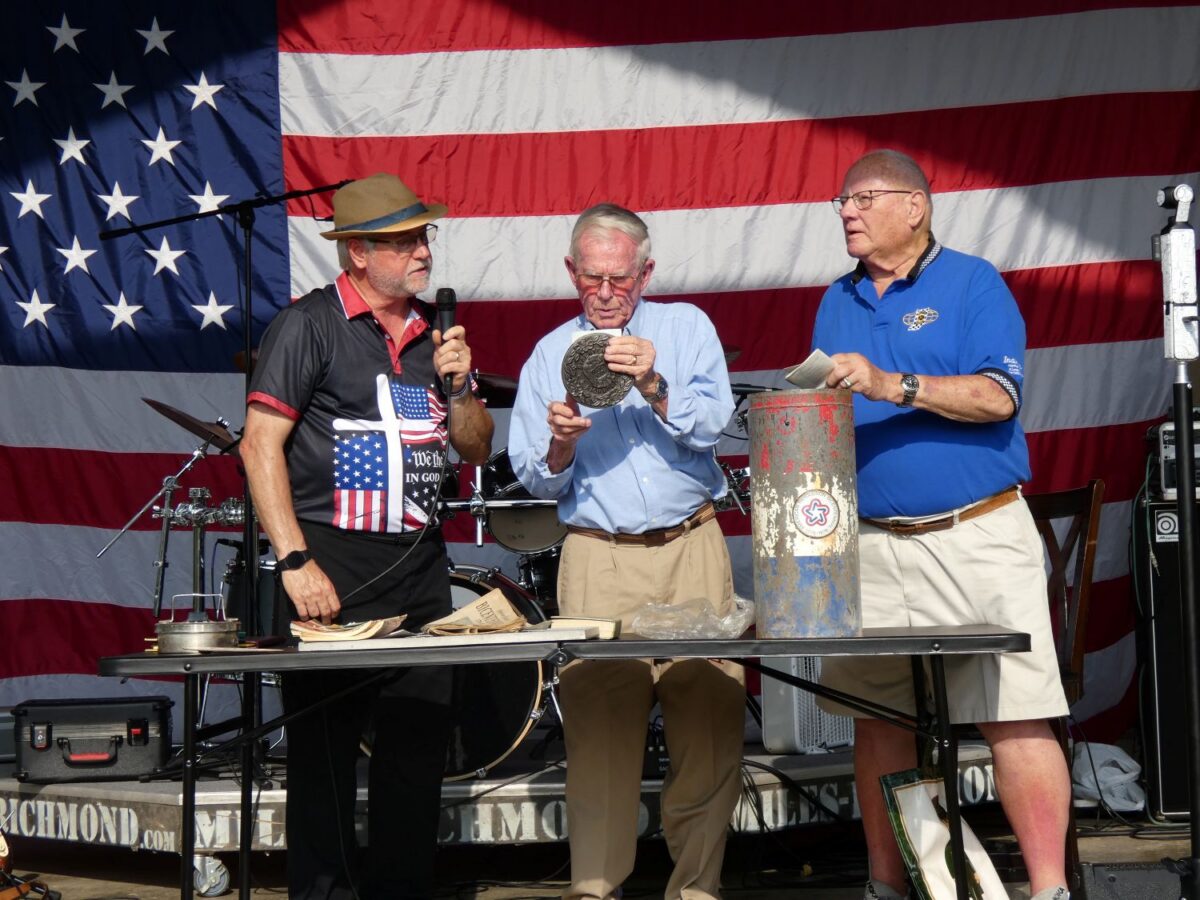
Nationwide celebrations of the 250th year of U.S. independence have included reflecting on the country’s past, present and future. In Wayne County, a snapshot of the community’s history took center stage as a time capsule from 1976 was opened.
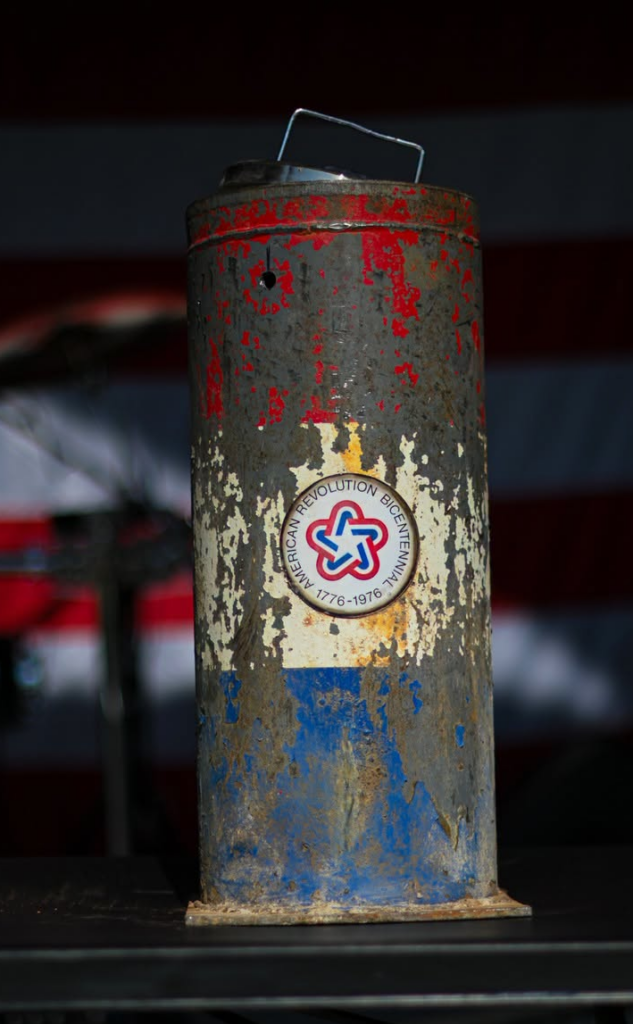
The original contents of the capsule, a tall metal cylinder, were sealed and placed under Freedom Fountain near the city building on North Fifth Street as part of Richmond’s celebration of the nation’s Bicentennial on July 4, 1976. Community members selected 37 items to preserve aspects of life in Richmond for future generations.
On Saturday at the July Fourth Freedom Jam event in Richmond’s Glen Miller Park, the time to revisit those items arrived. Officials started the unveiling at 6 p.m., earlier than expected to get ahead of looming rain showers.
Duncan Media’s Rick Duncan introduced Mayor Ron Oler, who was joined by special guests Ken Weber and Dana Weigle, both members of the 1976 Bicentennial Commission.
Oler described the excavation process as requiring more equipment than was originally anticipated.
After removing the plaque covering the burial site, officials used chisels, hammers, a winch and a hammer drill to no avail over the course of four days. Eventually the street department’s backhoe was able to hoist the capsule out by chain. Wilson Lock & Key was then able to remove the lid of the capsule without ruining the contents.
Among the artifacts was a typewritten letter authored by Dr. George T. Blakey, the chairman of the Bicentennial Commission at the time, to future residents.
“To the Wayne County Museum and the people of Richmond in 2026…” the letter began. “We hope the collected contents will be a representative — without being exhaustive — portrait of the people of Richmond in this 200th year of independence,” the letter said.
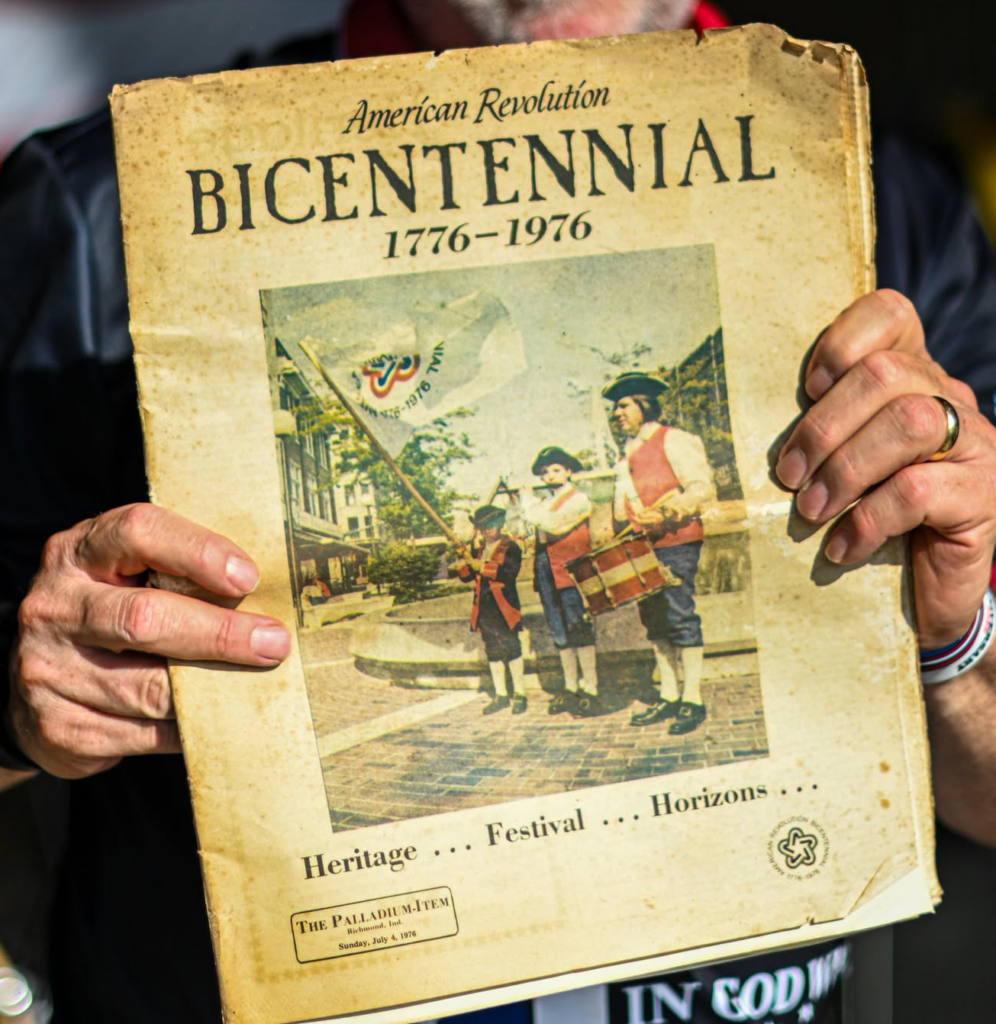
Items unearthed included a commemorative copy of the Palladium-Item, which highlighted that year’s Rose Festival. Weigle said the annual parade featured a record-setting 200 participants during that anniversary year.
The periodical boasted ads from former businesses, including Veach’s Toy Store, Esmond’s Shoes and downtown’s People Home and Savings Bank. The latter ad touted the then-new “cheese grater” siding that was recently removed from the building at 728 E. Main St.
The paper also included Richmond Community Schools comparative tax rates and teacher salaries. In 1976, a teacher with a bachelor’s degree earned $8,588 a year. According to InflationTool.com, that would be about $50,000 per year in 2026.
Material from Richmond’s colleges — Earlham College, Indiana University East and Ivy Tech — were in mint condition, along with an authentic $2 bill and a commemorative 1976 trivet from the Swayne, Robinson casting factory. Weber said the trivets were sold as a fundraiser for the events that year, including a bicentennial ball with period-accurate costumes from the theater. He also recalled placing in the capsule that week’s TV Guide, a publication that listed the times and channels of available broadcast television programming, before the days of cable and streaming.
Oler concluded the presentation by suggesting the creation of a future semi-quincentennial time capsule in collaboration with Weigle and the Kiwanis Club of Richmond.
A recording of the full presentation can be viewed on the City of Richmond’s YouTube page at wwn.to/timecapsuleopen and Oler said the city would also publish additional videos of the contents there. Wayne County Historical Museum will create a display of the items for residents to view.
A version of this article will appear in the July 8 2026 print edition of the Western Wayne News.
