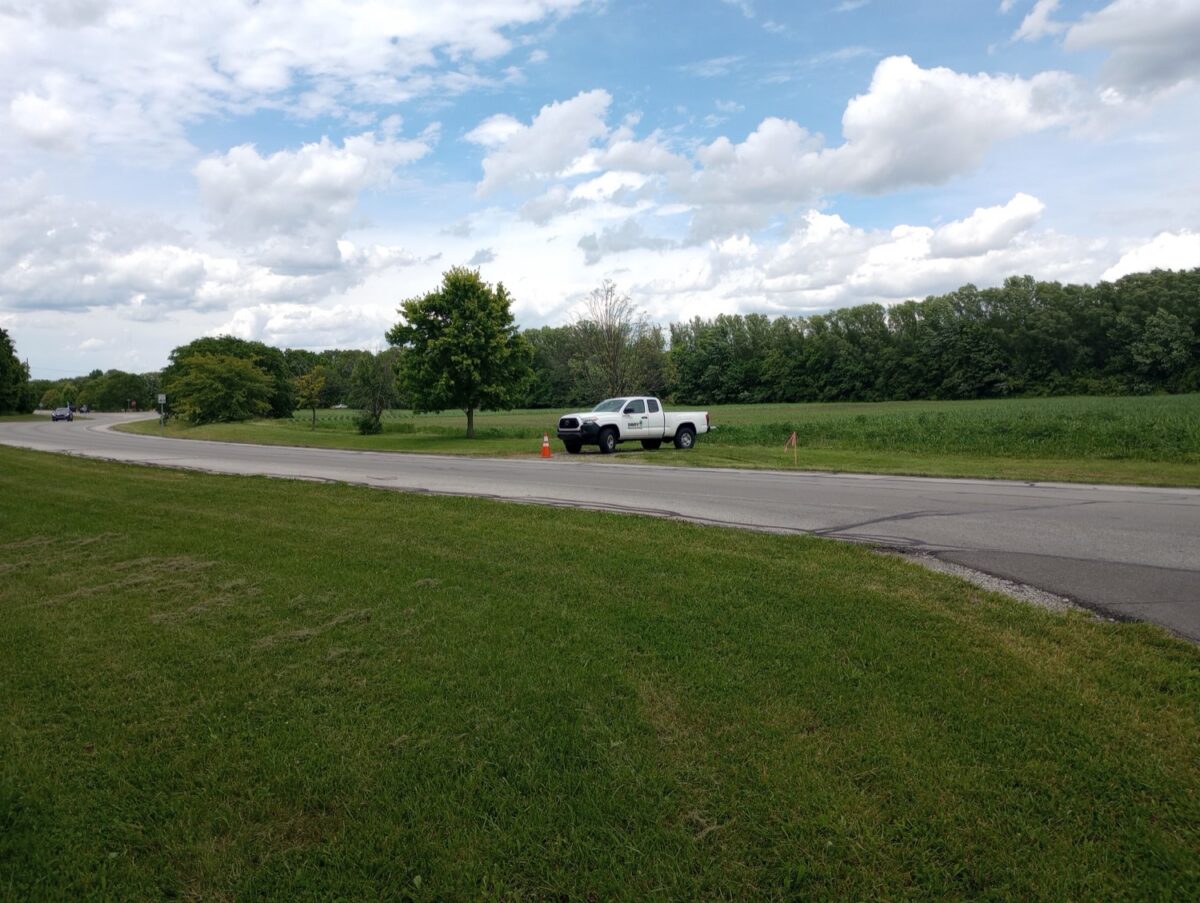
Day after day, the 2026 construction season passes without dirt turning for the Smith Hill planned unit development.
The developers, however, expect that will change before the season ends, according to Chris Hamm of HWC Engineering. There’s already activity with on-site surveying and a traffic study, plus progress toward funding for the initial phase’s infrastructure.
Smith Hill’s progress was a main discussion topic during last week’s Richmond Common Council and Richmond Redevelopment Commission meetings. The planned 287-unit development south of Backmeyer Road between South 37th Street and Garwood Road received $4.33 million from Forge East Central Indiana’s $35 million Regional Economic Acceleration and Development Initiative program. The award from the regional group that includes Wayne County requires a $4.33 million city match, which is designed as a forgivable loan to 11th Street Development. The $8.66 million is part of a $21 million project, Hamm said.
The match is planned to include $3.23 million from the Redevelopment Commission’s tax increment finance collections and $1.1 million from the city donating the project’s 80 acres to the developer. The city will acquire the land from Reid Health and forgive Reid’s planned $1,016,681 payment for the former hospital’s demolition. The payment would be due when the Chester Boulevard site’s environmental mitigation — performed at Reid’s cost — is completed.
Lisa Lee, a municipal finance partner at Ice Miller, presented the Redevelopment Commission with the forgivable loan term sheet during its June 16 meeting. The loan becomes forgivable when infrastructure for the development’s first phase is completed. Hamm said the first phase will contain about 40 of the planned 287 single-family units. As site engineering continues, Hamm said lots are lost and gained, leaving the final number in flux. That number will be finalized before primary plat approval is sought from Richmond Advisory Plan Commission, likely in August.
Hamm said the initial phase will likely have a mixture of the housing styles 11th Street Development presented for Smith Hill. The development will include custom houses, smaller houses, courtyard-style homes and up to 100 townhouses.
Redevelopment Commission members approved 5-0 a revised forgivable loan term sheet, requiring some clarifications that did not alter the terms. Lee said work will begin on a draft loan agreement and promissory note. A forgivable loan ordinance will be introduced to council July 20, and the Redevelopment Commission will consider a resolution approving its $3.23 million TIF contribution July 21. The city’s Economic Development Commission will conduct a public hearing Aug. 3 on the loan ordinance and make a recommendation to council, which is scheduled to vote on the ordinance that same night.
When 11th Street Development’s Bryan Stumpf provided council with a project update June 16, 2025, council member Larry Parker opposed inclusion of 100 rental homes. When Beth Fields, the city’s director of strategic initiatives, updated council during its June 15 meeting, Parker again expressed his opposition. He said council was specifically told before approving the land’s zoning that there would be no rental component. Parker said the developer “misconstrued to us and the plan commission” what the development would be, and council member Lucinda Wright agreed with Parker’s assessment.
Parker thinks the development must go back before the plan commission because any rental component significantly changes the project’s scope. Plan commission will hear the detailed plan when it considers — and could deny — the primary plat.
Council member Jerry Purcell questioned whether the 80 acres was appraised, saying it could be worth much more than the $1.1 million value stipulated by the city and developer. Fields said there was no appraisal because the value was stipulated and completed the city’s match requirement.
Purcell also questioned continuing to collect tax increment finance revenue on the development when the city needs additional property tax revenue, citing police officers and firefighters leaving the city and the necessity for police vehicles. A special allocation area was created for Smith Hill to enable TIF collection.
Mayor Ron Oler said that capturing TIF maximizes the city’s receipt of property tax money, because the state limits property tax levy growth to 4% annually. Even with property taxes assessed on the additional houses, the city would receive only the additional 4% added to the levy. The additional taxpayers would reduce the tax burden on other taxpayers, rather than additionally increasing the city’s revenue.
A version of this article appeared in the June 24 2026 print edition of the Western Wayne News.