Anticipating future growth, Richmond Power & Light has proposed phased rate changes that would cost a 1,000-kilowatt-hour residential customer about $14 extra each month in 2029.
The proposal follows a cost of service study by NextGen Strategies & Solutions that determined revenue necessary for RP&L to remain financially sound and prepare for its future. The RP&L board, which is composed of Richmond Common Council members, voted 7-0 to advance an ordinance with the new rate structure to council.
After the ordinance is introduced to council, a public hearing will be conducted during the second hearing, prior to council’s vote. The structure will include all RP&L rates ranging from residential to large industrial users.
A cost of service study completed in 2021 resulted in a three-phase rate increase implemented in 2021, 2022 and 2023. RP&L requested a 9.58% total increase, but the Indiana Office of Utility Consumer Counselor proposed a 5.42% total increase. The sides compromised with a 7.23% increase that was approved by the Indiana Utility Regulatory Commission.
In the November 2022 election, Richmond voters approved RP&L leaving the IURC’s jurisdiction, giving council the final say on RP&L’s current rate requests, which would increase the residential cost 11.0% in three years. The IURC had required that RP&L conduct cost of service studies every five years, an order council affirmed when permitting withdrawal from the IURC. Prior to 2021, RP&L’s previous cost of service study occurred in 2005.
Currently, RP&L’s monthly residential rates include a facilities charge that is a flat rate no matter how much electricity is used; a base rate per kilowatt-hour used that includes a rate for power, a rate for required RP&L payments to the city and a rate to build reserves for the upcoming coal ash mitigation project; and an energy cost adjustment that changes quarterly based on the cost RP&L pays for electricity from its wholesale provider, the Indiana Municipal Power Agency.
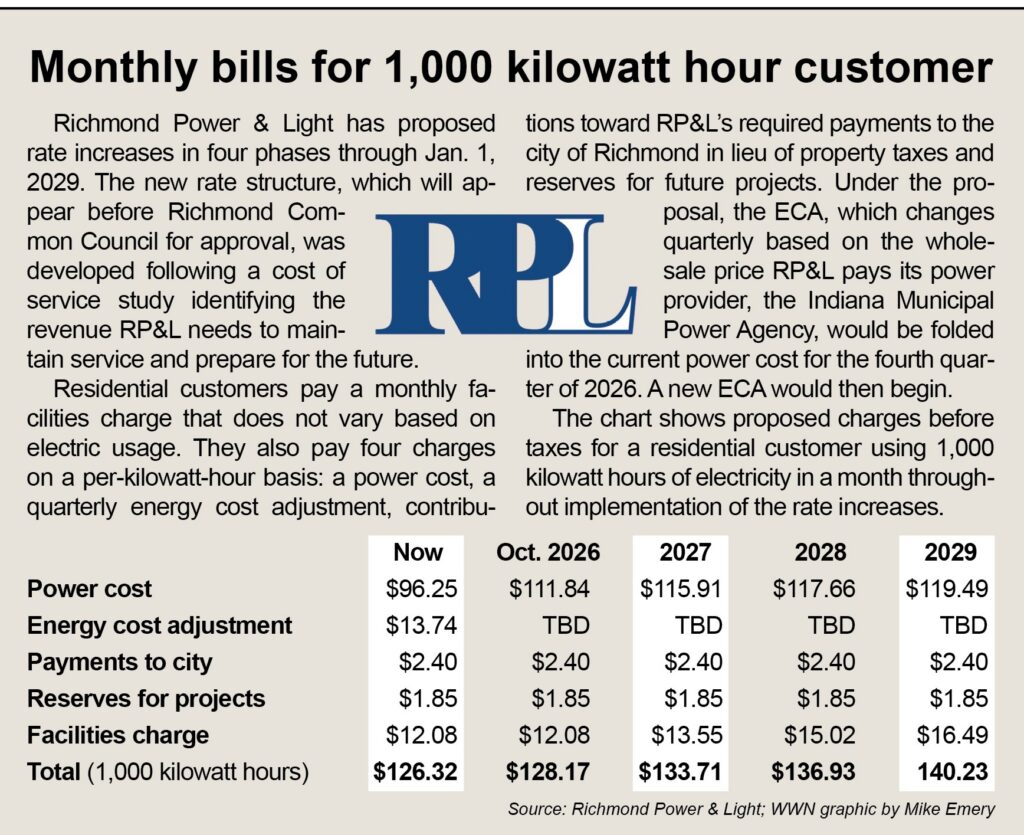
Under RP&L’s proposal, the facilities charge would increase 36.5% from the current $12.08 to $16.49 in 2029. It would be $13.55 in 2027 and $15.02 in 2028.
RP&L plans to restructure how the kilowatt-hour rates appear on customer bills. Future bills will show the rate for power and separate the city payments and reserves rates into two riders listed individually.
The city payments replace property taxes RP&L does not pay and provide a return on the city’s investment into the municipally owned utility. It will remain $0.00240 per kilowatt-hour, meaning it costs $2.40 on a 1,000-kilowatt-hour user’s monthly bill.
RP&L puts $2 million a year into reserves in anticipation of the federally mandated coal ash mitigation project that’s anticipated to cost about $30 million. The rate will remain $0.00185 per kilowatt-hour, meaning it costs $1.85 for a customer using 1,000 kilowatts during a month.
RP&L plans to increase its power charge four times through 2029. The first increase would take effect Oct. 1. It would combine the third-quarter energy cost adjustment of $0.01374 with the current base rate of $0.10050 and add the project reserves rider at $0.00185 for a total cost of $0.11609 — 11.609 cents — per kilowatt-hour. The ECA would begin again based on the IMPA power price, likely adding to each customer’s per-kilowatt-hour cost.
On Jan. 1, 2027, the power charge would increase to $0.11591, with the $0.00185 reserves rider and $0.00240 city payments rider increasing the per-kilowatt-hour cost to $0.12016 — 12.016 cents, plus the ECA.
On Jan. 1, 2028, the power cost would rise to $0.11766, with the two riders remaining stable, for a per-kilowatt-hour cost of $0.12191 — 12.191 cents — plus the ECA.
In the final increase beginning Jan. 1, 2029, the power rate would rise to $0.11949, with the riders continuing unchanged, for a per-kilowatt-hour cost of $0.12374 — 12.374 cents — plus the ECA.
Therefore, the current 1,000-kilowatt-hour user’s total cost before taxes of $126.32 a month, would be $128.17 plus ECA the last quarter of this year, $133.71 plus ECA in 2027, $136.93 plus ECA in 2028 and $140.23 plus ECA in 2029.
“Everything that we are doing here is being invested back into our community system so that we have reliable, reasonable-rate electricity for our customers,” RP&L General Manager Tony Foster said. “And planning for the future, not only maintenance, but system-wide. As our community sees community growth, we need to make sure we’re on top of things.”
The cost of service study considered RP&L’s expenses for system maintenance, environmental regulations, rebuilding and maintaining reserve accounts and preparing for future growth. Foster said seven of the utility’s 10 large transformers need attention during the next decade at about $1.5 million per transformer. He also highlighted increasing materials costs beyond normal inflation, such as a 135% increase since 2020 for smaller transformers, an 82% increase for 35-foot poles, a 70% increase for street light wire and a 28% increase for primary service wire.
Increased prices for materials plus two unexpected equipment failures ate into reserves. Foster said the standard is to maintain a 200-day balance, which RP&L currently does not have. Continued growth at the Midwest Industrial Park could also require that RP&L expand its infrastructure to service increased demand from additional large users.
More information and the new rate structure, including for commercial and industrial customers, is available at www.rp-l.com/rpl-considers-updated-rates-and-charges/.
Updated Thursday, July 23, 2026 at 10:05 a.m. to include the full name and title of RP&L General Manager Tony Foster.
A version of this article appeared in the July 22 2026 print edition of the Western Wayne News.