An 8-1 vote on Monday put Richmond one step closer to enacting a new food and beverage tax.
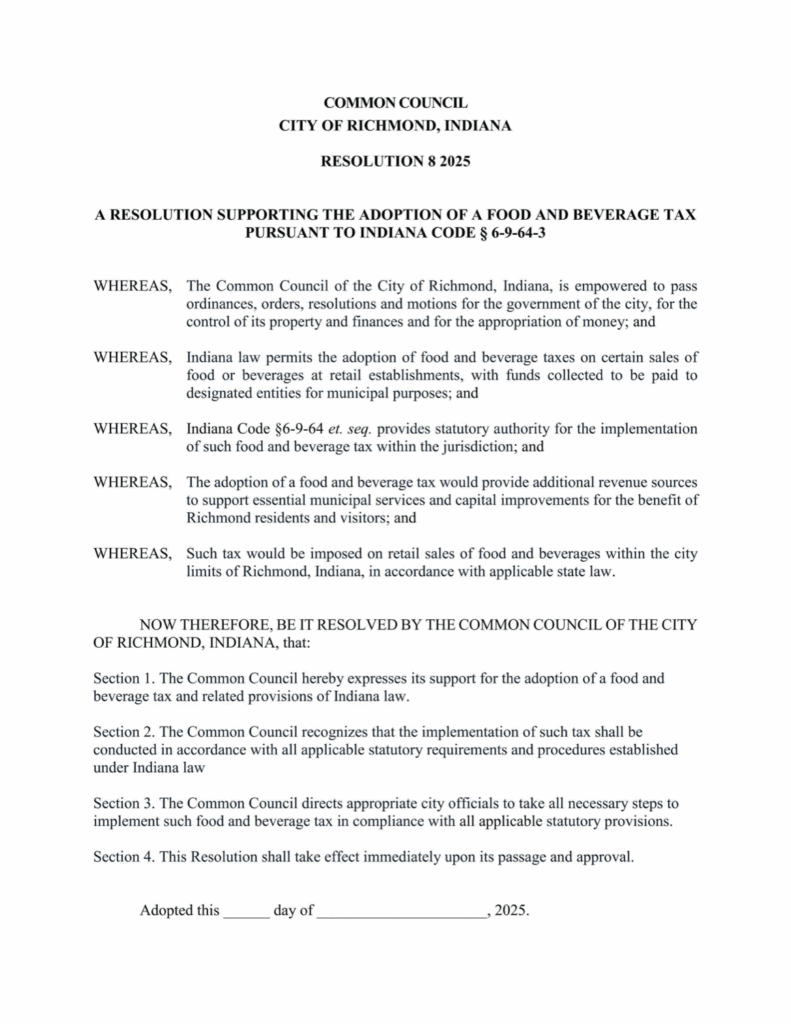
Richmond Common Council passed a resolution Nov. 17 supporting a city food and beverage tax. If adopted the tax would provide a new funding source for city parks, trails and Whitewater Gorge activation.
Council will likely consider a full tax ordinance at its 7 p.m. Dec. 1 meeting, and then schedule a special meeting to conduct a required public hearing.
The Indiana General Assembly this year passed a law that included Indiana Code 6-9-64, which permits Richmond to enact up to a 1% tax on certain food and beverage sales within city limits. If adopted, the tax would apply to food and beverage sales at restaurants, bars and cafes; catered events; and hot food or prepared items sold at grocery store delis.
For example, a 1% tax would cost a customer 15 additional cents on a $15 restaurant meal.
When presenting the resolution to council, member Bill Engle framed the tax as a user fee that’s a choice for residents.
“If you go out to eat, you pay the tax; if you go to the grocery store, you will not pay the tax,” Engle said.
Council member Lucinda Wright, the lone no vote, said the tax takes away choice and citizens deserve assistance rather than another tax.
“Talking to my constituents, this administration, as far as I’m concerned, we haven’t done anything to help the citizens, and the citizens are crying,” Wright said. “They’re in need, and we’re not listening to them. I cannot see taxing them when we haven’t done anything to help them.”
According to the Indiana Department of Revenue, 15 counties and 26 cities already have food and beverages taxes, some implemented in the mid-1980s. Along the Interstate 70 corridor between Wayne County and Indianapolis, Henry County enacted its tax in 1987, and Hancock County and Marion County have had their taxes since 2005. Also in east-central Indiana, Delaware County enacted its tax in 1986.
Engle told WWN that he and others have been working toward this step for a while. He said that a group of council members and park board members have been consulting with community leaders, business owners, economic development organizations, tourism officials and restaurant owners, and that they’ve received “broad support.”
Engle, who is a liaison between council and the park board, said important park improvement projects are often put off, and this is a way to get them done sooner, or at all. Near-term projects could include a new playground and splash pad at Glen Miller Park.
Engle acknowledged that no one wants to see new taxes, but with major changes at the state level draining traditional funding sources for community improvement projects, including limits on property tax revenue, he said now is the time for a food and beverage tax.
“We need to keep up our parks, we can’t go back to a time when the parks were deteriorating and we were aware of it and scratching our heads, trying to come up with solutions,” Engle said. “We have projects to do, and this is a way to tackle them and make our parks something we can all be proud of, and use them as a way to bring in new residents and serve residents that are here.”
All funds collected would be deposited into a Richmond Food and Beverage Tax Receipts Fund, which may be used only for parks and recreation, trail development and activation of the Whitewater Gorge area, or to pay debt on related projects.
An earlier report by the Legislative Services Agency’s Office of Fiscal and Management Analysis estimated that implementing the tax could raise the city about $900,000 in 2026. Engle said he thinks that number may be low; he expects $1.3 million or more to come from the tax in the first year. The City of Richmond’s website puts it at $1.5 million.
According to IC 6-9-64-11, the tax, if enacted, would remain in effect until January 1, 2047.
For more information, visit the city’s web page dedicated to the proposed tax at wwn.to/fab26.
Updated Monday, November 17 at 9:30 p.m. to reflect the outcome of the council meeting and vote held today. An earlier version of this article previewed the meeting agenda and the resolution supporting the food and beverage tax.
A version of this article appeared in the November 19 2025 print edition of the Western Wayne News.