Richmond has served as a city of firsts during its relationship with the Indiana Municipal Power Agency.
Richmond Power and Light helped found IMPA, served as a solar park pilot site and hosted the first solar panels that tracked the sun throughout the day. And now, IMPA chose Richmond as its first battery energy storage system site.
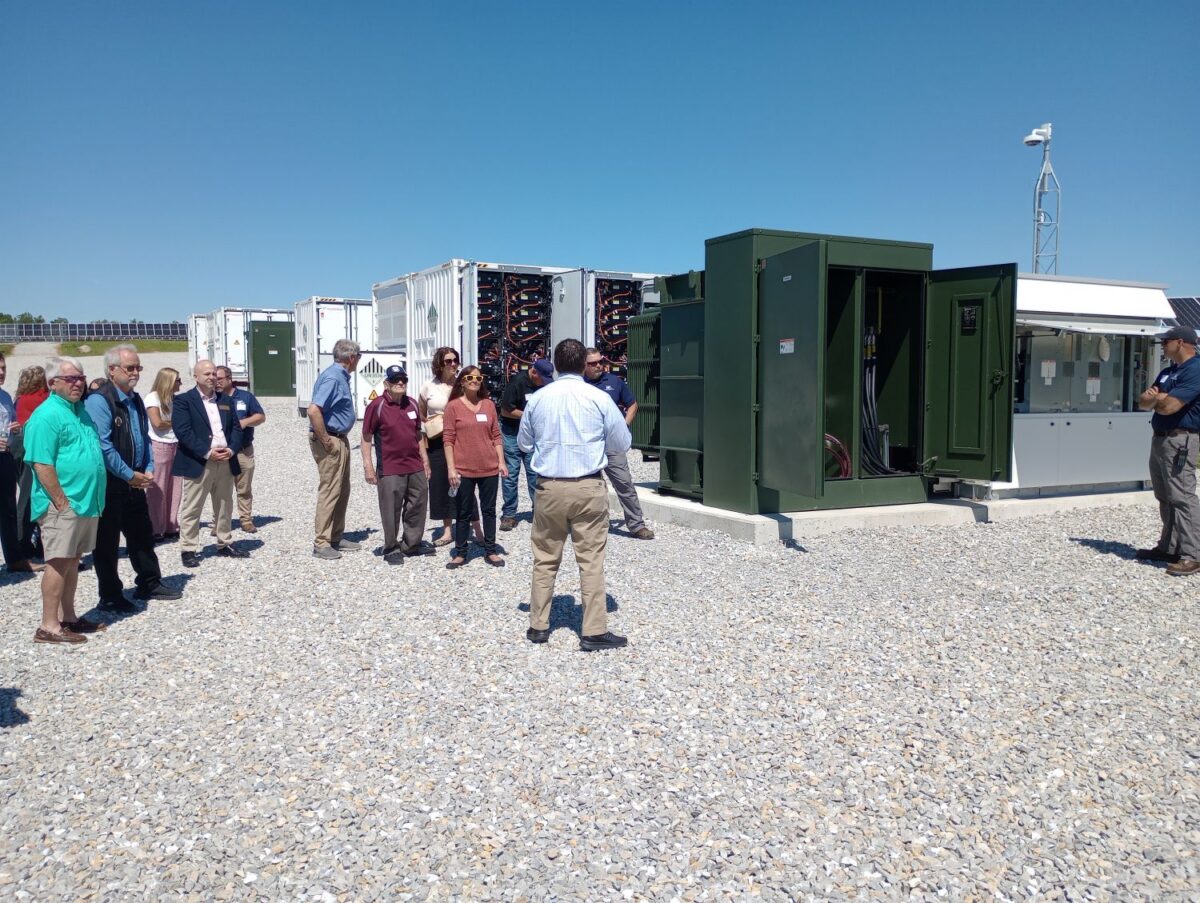
IMPA celebrated the battery system June 3 with a ribbon cutting and tours at the Richmond 6 solar park along Wernle Road. City administrators, RP&L representatives and other guests attended to see the system and learn more about it.
“I truly appreciate IMPA’s investment in our community,” said Doug Goss, a Richmond Common Council member and chair of RP&L’s board. “Their roots go deep here, and I’m glad that they trust Richmond enough to be the pilot program for their batteries. It’s pretty cool.”
Jack Alvey, a Richmond native and the president and CEO of IMPA, said Richmond is an important partner as one of the two biggest of IMPA’s 61 member communities, and the battery system is another step in IMPA’s mission “to deliver a low-cost and reliable power supply” while being environmentally responsible for its members.
The battery system consists of three inverters, with each having three battery containers and its own transformer. The battery containers each consist of almost 15,000 cells, according to Chris Sanders, IMPA’s vice president of generation.
IMPA charges the battery system, which tested at 6.9 megawatts, either from the park’s solar panels or from the electric grid when customers demand less power demand. IMPA then discharges the system for four hours during high-demand times when wholesale power prices are higher. Tony Foster, RP&L’s general manager, said the system functions as a peak-shaving tool to balance power costs.
“When IMPA is able to continue to provide us with low-cost power, that is passed along to our customers,” Foster said.
The battery system helped handle demand during cold winter months after it was commissioned Dec. 15.
“It really proved and came in handy when in those early morning hours we could release the battery discharge when we were seeing those peak loads at that point,” Alvey said.
IMPA will analyze the battery system and decide whether more batteries will become part of its power supply, complementing the 54 solar parks that generate 210 megawatts of power.
When the battery system is discharged, usually around sunrise or sunset when solar fields are not generating, the power goes directly to RP&L’s lines, serving RP&L customers. That’s the same as the city’s eight solar fields, which also provide lower-cost power. The ribbon cutting occurred during bright sunshine, and Foster said the solar parks were generating 37 megawatts of power while demand was 106 megawatts. That’s 35% of RP&L customers’ power usage supplied by the solar parks, without the Richmond 6 solar generation that was disabled for safety during the celebration.
“It’s produced here, stays here and legitimately feeds our customers,” Foster said.
Richmond solar parks can provide 100% of some substations’ power during sunny days. That includes an Industries Road park that feeds into the Midwest Industrial Park. Valerie Shaffer, president of the Economic Development Corp. of Wayne County, said RP&L’s renewable energy is attractive to businesses.
“It does help tremendously, because we often get asked by prospects and even existing tenants at the Midwest Industrial Park about green power consumption because most companies have renewable energy plans,” she said. “So having solar directly feeding our industrial park is a huge advantage because they are able to partially meet their renewable energy goals.”
A version of this article appeared in the June 10 2026 print edition of the Western Wayne News.