
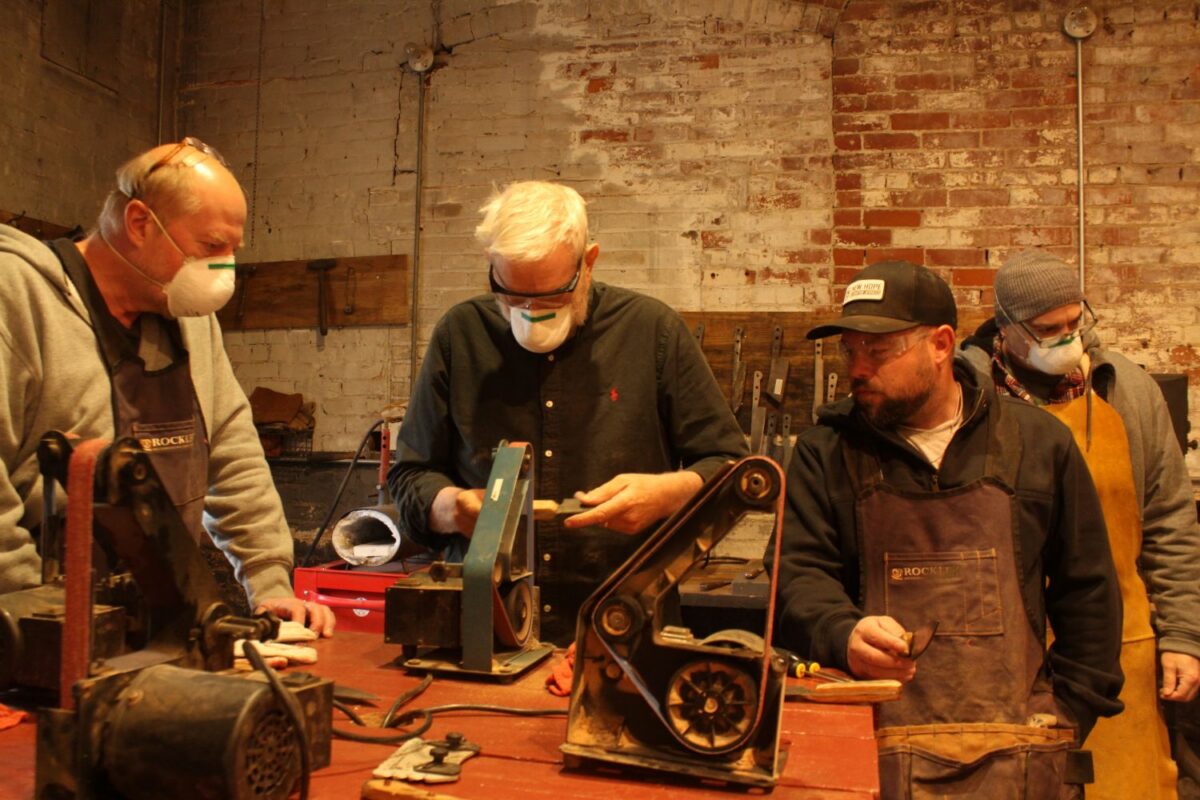
Henry Freeman likes history, old knives and the old wooden buildings in Wayne County. Nearly a decade ago he put the three together and started making knives the old way, using some of that old wood for the handles.
He teaches one-day classes where students walk out the door with their name etched on a knife they made. The knives are carbon steel, but what stands out are the wooden handles.
“The wood has to have a story … a history,” Freeman said. The students pick which wood they want. Choices include pieces of the floor joints from the house where Civil War-era Indiana Governor Oliver P. Morton lived, a barn built in 1823 and others from the area.
Freeman makes his knives and teaches his classes in the Henley factory built in 1892 that has seen quite a few things made within its walls.
“I work at a bench where people have been making stuff for nearly 150 years. This factory breathes history,” he said.
Freeman said he likes the “lived-in feel” of the factory at 523 N. 16th St., but it’s the other people working there that really make it special.
“It’s energizing being surrounded by creative people who appreciate history,” Freeman said.
Sam Stone is one of them. His Sam Stone Masonry has been in the factory since nonprofit Quaker City Cooperative bought it in 2021.
“We’re trying to restore the housing stock we have here in the area,” Stone said. He added he will work on any home, but likes to focus on ones built at least before 1950 and much older than that if possible, when construction was more a skilled craft and homes were built to last hundreds of years.
Stone said much of the building industry today just slaps up homes for maximum profit. Skills have been lost and there is a lack of pride in a lot of their work, he added.
Like Freeman, Stone has a deep appreciation for history and the spirit of the others working in the old factory.
“Every day it’s an inspiration from the people here,” Stone said.
About 10 people have set up shop in the factory with the Quaker City Cooperative, which aims to support melding the arts and practical trades, member Scott Bartel said.
That was Micajah Henley’s original charter with the factory he built in the late 1800s, Bartel said.
The Quaker City website at quakercity.org adds: “We enact a vision of local renewal — one that preserves our heritage and revitalizes our sense of shared life.”
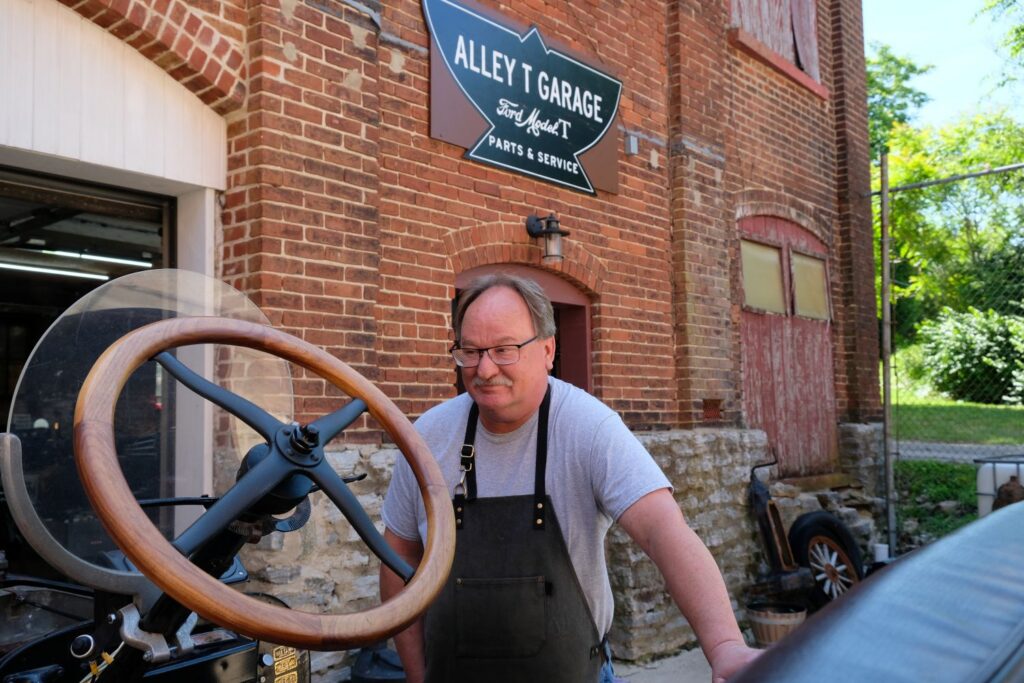
Henry Ford’s first Model T rolled off a Detroit assembly line Oct. 1, 1908. Before they stopped on May 26, 1927, there were more than 15 million of them. Today there are 300,000 of them left at most, said Mark Atkins, a restorer with Alley T Garage on the ground floor of the factory.
Atkins started restoring Model Ts years ago in his garage, then in 2024, moved into the Henley factory where he has space for four cars inside. It’s a good setup with ample space for the cars and numerous tools and parts, he said.
He prefers the older four-cylinder Model Ts with most parts still available that can be mailed within a couple days. The one exception is body work. When that is destroyed, you have to make it from scratch.
Atkins said he “maintains” the cars more than reconstructs them, but from the photos of a few he has worked on, it appears they had a lot of maintenance done.
He has stayed busy with people who hear about his work from other people. “I thought I might have one or two cars in here. I have 11 in line waiting,“ he said.
“I’m not in it to get rich,” Atkins said, adding that several friends volunteer and help, but that is as much about doing something interesting that they like than actual work.
The factory is a good location, it feels right, and it’s older than the first Model T, he said, and it’s being with other like-minded people that he really likes.
“I really like the community in the building. It’s a collection [of] people working in lost trades,” he said.
Micajah Henley built the factory in 1883, and at one point it produced more roller skates than the rest of the world combined. At other times bicycles were made there, and Henley reportedly sold Wilbur Wright, who lived two doors down on North 14th Street at the time, his first bicycle.
Henley was a Richmond mover and shaker who held more than 20 patents, including for the roller skates that strap onto shoes to make any footwear mobile.
Another was the old non-motorized “reel” lawnmowers. Other things were made at different times, and the factory employed about 300 workers at its height.
Some of the history has been lost, Bartel said; it’s unclear if there really was a roller skating rink on the ground floor.
But history lives there now, with cottage industries keeping it alive and relevant. A dose of idealism lives there, too.
Mick Elmore contributes to WWN as a part of our writer’s network.
A version of this article appeared in the June 10 2026 print edition of the Western Wayne News.