

Forward Wayne County provided a status report on its Big Indicators of Success plan five years into launch. The six community-wide goals set in 2020 focused on ways to collectively improve work conditions across the county.
Among the wins, the county hit its population target and made measurable progress on wages, educational attainment and assessed value. However, room for improvement awaits poverty reduction and three pre-pandemic initiatives.
“We set these goals in a very different world, and then a pandemic landed in the middle of them,” said Acacia St. John, director of Forward Wayne County, in a news release. “What matters is that Wayne County kept moving. Our population did not fall as projections said it would. Wages went up. More of our neighbors hold a credential or a degree than five years ago. We are going to celebrate every one of those wins, no matter how small, because each one represents real work by real people in this community.”
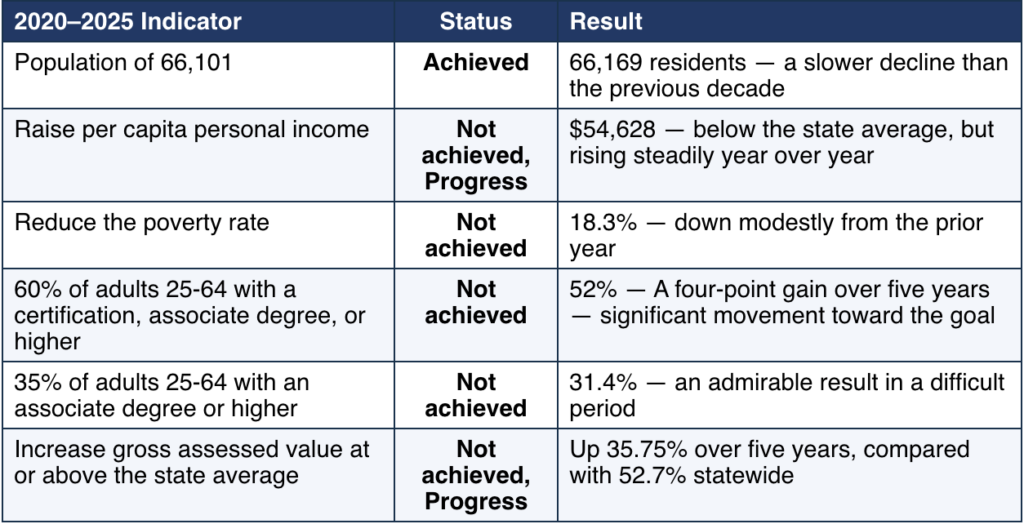
According to the press release, Wayne County surpassed its population target of 66,101 with 66,169 residents for the period. And personal income per capita was $54,628. While still below the Indiana average, it is a steady year-over-year increase.
The number of adults 25 to 64 with a certification, associate degree or higher reached 52%, a meaningful shift and four-point gain over the period. Similarly, 31.4% of adults in that same range earned a degree. Neither figure met its mark, but hundreds of residents completed some form of training or earned a credential.
The goal for gross assessed value missed matching the state’s 52.7% figure, growing to 35.75%. However, one-third increase in the county’s tax base represents substantial private investment in property and development. Finally, the poverty rate topped out at 18.3%.
Moving forward, FWC’s Steering Committee has activated a new strategic plan through 2033, known as 7inSeven. The countywide initiative incorporates seven metrics for success: population, assessed value, per-capita income, recreational amenities, housing units, revitalization and beautification, and placemaking and arts.
While the first three are standard metrics to use as benchmarks in comparison to other counties, the last four draw attention to the physical and cultural fabric of the county — from where we gather and live to the cultural portfolio that varied attractions creates.
“Comparison benchmarks tell you where you stand. Neighborhoods, housing, Main Streets and the arts tell you who you are,” said Rebecca Gilliam, executive director of the Wayne County Foundation, in the news release. “Those are the things people actually point to when they talk about home. 7inSeven measures both and that’s by design.”
St. John said the new initiative is currently active. Data will be reported in quarter one of 2027.
Visit wwn.to/wcsip26 for the full strategic investment plan document.
A version of this article appeared in the September 2 2026 print edition of the Western Wayne News.