
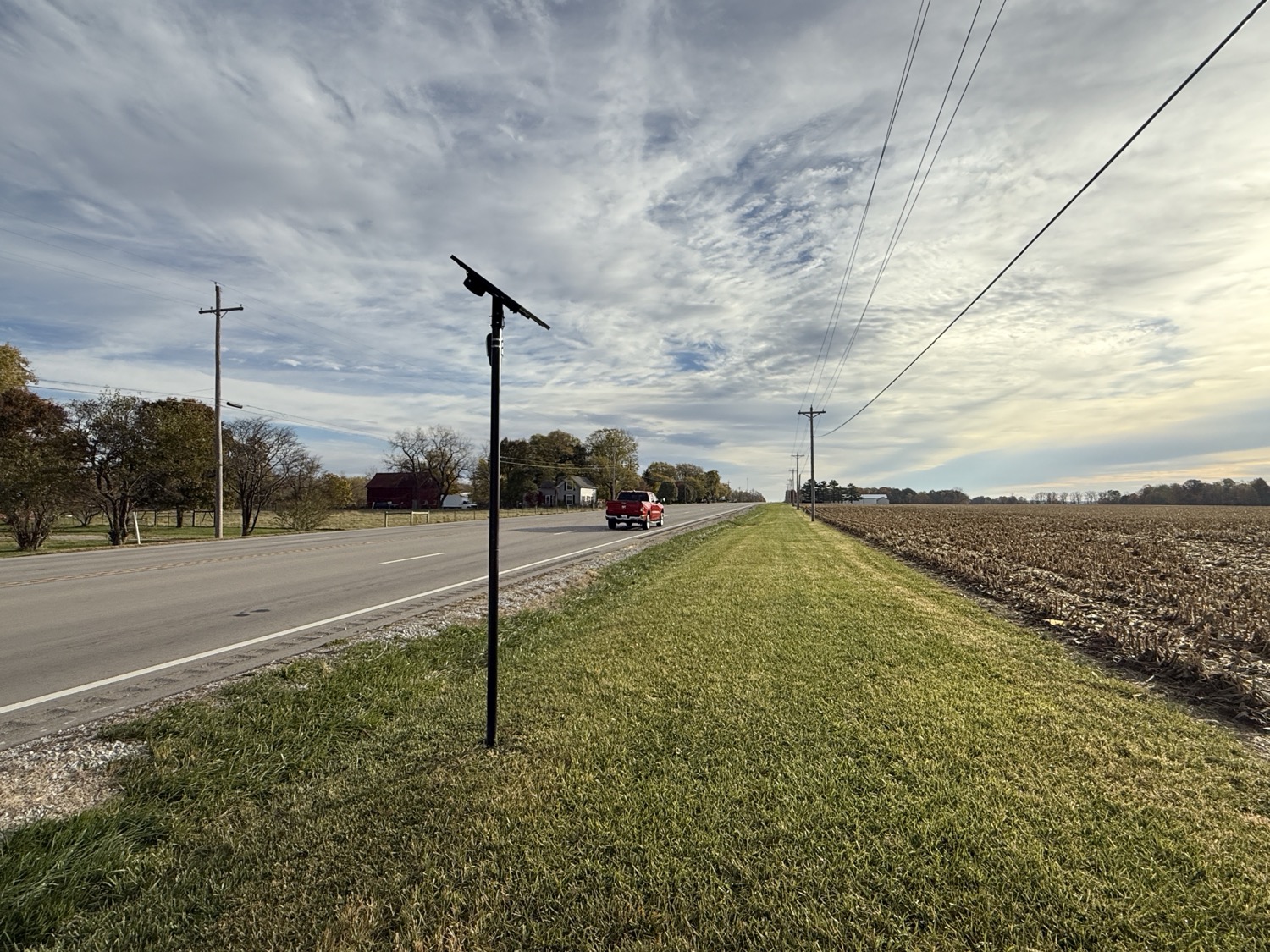

Cameras being installed on Wayne County roads are slowly but surely connecting the community to a nationwide, privately owned surveillance network. Local law enforcement officials say images captured by the devices will increase public safety, while officials and courts in other areas that have used them are reconsidering the invasion of privacy they may represent.
Law enforcement agencies have long used technology to investigate and solve crimes, including video cameras. However, the latest generation of interconnected devices, software that can instantly recognize faces, vehicles and other personal details and upload them to a central online database accessible from anywhere means that residents’ privacy might be getting harder to protect.
A website that collects sightings of automatic license plate reader devices, deflock.me, shows at least eight of these devices visibly installed on Wayne County roadways.

Additional devices could be installed in a way that is concealed from view.
Milton installed two Flock automatic license plate reader devices in town in September. The Town of Cambridge City also recently accepted a $6,000 donation from American Legion Post 169 to purchase and install two Flock devices. Another pair of Flock devices can be found watching traffic on U.S. 40 near Centerville. The Richmond Police Department says it operates two automatic license plate readers, or ALPRs, made by a different vendor along high-traffic routes, but didn’t disclose the locations.
Sgt. Seth Biava with the Cambridge City Police Department says the devices, which are expected to be installed in the town within the next few months, will “allow us to quickly identify vehicles connected to criminal activity, locate stolen vehicles and develop leads for investigations.” He said the devices provide “real-time data that enhances officer safety and improves our ability to respond effectively to incidents.”
Connected devices raise concerns
Flock, an Atlanta-based company founded in 2017, has built a network of ALPRs, cameras and gunfire detection devices that span 5,000 communities across the country. Their cameras take multiple timestamped images of every vehicle that passes by, and the company collects that information for use by its law enforcement customers.

While their pervasive presence is appealing for public safety organizations wanting to track down suspects, the company has also faced criticism from lawmakers and privacy advocates who say the data they collect is ripe for abuse and overreach by authorities. An official in Wayne County can ostensibly search not only images captured here, but also anywhere else in the country where a Flock device is used — and vice versa.
404 Media reported in May that a sheriff’s deputy with the Johnson County Sheriff’s Office in Texas was found to be accessing nationwide ALPR data to track a woman they believed had an abortion, while claiming to be searching for a missing person. Flock data searches do not generally require a court order or warrant, according to the 404 article; some civil rights organizations say this is unconstitutional.
Flock also doesn’t require standard security enhancements for law enforcement login accounts, leaving some departments open to having their cameras accessed by unauthorized users if insecure passwords are chosen. A recent breach published online exposed 85 sets of login credentials, including some from government, police department, and sheriff office email addresses in Atlanta, Missouri, Michigan, Ohio, Oklahoma, and Texas, according to 404 Media.
Biava says that Cambridge City’s cameras will not use facial recognition features, enforce minor traffic violations or track individuals. “LPR cameras focus solely on vehicle-related data visible in public spaces, ensuring a balance between effective policing and the protection of individual privacy,” Biava said.
Milton has a transparency page describing how the cameras are used, transparency.flocksafety.com/milton-in-pd, and it says facial recognition, people, gender and race are not detected. Prohibited uses include immigration or traffic enforcement, harassment or intimidation, usage based solely on a protected class (such as religion, race and sex) and personal use.
Chief Keith Folkner with the Hagerstown Police Department says HPD does not use and has no plans to use the ALPR devices, but does make use of devices that Wayne County Sheriff’s Office owns, and has other cameras that capture intersections and alleyways.
“LPR photos are used for investigations and allow officers in real time to be made aware of vehicles that have expired plates, stolen plates or vehicles, suspended drivers and wanted individuals,” Folkner told WWN. “Town cameras are only used for investigation purposes if a crime has been committed.”
Multiple attempts by WWN to contact the Centerville Police Department and the Wayne County Sheriff’s Office by phone and email over the course of two weeks for comment on this story were not returned. A public records request sent to the county asking for information about what cameras it uses and how they are used was received and is still pending a response as of press time.
RPD officials say that their cameras, made by Vigilant Solutions, only capture still images of license plates, and do not record audio, use facial recognition or connect to gunshot detection systems.
Vigilant’s cameras are advertised as having infrared technology that can capture vehicles moving up to 150 miles per hour in zero light conditions. The cameras can scan as far as 125 feet away in almost any weather.
RPD Major Adam Blanton said, “the technology is not used for continuous tracking or surveillance of residents.” He also said every search query performed is logged and audited.
Cameras becoming ‘instrumental’ for police
Officials note that the devices are already helping to address public safety incidents. Folkner said town camera images were used to identify a vehicle in a hit-and-run incident. Biava said they’ve been instrumental in several investigations, “assisting with cases involving suspended drivers, stolen vehicles, stolen license plates, drugs and missing individuals.”
Blanton said “ALPR data has directly supported stolen-vehicle recoveries and the apprehension of wanted persons, helping officers resolve cases more quickly and safely.” He noted that the system has provided other leads that helped investigations.
Privacy advocates have also raised concerns about how long data collected by the devices are stored, and how that data might be transferred or accessed later. If a vehicle isn’t under suspicion today but records of it traveling certain routes can be accessed long into the future, it begins to create a significant profile of resident activities and destinations.
Most of the law enforcement agencies responding to WWN questions noted that data would be stored for 30 days if it wasn’t needed for an active investigation, but offered caveats like “unless required by law” or unless there are regulations that specify “a different retention period.” Individual departments are also allowed to decide what state, federal or other agencies they share their data with, and those agencies could have different retention policies.
“I feel the community should be happy to have these resources as it makes our community safer,” Folkner said. “This information is not used for anything other than enforcing the law or community safety.”
Courts are still catching up to these technological changes, and while they have not traditionally found that capturing a single license plate image would constitute an unconstitutional violation of privacy, they’ve yet to decide whether compiling and aggregating information across many image captures does cross that line.
A few weeks ago, a judge in Washington state ruled that all images taken by Flock cameras are public records that can be requested as a part of normal records requests, according to 404 Media. If that ruling extends to the entire Flock network, you might soon be able to request the images of your car — or any vehicle — that Flock cameras see go by.
“We understand community concerns about surveillance technology,” Blanton told WWN. “Our ALPR program is designed with privacy protections, short retention periods and strict auditing. The system is a modern investigative tool—not a tracking device.”
A version of this article appeared in the November 19 2025 print edition of the Western Wayne News.