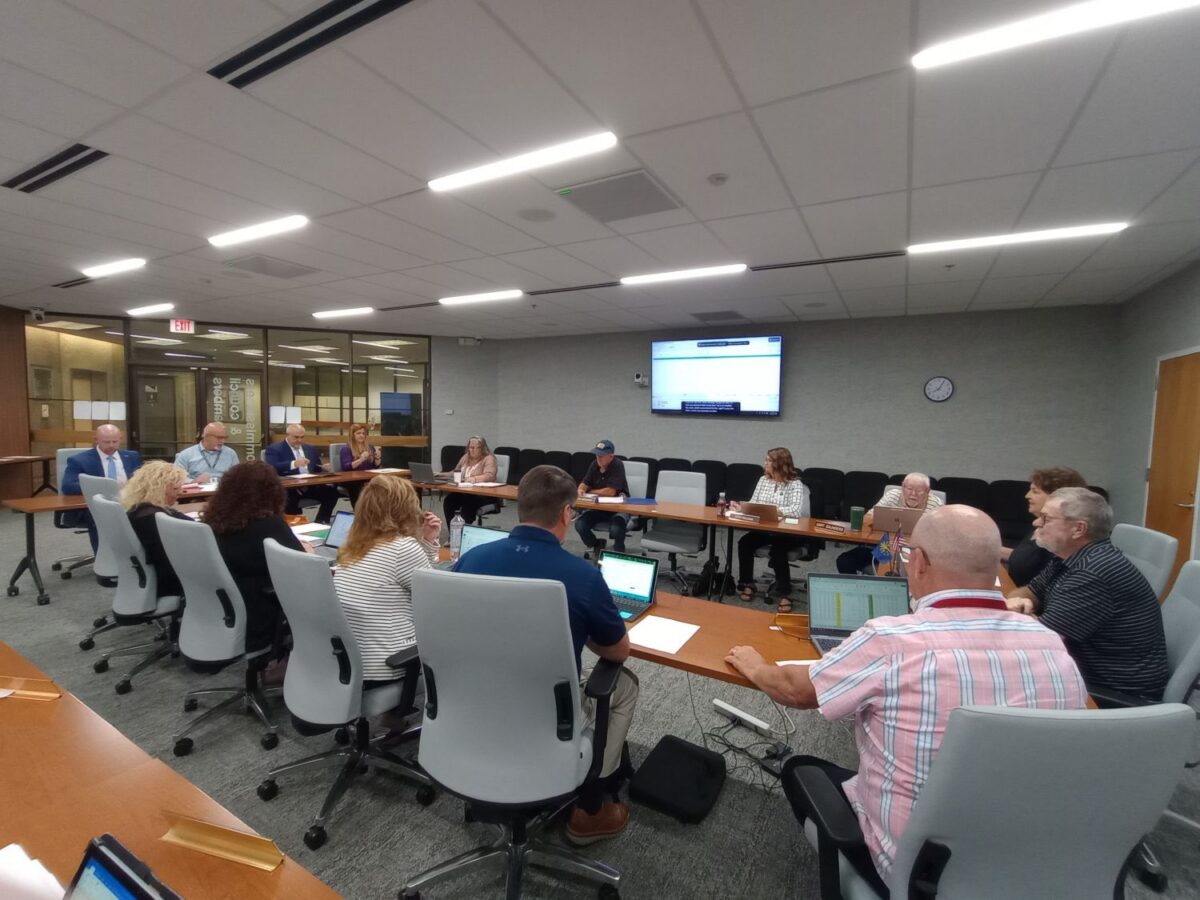
For about five hours July 22, Wayne County department heads and elected officials made modest budget requests to the county council members who control county finances.
There were unavoidable increases, such as for dues, travel or increasing maintenance contracts, but requests for new positions were completely absent. By comparison, in 2022 council received 13 requests for new positions when beginning 2023 budget discussions.
“This is fantastic compared to years prior,” said Beth Leisure, chair of council’s finance committee, which still must hear from the sheriff’s department, the coroner’s office and Purdue Extension. “We had zero asks for new employees, so we’re on the right track.”
However, council isn’t yet sure where that track leads. Council passed a $40 million general fund budget for 2026, but where that budget could land in 2027 remains unknown.
During the subsequent July 22 county workshop, council selected Indianapolis-based C.L. Coonrod & Company to serve as its financial advisor. Coonrod will provide a projected revenue that quantifies losses because of property tax caps. Then, council can begin matching the budget to available funding.
“They will also help show us how to make sure that our budget’s balanced and that it’s doable the next three years or so,” Leisure said about the consultant.
The state legislature this year did not limit the growth quotient applied to tax levies. While the quotient had been restricted to 4% in previous years, it’s 6% for 2027. Leisure said council hasn’t decided yet whether to collect all of the extra revenue or not, a decision that will impact property tax rates.
Amy Chenowith, who’s running unopposed to become the next auditor, will provide council with how much each 1% of an across-the-board raise costs and the cost of continuing the county’s longevity stipend. Those figures will also factor into budget decisions.
There were some requests that council will cover with its one-time expenditures line item rather than in departmental budgets. Council put $6 million in that line to ensure the Indiana Department of Local Government Finance would permit the county’s entire tax levy, but fully expects to remove about half of that.
New election equipment, a money counter for the treasurer’s office, five cars and related equipment for the sheriff, and increased expenses for a Fountain City Pike bridge project are already slated to use one-time funding. Council also contributes $150,000 annually from that line toward the highway department’s capital purchases. Mike Sharp, the highway supervisor, budgeted $679,000 to buy a pull broom, broom grader, sign truck, crew-cap truck and asphalt distributor.
Sharp said the county received a $399,500 lane-mile payment this year from the state. Council enacted local option highway user taxes this year to become eligible for the lane-mile payments. Sharp also told council that he has contracted for 800 tons of salt at $139 per ton after the Indiana Department of Transportation’s Greenfield District did not receive bids for salt purchased by its communities.
In personnel issues, the probation department is one of 16 counties notified it will receive an Indiana Department of Correction grant. The grant has paid for an employee probation moved into its general fund budget after being told the grant would end. However, how much the grant covers is unknown. Also, council opted to leave full-time money in the auditor’s grant clerk position although it’s been a part-time position. Chenowith said that she would request it be a full-time position.
The commissioners budget includes several unknowns. Contracts to run the Hagerstown transfer station and to provide countywide ambulance service expire at the end of 2026. Commissioners will explore providers and lock in contracts prior to the budget’s passage this fall.
The emergency management and 911 budgets both include increases related to new emergency communications towers and county volunteer fire departments transitioning to 800 megahertz radios. The EMA budget includes an extra $6,800 to pay utilities at the tower sites, and the 911 budget is absorbing a $79,000 cost for Motorola’s maintenance of equipment at the towers. The maintenance contract required a $20,000 budget increase.
Council also received budget requests from the Wayne County Convention and Tourism Bureau and the Economic Development Corp. of Wayne County. The projected tourism budget, which is funded entirely by an innkeeper’s tax, is $1,250,000, and the projected EDC budget, which is funded by communities’ economic development income tax contributions, is $829,312.53.
Council member Misty Hollis, who is not seeking reelection in District 4, expressed concern about security at the Wayne County Administration Building and about council members’ salaries. Without naming any specific deficiencies, she said the county is not fulfilling its responsibility to annex building workers with the current security measures. Hollis also said the job responsibilities for council members, who receive about $15,000, are changing dramatically because of new state legislation. During 2028, council must enact local income taxes that impact other taxing units.
A version of this article appeared in the July 29 2026 print edition of the Western Wayne News.