

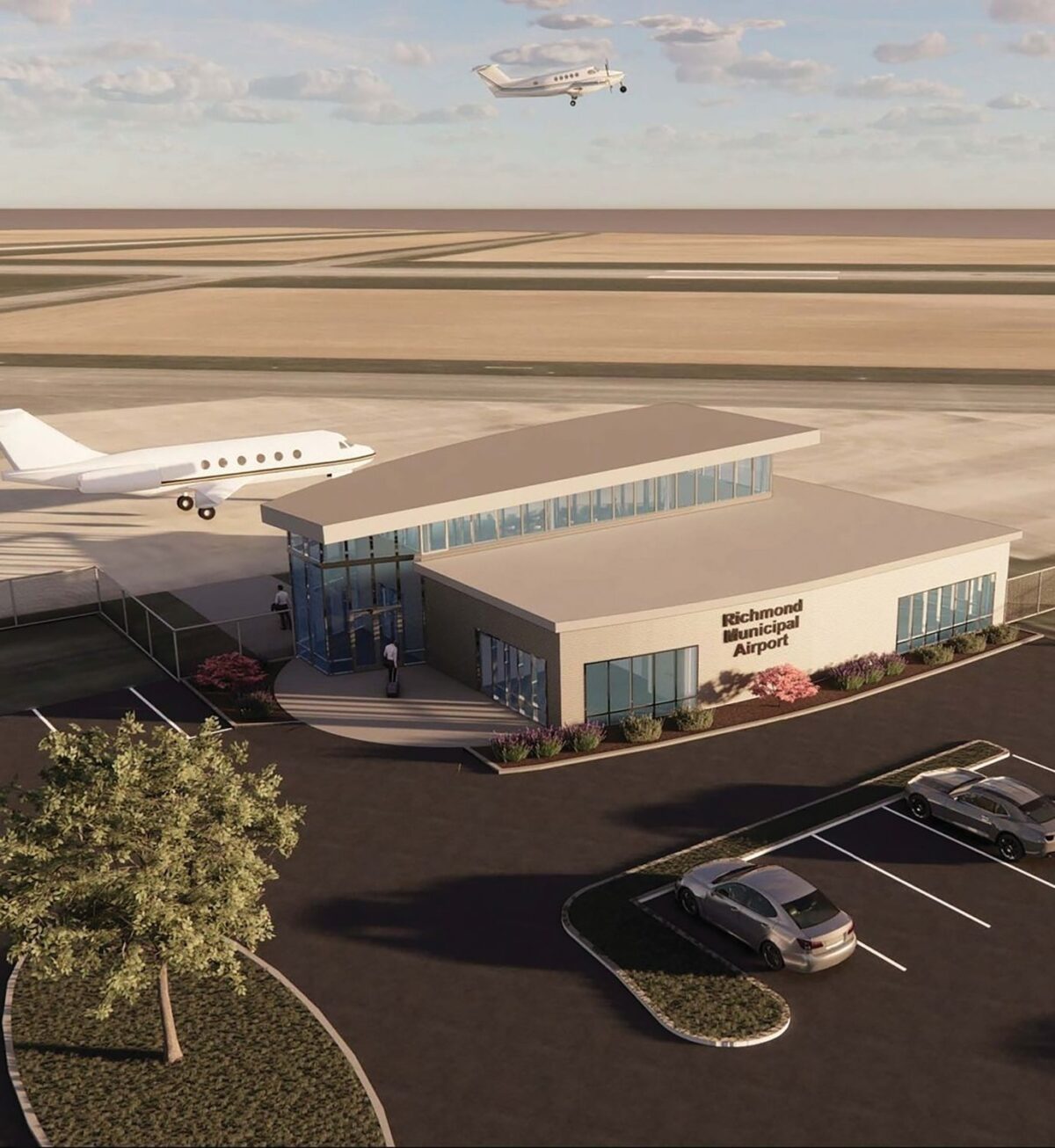
Richmond Municipal Airport serves as a gateway to the city for flyers, providing a first impression as U.S. 40 and U.S. 27 do for motorists.
Jonathan Meade, president of the city’s Aviation Board, told Richmond Redevelopment Commission members a planned new terminal building would provide a welcoming environment for those flying into the city. Meade updated the commission on the airport design and its financing during its Jan. 20 meeting.
The city has applied for a $1.4 million grant from the Federal Aviation Administration, which has funding available through the federal Bipartisan Infrastructure Law. Meade said hopes run high that the city will be selected because it has a shovel-ready project and the FAA contributed to the terminal design with a $257,165 grant last year.

“If we get that grant, we’re golden,” Meade said.
The Aviation Board, however, is considering funding alternatives should the FAA not award the grant. The options include requests for $250,000 in redevelopment funds in 2026 and again in 2027. Meade said the Aviation Board hopes to receive the FAA’s funding decision by the April bidding for the project; however, he said the FAA is “not historically speedy” with grant decisions.
The total project cost is anticipated at $3,056,000, including an estimated $2,425,000 for construction. Costs include $191,000 for LWC Inc.’s design work, $45,000 for project management, $245,000 for site preparation and $150,000 for furnishings.
Funding already secured totals $2,088,200. That includes federal, state and city money; a $200,000 private contribution; and $750,000 from airport funds that Meade said cuts airport finances to the bare bones. That leaves a $967,800 shortfall the FAA grant would cover.
If that grant is not received, however, possible alternative funding sources include terminal and other naming rights, a donation wall and the redevelopment request. Meade said businesses could consider donations appealing, because “I don’t think people realize how many businesses use the airport.”
The new terminal will be closer to the apron and runways than the current terminal. That enables the current terminal to remain open during construction and puts the new terminal closer to where passengers board and disembark planes. The new terminal will feature three times more passenger waiting space, Americans with Disabilities Act-compliant restrooms, after-hours pilot access and a community room, plus large windows and a patio with runway views.
A news release from the city said the terminal improvements will improve passenger and pilot services, as well as better support business aviation, air cargo and emergency response operations. The terminal is expected to make the airport more attractive to current businesses and employers considering the region.
“This project is about investing in infrastructure that supports economic growth and long-term sustainability,” said Rodney Mayse, the airport manager, in the release.
Parks projects
Jason Semler of Baker Tilly Municipal Advisors presented commission members information about how food and beverage tax money can finance planned Richmond Parks and Recreation Department projects.
Richmond Common Council enacted the 1% tax in December, and it takes effect March 1. The city likely won’t receive tax payments until May, and Semler said several months will be needed to understand how much the city might receive before initiating a bond sale. The food and beverage tax revenue, currently projected up to $1.5 million annually, would pay the annual bond debt.
In the meantime, the parks department wants to begin priority projects immediately. Semler said the city can use bond anticipation notes, which are short-term debt instruments, to quickly receive cash that serves as a bridge to a long-term bond sale. Those notes, however, would require payments before bond issuance.
Food and beverage tax revenue would be used for the payments, and could be supplemented, if needed, by tax increment finance collections, Semler said. The city would anticipate closing on bond anticipation notes in March or April, but to get a jump on projects, some expenses could occur before that timeline. In that instance, the city could ask to borrow redevelopment funds that would be repaid from the bond notes.
No decision was made, and the topic will likely again be addressed during the commission’s Feb. 17 meeting.
A version of this article appeared in the January 28 2026 print edition of the Western Wayne News.