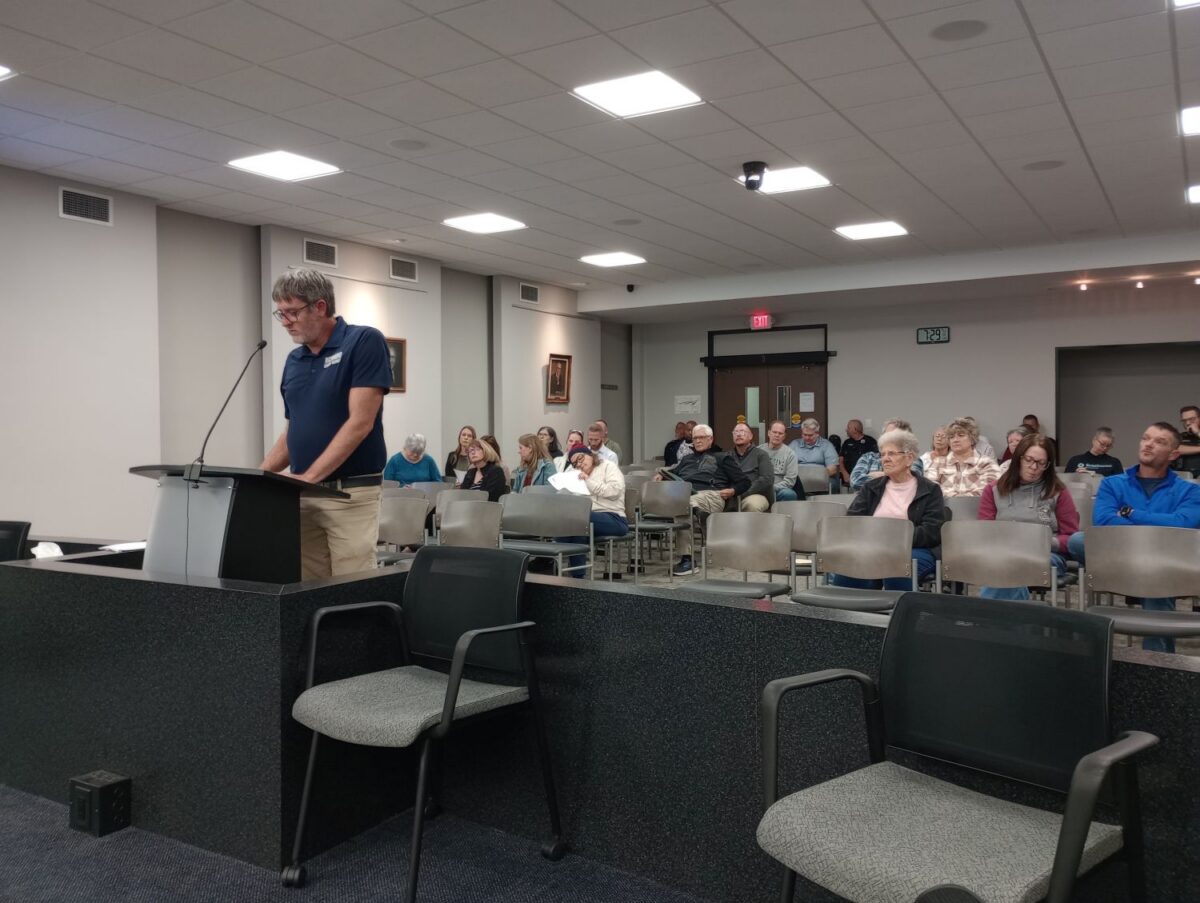
After more than a year’s delay, Richmond Common Council members will decide Nov. 16 whether residents see four years of sewer and storm water rate increases.
Council tabled on Sept. 2, 2025, the ordinance proposing the hikes to fund sewer expansion for the Midwest Industrial Park; however, Pat Smoker, director of Richmond Sanitary District, brought the ordinance back before council during its Nov. 2 meeting. The project is now eligible for a lower interest rate through the Indiana Finance Authority’s State Revolving Loan Fund.
Residents, though, oppose paying higher rates when industry benefits, not them.
“Put the onus of the expenses on the shoulders of those who would be serviced by it,” Theresa Whittaker said.
Her Woodlawn Avenue neighborhood has an “untenable” storm water situation and is boggy 10 months of the year, Whittaker said, adding that residents expected to pay higher rates should receive better services.
Eric Rastbichler agreed that only industry benefits from the project, which was estimated in 2022 to cost $38 million across three phases that would boost sewer capacity from 290,000 gallons per day to more than 2 million gallons.
“If that’s the case, why not put the burden on them and leave the residents alone?” he said.
The ordinance proposes 6% annual increases for four years. Since a third consecutive annual increase took effect Jan. 1, 2025, residential customers pay a monthly flat fee based on meter size, which is $28.55 for the standard five-eighths or three-quarters-inch water meters, plus $6.67 per 1,000 gallons of water used and a $6 monthly storm water fee. Customers without water meters, such as those with wells, pay $61.67 per month.
Dan Lahrman, who has a well, said the charge for unmetered customers is unfair. It’s not based on anything, such as number of people in the household, he said, meaning he and his wife pay the same fee as large families.
Council member Jerry Purcell said he helped explore ways to fund the project without raising fees 24% in four phases. The search was ultimately unsuccessful.
“To put this rate increase on all of our citizens for our business park is not a situation I see as fair,” Purcell said.
During 2022, the city and county combined to purchase 326 acres to expand the Midwest Industrial Park. Valerie Shaffer, president of the Economic Development Corp. of Wayne County, said 500 acres are ready for development, but inadequate sewer capacity makes the park noncompetitive when trying to attract industrial tenants. It also impacts current tenants at the Midwest and Northwest industrial parks.
“We have to ensure that businesses who have invested millions of dollars in this community have the ability to sustain their operations and grow their operations as it’s demanded by their customers,” Shaffer said.
Smoker said the project not qualifying for State Revolving Fund loans was not surprising because it’s not a regulatory-mandated project. However, other projects withdrew from funding this year, and the sanitary district was informed in July that it could receive funding. The lower interest rate would reduce the sanitary district’s payback amount by about $5 million; however, cost increases because of the year’s delay effectively negate the savings, Smoker said. Still, he does not think the project would qualify for the state loan again.
Council member Gary Turner said that developing the industrial park would create new tax increment financing revenue.
“I’d love to be collecting it now, obviously, so that we could pay down this debt, but we can’t collect it until there’s industry out there,” Turner said. “But once it’s there, there will be a tremendous increase in revenue for us that will hopefully offset the problem that we have now.”
Purcell asked if council could pass a companion ordinance to prohibit public financing, such as TIF funds, for industries moving to the industrial park.
“If we’re going to use the argument that it increases the tax base, then let’s increase the tax base,” Purcell said.
A.J. Sickmann, the city attorney, advised the city should ask consultant Baker Tilly about that, because TIF funding usually serves as the companies’ bond repayment source.
A version of this article will appear in the November 11 2026 print edition of the Western Wayne News.