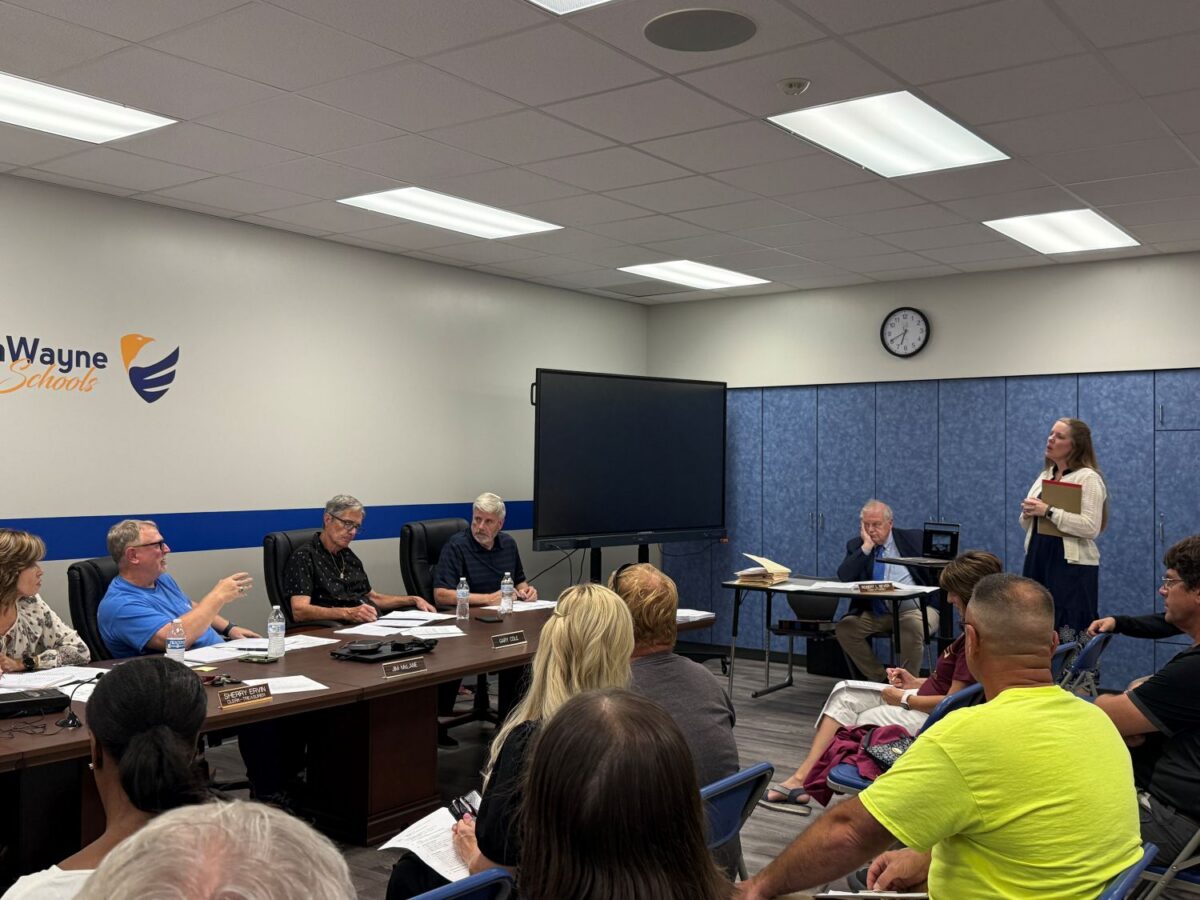
The burden of repairing and rebuilding Cambridge City’s civil infrastructure after August flooding weighed heavily on town leaders during an Oct. 12 town council meeting. But with growing public and private financial support options emerging and groups from around the community contributing time and labor, projects are moving forward.
Acknowledging that providing safe and reliable water to residents is a core responsibility, council members moved to pursue nearly $1 million in assistance from a rapid funding flood relief program from Indiana Bond Bank. Attorney Brenda DeVries with Bose McKinney & Evans LLP presented the option to council, saying IBB is offering bonds with a low 2% interest rate and no interest or principal due for two years. Bond funds have to be used for repairs to water infrastructure only.
DeVries recommended structuring the bond as $650K from future water revenues and $350K from a general obligation bond. Council will have two years to figure out how repayment financing could work and noted that part of the bonds could be repaid with property tax revenue.
With potential cost estimates for making long-term fixes to Cambridge City’s water plant approaching $2.4 million, bills already piling up, and some uncertainty about when and how federal emergency dollars would come, council members agreed to move forward.
A tight timeline pushed council members to suspend normal procedure and introduce, advance and approve adopting an ordinance to take on the bonds. A related appropriation ordinance will require a public hearing being advertised for council’s Nov. 9 meeting, when the funds can then be approved for appropriation into the 2026 budget.
“The greatest need of our town is water,” council member Jim King said. While the fast-tracked approval was unusual for council, King said it was the prudent thing to do and that a lot of forethought had gone into the process.
Damaged structure reassessment
Council also voted to join an Indiana Department of Homeland Security program that will send Tetra Tech specialist teams to reassess about 200 flood-damaged structures.
The reassessments will determine whether buildings are “substantially damaged,” meaning repair costs equal 50% or more of preflood market value, which triggers stricter rebuilding rules.
Initial notices sent to building owners looked mainly at water depth, so some estimates may be too high. Teams were expected to begin Oct. 14 and finish in under two weeks.
Owners pay nothing, and after Federal Emergency Management Agency and state contributions, the town expects to end up paying for about 6.25% of the cost.
Floodway properties will be prioritized, and existing permitted work can largely continue.
Dumpster dollars
Council reviewed a request from the American Legion to have some of its flood recovery dumpster costs reimbursed. Council President Jim McLane said FEMA’s requirements mean those costs wouldn’t qualify because they were not a part of the town’s documented debris removal project. The town itself faces about $90,000 in dumpster bills.
In other business
- Budget: Council adopted the town’s 2027 budget, which has the same bottom line as last year’s.
- Public works and floodplain administrator Joe Webb reported that at the water plant, new electrical panels, variable frequency drives and air conditioning units are installed. Crews are waiting on a contractor to start up the plant so it can move off a generator and onto Duke Energy power. The town is renting a backup generator monthly after the flooded one was declared a loss. A replacement will be on next month’s meeting agenda.
- Youth league: Cambridge City Youth League Commissioner Nate Criswell said volunteers have cleaned out and power washed the concession building, and Oler Fencing plans to repair or replace the downed fences as a donation. The league needs the town’s direction on funding by Dec. 1 to prepare for 2027 signups, which usually open Jan. 1. Needs include freezers, cabinetry, flooring, ceilings and electrical work, plus an estimated six new breaker boxes. Running a season costs $13,000 to $15,000. McLane said in-kind donations will need to be tracked carefully.
- Fire department: Council approved splitting firefighters’ clothing and vehicle allowances with Jackson Township after the General Assembly raised the state minimums to $250 each. Cambridge City will pay half of the township’s share, cutting what could have been a $6,000 expense. Council also approved buying a 2027 Ram 3500 Tradesman from Wetzel for $49,684 after comparing bids, and a skid unit with installation from THL for $21,890. Chief Jeff Gabbard said the insurer’s settlement for the flooded 2018 Ram is $79,000.
- Council accepted a $350 Golden Corral donation for trick-or-treat candy and 24 smoke detectors from Koorsen Fire and Safety to replace ones lost in the flood. The fire department will install them for residents in need, with a maximum of two per house.
- Council accepted $550 from Marilyn Lyons and $70 from an anonymous donor to the feral cat fund, plus $4,232.33 from Amanda Minick, owner of the Whiskey Wrangler Mercantile in Brookville, who raised flood relief money by selling T-shirts.
- Donations to the town flood fund also continue to help replace downtown Christmas lights and wreaths lost in the flood, which were not covered by flood insurance. Replacement is estimated at $8,000 to $10,000.
The next council meeting is 6 p.m. Monday, Nov. 9, at the middle/high school, 205 E. Parkway Drive, Cambridge City. The public may attend.
A version of this article will appear in the October 21 2026 print edition of the Western Wayne News.