

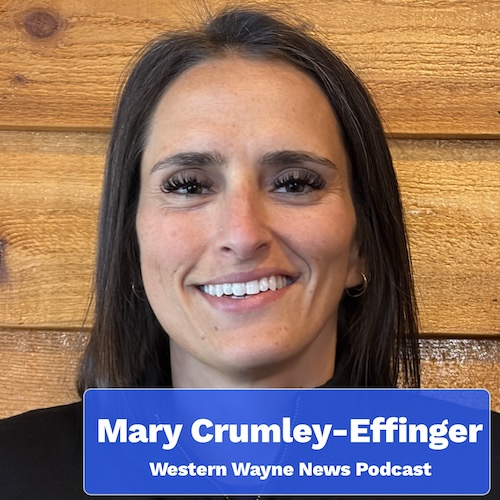

In this episode of the Western Wayne News podcast, Kate Jetmore sits down with Mary Crumley-Effinger, managing partner of the Richmond Texas Roadhouse, to talk about growing up in Richmond and Wayne County, choosing to stay, and building a career here from the ground up. Mary shares her path from hostess to restaurant owner, her deep ties to the community through the Richmond Rotary Club, and a candid look at a health journey that culminated in running her first half marathon in November. Enjoy!
Transcript
Mary Crumley-Effinger: I’m Mary Crumley-Effinger, managing partner of the Texas Roadhouse in Richmond, Indiana.
Kate Jetmore: From Civic Spark Media and the Western Wayne News in Wayne County, Indiana, I’m Kate Jetmore. As a native of Richmond, Indiana, I’m excited to be sitting down with some of our neighbors and listening to the stories that define our community.
My guest today is Mary Crumley-Effinger, a lifelong resident who graduated from RHS in 2009 and from Earlham College in 2013. She has worked for Texas Roadhouse for the last 17 years and has been a member of the Richmond Rotary Club for 11 years. She loves to spend time with friends and family, stay active, read, listen to audiobooks and podcasts, and travel extensively, both domestically and abroad. Mary has been on a health journey for the last four years, losing a total of 130 pounds, and just completed her first half marathon in November.
Welcome, Mary. Thanks so much for joining me today.
Mary Crumley-Effinger: Thank you so much for having me.
Kate Jetmore: Tell us a bit about what it was like to grow up in Richmond and your decision to stay in the area after finishing high school.
Mary Crumley-Effinger: Absolutely. So for me, growing up in Richmond, Indiana was also growing up at Earlham College. And even though I didn’t study there until after high school, my mother worked there my entire life. So, so much of my community was the Earlham community as well. So that was a big part of my life and childhood because my parents live right next to the campus.
But growing up in Richmond was so much fun. I had many friends who lived just down the street. And being in just a great community was something that I’m so grateful for.
And while my family, my extended family, did not live close by, we had such a sense of community and family in Richmond. And I think that is one reason why Richmond will always be home to me.
And I would say for me, if you had told high school Mary that I lived in Richmond now, she would call you a liar and tell you you were crazy. Because there was nothing I would say more than, I’m getting out of here. But when it’s time in high school to go visit colleges, I told my parents I’m not going to Earlham. It’s not happening. I’m going away.
So we visited schools, and the more schools I visited, the more I compared them to Earlham. And I was like, well, this is great, but at Earlham there’s this, and I like it better. And I think I had pretty much everyone was convinced that I was not going to Earlham.
And I was like, I got into IU, and I was like, I’m going to go to IU. And then I pulled the 360. And I was like, No, I’m going to Earlham. Because no matter where I went, and no matter I was like, I can’t stay in Richmond.
I was like, Earlham is the place for me. And I could not be more grateful for that decision. And I think that one thing for me that gave me a lot of success, and advice that I give to other people from Richmond that go to Earlham is… when you go to Earlham, especially in that first year, you go to Earlham. You live on campus, if possible. And you really, not like leave your high school friends or your Richmond friends behind, but you create that space during that beginning time of your studies at Earlham. Because I think that really helps for the success of becoming an Earlham student, as opposed to someone who lives in Richmond and goes to Earlham.
Because I think that is where some people fail to have that success. Because while Earlham is amazing and so fun, it’s also really hard. And so being focused on school and not also trying to keep up with what you did before starting Earlham was very important to me because Earlham was really challenging, especially in my first year.
I remember calling my parents a lot with just how hard the schoolwork was. And so being at Earlham, as opposed to living at home and going to Earlham, even though my parents lived right across the street, living in the dorm was really important to me.
Kate Jetmore: That sounds like a really pivotal moment in your life. I mean, it sounds like… you were very clear saying, I knew I wasn’t going to Earlham. Everyone around me heard me saying I wasn’t going to Earlham.
So can you talk a little bit more about that kind of internal struggle and how it resolved with you kind of looking in the mirror and saying, I guess I am going to Earlham?
Mary Crumley-Effinger: Yeah, absolutely. So I think part of it was I always grew up visiting family. Both of my parents grew up in New York, and they moved to Richmond and Earlham in the 70s when my mom attended Earlham. And so my whole life I grew up visiting my cousins in New York City and Long Island, and it was so fun.
And then I’d have to come back to Richmond. And I was like, oh, Richmond’s so boring. And when you’re a kid or when you’re a teenager, you feel like, oh, Richmond has nothing. But then the more you look at it from an outside perspective and you go to other towns when doing college visits, you’re like, oh, well, I guess if I do this, Richmond has that.
And so I think for me as well, I would be remiss not to mention as well with my mom’s position at Earlham, there was also tuition remission. And I would lie if I’d say that wasn’t a factor. While Earlham helps pay for other schools as well when your parent, or they did back then, that also was a factor. Because when I talked about going to IU, I would have to pay almost three times as much to attend IU.
And so my parents really imparted upon me like, you’re going to have to pay that back. So while they would have supported me going anywhere and we would have figured out the money, getting out of school with as little debt as possible was also a very big draw.
But it wasn’t going to be my deciding factor. So that also contributed to that. And I would be lying if I didn’t say that, but also just kind of too, I think I talked to my sister and definitely my brother, because they also went to Earlham and they were like, it’s different. Just go to school. It’s not going to be the same. And one of them gave me that advice about living on campus because all of us lived on campus. Like none of us lived at home in any of our time at Earlham. So that definitely helped.
Kate Jetmore: Yeah. That makes a big difference, for sure.
Mary Crumley-Effinger: And then in the summers, I also worked on campus. So while also working at the Texas Roadhouse, but I did work on campus in the summers too.
So it was kind of like Richmond from a different view. And I’ll also say too, one of the, my college essay I remembered when I was looking over things was that it was talking about growing up in Richmond as a member of the Earlham and Quaker community.
And then, then when I went to work at Texas Roadhouse, I experienced an entirely new Richmond that I had been exposed to in this small westside bubble while I went to Richmond High School. And I knew a lot of people in the high school working on the east side of town, which is so close, but when you talk about Richmond, the east side of town is so far away.
Kate Jetmore: For sure, it’s very different.
Mary Crumley-Effinger: And that definitely changed my perspective of the city of Richmond, and my college essay was actually about like the two worlds within one city.
And I’m sure if I read it now, it would be terrible.
Kate Jetmore: Or maybe not, or maybe not. Well, I really want to get back to talking about your journey with Texas Roadhouse, but before we do that, I’d love to kind of take a step back and hear a little bit about your experience as a young professional in Wayne County.
Can you talk a little bit about the role the Rotary Club has played or any other local organizations?
Mary Crumley-Effinger: Yes, absolutely. So I had never heard of the Rotary Club, and I actually have my sister Anna to thank for that, because she did something called the Rotary Peace Fellowship, and that is a scholarship for students to get their master’s degree, and I think there are seven or so universities that have that fellowship throughout the world, and she got sponsored by the club locally, and then by the district, and then internationally to pay for her schooling, so she went and studied for two years in Uppsala, Sweden, and became a Rotary Peace Fellow, and when she came back, she had to present to all the Rotary Clubs that had helped sponsor her, and she had been living abroad, so who got to drive her to all these talks was her little sister who lived in Richmond.
So when she finished her studies, I had the pleasure of driving her around to all these Rotary Clubs and listening to her presentations, and so I started going with her, and then I started going to the Richmond Rotary Club and felt very welcomed, because I have always loved helping others and being involved. And that gave me a new way to do that. And I met a lot of new people in the more professional scene than I had before. And so that’s kind of how I got involved in the Rotary Club back then.
And then right away, I remember I was, the ink wasn’t dry on my membership yet. And my great friend Sayward, who was also an Earlham grad, was like, hey, would you want to be on the board? And so I joined the board right away. And that also gave me some great experience that I had never had and got me more welcomed to the Rotary Club.
So I felt more at home and just going to our weekly Tuesday meetings and really meeting more people than I ever would have that worked at banks, insurance agents, funeral directors, business owners in town.
So that was a great way to do it. And I think Rotary helped me as well, because with working in the industry I do, I work second shifts and weekends. And so that is when a lot of other organizations have their meetings, so like HYPE or the Wayne County Chamber, a lot of those events I cannot attend unless I get lots of notice, because that’s when I’m working at Texas Roadhouse, and that’s when our busy time is. So Rotary really worked well for me because it’s on Tuesdays at noon, and so I could be there each week and meet our speakers, so that was very helpful for me.
And while I try to attend other events when I can, Rotary really opened the door for me to meet other people and make connections, which has been very helpful.
Kate Jetmore: Yeah, and would you say that that’s, first and foremost, what you got out of your involvement with Rotary Club is connections, you know?
Mary Crumley-Effinger: Yes, absolutely.
Kate Jetmore: Go ahead.
Mary Crumley-Effinger: Sorry, I didn’t interrupt. Yes, so Rotary, the wheel of Rotary, like the logo faces inwardly for like self development, and then outwardly for the community.
And so I definitely think that helped me and was really why I enjoyed it, because it’s, while helping people is amazing, you also want to fill your own cup with your free time.
So that’s what I loved about the Rotary Club, because you’re not just helping, you’re also learning from the weekly speakers that come and talk about the community.
Kate Jetmore: Mm hmm. And do you find yourself giving back to the community in that same way?
Mary Crumley-Effinger: Yeah.
Kate Jetmore: I mean, I’m guessing that you sort of, I mean, you said the facing inward and the facing outward, so you’re sort of drinking from the cup and also pouring into the cup.
Mary Crumley-Effinger: Yes, it also gives me many opportunities, because we can donate to many of the people that come in.
So, for example, like Bridges for Life came in and Rotary did a meal with them and they do a meal on Friday nights feeding the like food insecure population and then some people that are unhoused.
And so Rotary, we volunteered and did and sponsored the meal and served, but then also that gave me through Texas Roadhouse the ability to see a need.
They use cutlery kits. And when I was there, the ones they had didn’t have spoons in them and they were eating soup that night. And I was like, well, at Texas Roadhouse, we have cutlery kits with all three. So then I was able to talk to Tim, who’s in charge, and donate a couple cases of cutlery kits.
So it’s a great way for me with Roadhouse, because Roadhouse has a passion for helping the community and being involved, to find organizations to donate to. And so that’s been really great. And we did it again. And we heard from Carl at the Warming Center, and we had a conference we hosted at the Richmond Texas Roadhouse with members from the Roadhouse community in other cities. And they came and brought donations, and I was able to bring them to the Warming Center. So it really connects me because everybody’s job is busy and crazy. But with the hours I work, I think it poses another set of challenges that not everybody sees. And so Rotary has been a great way of us being able to connect. So then Roadhouse can also make an impact, not just me.
Kate Jetmore: Well, let’s do turn to your role at the Texas Roadhouse.
I’d love to hear how you got to be a managing partner there. I think you may have started as a server and worked your way all the way up.
So what kind of training or professional development did you have to go through to get where you are now?
Mary Crumley-Effinger: Yes, so I actually started at the hostess stand, which is before server, because you can do that job when you’re in high school. And I often think about my start with Texas Roadhouse, because I’ve been with them for 17 years. And there was a woman in my pre-calc class. Her name was Sheena. I don’t know where she is in the world, but she changed my life because she was talking to me about how they needed some hostesses at the Roadhouse.
And so in January of 2008, I became a hostess and worked at Texas Roadhouse as a hostess. And then I did leave for one year at Earlham because, like I said, I was really in that Earlham community.
But then I went back and was rehired as a hostess. So the only year I didn’t work for them was 2011. That was the only year I didn’t clock in with Texas Roadhouse. But then I went back in 2012 as a hostess. And then once I turned 21, I cross-trained to bartend and serve as well.
But serving was never my bread and butter, because then I also became an hourly manager. And so I was an hourly manager and a bartender. And management has always been something I enjoyed through jobs I had at Earlham as well. And then through Texas Roadhouse. And it really gave me the freedom to do what I want. Because when you’re in that hourly job, you can request off and things like that.
So I always had other jobs. So I always have babysat. And so being an hourly manager and a bartender on the weekends and in the evenings, I was a nanny during the days as well after high school. Or after college, my apologies.
And in the two years after college, I used that really to my advantage where I would work so much and then travel. So in the two years after Earlham, I went to 11 countries in those two years, taking long vacations and then working all the time as a bartender and manager in between.
And then after my two years of travel, and I was still living at home, getting ready to get your real job, as they say, because now I look at it differently. But back then you see restaurant work as kind of a transitional period. And so I applied for other jobs and did other things and realized that I could never sit in an office, sit still, or be quiet, because those are not my strong points.
So then my boss, Dio, was like, well, you should go to manager training. And I was like, that’s quite a commitment. So what that is, with Texas Roadhouse to become a salaried manager, you go away and you do 16 weeks of training and you learn every single position in the entire restaurant.
So when I made that decision that Roadhouse could take me somewhere and it could be a job that I loved because I really enjoyed the hourly manager aspect of it, I went away to Fairbourn, Ohio, and I did my 16 weeks, so learning every position, and I still have nightmares about my two weeks in the meat room because it’s about 36 degrees in there, cutting all the meat. So while I’m not the best meat cutter, sometimes if you come in and order a specialty steak, I am your meat cutter.
But Roadhouse really develops within itself, because we are owned by ourselves. So Texas Roadhouse started in 1993. Actually, the first store was in southern Indiana. So our corporate headquarters are in Louisville, Kentucky, so very close. So they are very involved in the development of their staff.
So I went to manager in training, became the service manager, and really loved it. And for me, I love a goal, and I love working towards a goal, and Roadhouse has great rubrics. So then the next step for me would be to become a senior service manager. So while time was a factor, I also had certain things I had to meet.
So then I became a senior service manager. And then I was like, well, what’s next? And I really thought someday I could be a managing partner. And so then my next step in that goal was to become an operations manager. And that is working more in the kitchen as well. And so I did that. And then I was like, okay, I want my own store.
And I spoke with my boss about that, who’s in charge of multiple Roadhouses. And I really discussed that I wanted to stay within three hours of my parents, because I love being near my parents and being able to spend time with them. And my sister and brother have both moved away. So it’s really important to me to be close to them.
And so I talked about going to another store and maybe was wanting it, but also really enjoyed being here.
And I spoke with my boss, who I had worked with my entire career of Texas Roadhouse. And I was like, I think I’m ready to go and get my own store. And he was like, well, maybe I don’t want to do my job if you’re not here also, because he had been doing it for 20 years. So I was like, well, great. So and then once he got, he was like, No, I’m ready to go. I’m ready to retire. So he retired, and I got to take over the Richmond store. So I did not have to move three hours away, which was such a blessing. And I’m so grateful for it.
Kate Jetmore: How long, how long ago was that?
Mary Crumley-Effinger: So that was in January of 2023. So it’ll be three years this January, is when I officially took over the store. It’s by periods and not months. So it was December 28th, 2022. But like January ‘23 is my starting time for being the managing partner.
And with Texas Roadhouse, while it is a corporation and the store, all the stores, most of the stores are corporate, they all are locally owned and operated. So as the managing partner, you have to buy in, and you get a percentage of your store’s profits. And then you also get stocks because Texas Roadhouse is publicly traded on the stock market.
Kate Jetmore: So that was a huge step.
Mary Crumley-Effinger: Yes. So I had to get lots of money because you have to, they can loan you part of the buy-in, but if they don’t, then you collect your stocks quicker. So it was a lot of getting ready, saving money, and then borrowing some money from your parents and your siblings if you’re lucky like me and they are able to support you.
So I was able to get that full buy-in and that was one of the most nerve-wracking things was having that check and sending it into corporate to become the owner.
And man, do they tell you, you don’t know what you don’t know until you don’t know it. And I thought I was so ready to be the managing partner, but it was, it’s definitely been a learning curve.
The people, I’ve always been great at, but it was learning the facilities and everything, because at the Richmond Texas Roadhouse in 2024, we hit $7.2 million in sales, which is so lucky. We have a staff of around 180, so it’s a big part of the community is our workforce, so we’re very blessed to be able to employ and work with that many of the Richmond and surrounding town locals.
Kate Jetmore: Absolutely. And that is such an inspiring story. I mean, when you hear, when you sort of, you know, maybe you’re younger and you’re waiting tables or busing tables and you kind of look at the higher ups, you look at your boss and you think, well, you know, I don’t know what they know, or I would never be here as long as they are.
But what you’ve just described is, you know, things happen step by step. You know, you walk from point A to point B by standing up and then taking a series of steps, and then you get to the finish line. So I really appreciate you walking us through that, Mary.
I want to, I want to ask you about, I mean, I’m kind of going back to COVID now, you know, when, when we were during the lockdown, when things were closed and different measures were taken, the experience of dining out really changed.
I mean, it was what we learned during the lockdown, but also costs have changed. There’s a lot of challenge when it comes to finding and keeping workers.
What have you noticed as someone who’s in the industry? And what do you think people enjoy about eating out or appreciate most about eating out these days?
Mary Crumley-Effinger: Yeah, so COVID was definitely a large learning curve for everybody in terms of health and customer service and dining out and being in a public space.
So one thing Roadhouse gives us the freedom to do as the local owner, but then also the support of the corporation is changing.
And I think one thing that it taught us is we were very stuck in our ways before. And this is how you did things.
But it taught us to pivot more. We had weekly calls with the higher ups every single week during the shutdown to kind of be able to pivot towards whatever was changing because everything was changing during those times.
So we were closed and did takeout only. We only closed for one day. It was the Monday after the shutdown.
And then we went straight into to-go only. And we offered people – I remember sitting down at the booth and making the calls, hey, we’re going to be closed for a week or we’re going to do to-go for a week, and then everything will go back to normal.
So we’re just taking volunteers, who wants to do to-go only, and I can still picture sitting there and saying that.
But we really pivoted and did to-go only, and we changed the parking lot into parking spots. And I remember we numbered them 1 through 10, and then that first stimulus check hit, and we had parked cars up through number 62.
And I remember saying, stop answering the phones. We can’t do any more.
So then the next morning, I was out there hand-painting parking spots numbered up to 62, so that we could be ready for it.
And we had to change again our system because we had used a whiteboard, and then we had to use Excel. So we really changed on that.
And then when we opened, I would say it changed the experience because before then, often the mentality was the customer is always right, but then we had to follow these new restrictions, where you had to sit so many feet apart.
So we had every other table closed. And they would say, well, I want to sit here. And we then had to answer to a higher rubric, I guess, so we always answered to like the health department.
But at that time, we had to be very strict and always following the rules. And so really pivoting with that and being like, well, while we could fill all these tables, we closed them off with ribbons.
And so really working with the guests to understand while we want to make you happy, we also have to follow the rules.
So I think that helped some, in that sense, and gave a little bit more recognition and validity to the work that service workers do, like while yes, you are the customer, and you’re right, this worker and this customer service worker also has to do what’s right.
And so I definitely think that came out of it. And then in terms of to-go for us, it’s always something we’re working towards, as being the best we can be.
But before the pandemic, we did about 3% in to-go sales, and now we’re sitting right about 17 or 18%.
So in 2024, we actually did write over a million dollars in to-go only.
Because even though restrictions are lifted and our dining room is fully open, we turned our waiting room into a to-go room, and there’s a walk-up window, and before it was literally like a four-foot counter in the kitchen, and now it’s an entire room.
So that’s definitely changed the way we do business, and I know other people do as well, is to-go will now always be a bigger focus, whereas before it was just something extra, but now it’s such an integral part of our business.
Kate Jetmore: Yeah, yeah. Interesting.
Mary Crumley-Effinger: And so definitely, I feel like keeping that in mind, and then I also think, too, during that time, it gave us more voice as being like, this is how we have to be safe, and I think that’s been helpful, because it’s like, we don’t have a say in this kind of reminding the guests that, while yes, you are correct, and we want to make the guests happy, we also have to follow the bigger rules, like during COVID, we had to close those tables, now we have a capacity that we have to reach, or we have to do everything safely, so I think it definitely brought to the forefront like safety and public safety in a sense, whereas it’s before you’d kind of be like… This is what I want to do as a guest. But now we can be like, yes, but we also have to do what’s right.
And then the rising cost of things, making sure that you’re mitigating the cost, but then also being fair to the guests is always a critical goal.
And I have the backing of corporate, which is very helpful. And they do all the purchasing in terms of at the greater scale.
And we just do it on a smaller level. But I definitely think it shifts because before we would always get this from this person at this time.
But now maybe that’s not where it’s available. So they had to kind of look outside the box. So we definitely switch things up in that sense.
Kate Jetmore: Yeah, yeah, for sure.
Mary, before we have to wrap things up, I wanted to ask you as someone who has been on a health journey, we mentioned in the introduction that you recently, well, I don’t know over what period of time this happened, but you have lost 130 pounds, which is so impressive, such a significant amount of weight, but I’d love to know what it’s like to work with food every single day when you’re making those kinds of changes in your habits.
Mary Crumley-Effinger: Yes, absolutely. So it’s been a big shift. I would say that my life changed since it was in 2021 when it was really recognized that I needed to be healthier.
And my favorite phrase during that time was, when I said that I was diagnosed with prediabetes and needed to lose a lot of weight, people were like, you’re one of the healthiest people I know. You work out more than anyone I know and try to eat healthy.
And I was like, yes, isn’t that so fun? But I was working with an endocrinologist at the hospital and worked with them.
And it was really changing my life, drinking alcohol much less and drink like calories in general. During the shutdown, one of our favorite things to do was to get Starbucks across the street multiple times a day.
And you never think about how many calories are in those drinks until you think about it, and just things like that.
So shifting, and then while food is available to me at all times, am I actually hungry? Or does that just look delicious in the window?
And do I want to order it? So I think that’s definitely an added challenge to my journey. But really just focusing on what I was eating, working out a lot and changing my habits is what has done that for me.
And then while Texas Roadhouse has a delicious loaded sweet potato and fries, we also have great grilled chicken and side salad.
So choosing healthier choices. And for me, one of the biggest things is not restricting myself to not eat unhealthily at all, because food has always been a huge part of my life, but eating much smaller amounts of it.
So like, I can get french fries and eat a kid’s portion and then not do it, as opposed to eating french fries with multiple meals.
So it’s definitely a challenge. And then to stare at the delicious food all day, but just making smarter choices has been what’s really been successful for me.
And I hope now that I can, this is my new life, and I’ve definitely changed my lifestyle. And I hope that that will be true going forwards, even with the temptation of the delicious food in front of me at the Texas Roadhouse.
Kate Jetmore: Well Mary, I want to thank you so much for sitting down with me today. It was so great meeting you and getting to know more about you, and I want to wish you and your family all the best.
Mary Crumley-Effinger: Thank you so much. It’s been a pleasure to meet you and sit down with you as well. I appreciate your time.