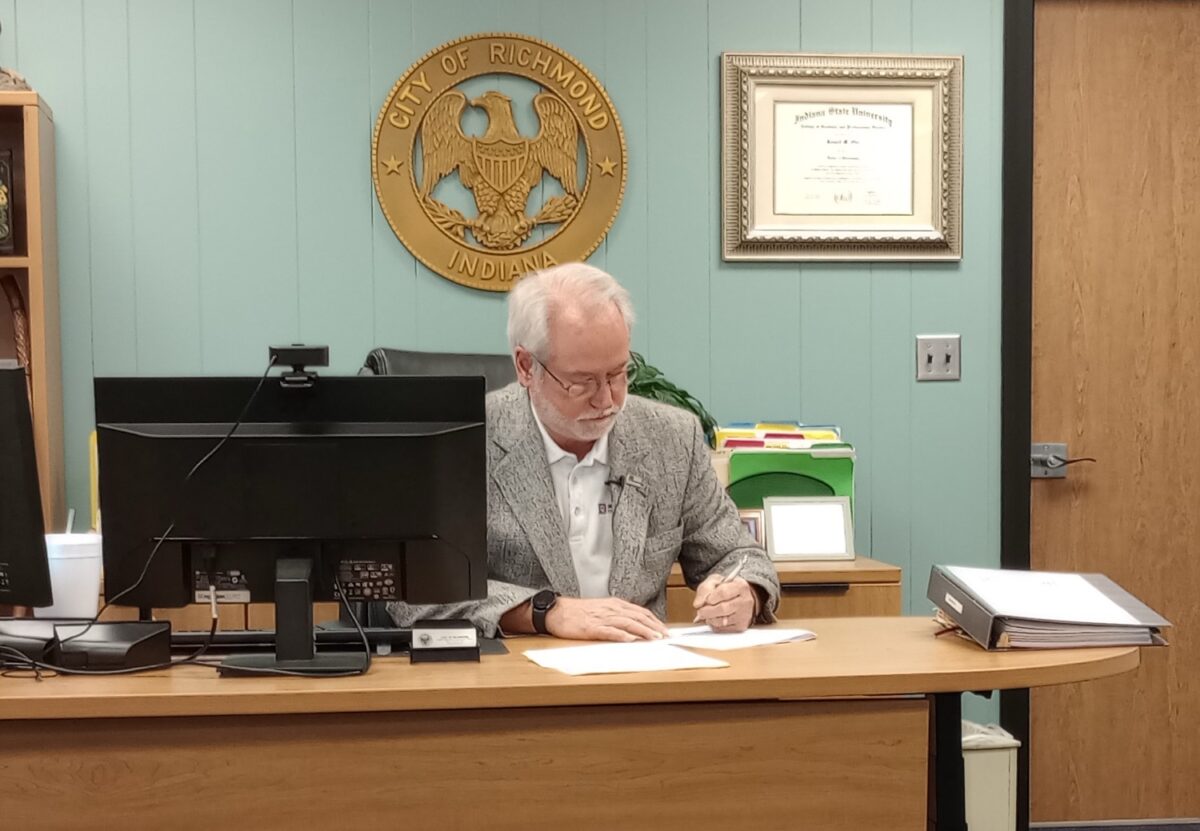
A 2026 city budget Richmond Mayor Ron Oler called “realistic” and “workable” before it was passed by Common Council will cost the city 21 employees.
The impacted employees — a 5% reduction in workforce — were notified Friday, Oct. 31, Oler said during a news conference, and will remain with the city through Dec. 31. One of the positions is a vacant union position, but the other 20 are non-union employees. A hiring freeze for nonessential positions enacted Oct. 14 remains in effect.
Oler blamed property tax caps that have cost the city $120 million since 2010, as well as Senate Enrolled Act 1 that he said results in Richmond’s 2026 revenue falling $1,484,760 below expectations.
“There will be changes in how the city operates, in how it provides services to the community,” Oler said in a prepared statement. “It will take considerable time to re-assign key duties to other members.”
He asked the public to be patient as the city works “to create our new normal with fewer members fulfilling new responsibilities.”
The announcement follows a Thursday, Oct. 30, meeting where council passed a $60,977,112 total budget, including $24,738,254 in the general fund.
Council member Jerry Purcell said the current council is willing to address “right-sizing city government” but should have done it a long time ago.
“Of course there’s regret; there’s always regret when you let something get to the point where you have to make drastic moves, but that’s where we are,” Purcell said.
Justin Burkhardt, chair of council’s finance committee, said the cuts were unfortunate but necessary for the good of the city.
“This is about essential services for the entire city, and I hope everyone can understand that, that we’re trying to operate more efficiently,” he said.
‘The toughest one’
Council members credited Beth Fields, the city’s director of strategic initiatives, who became the budget lead, and all who worked on reducing the budget. Larry Parker, council’s president, said they spent “gobs and gobs and gobs of hours” during a budget process that was most unique and difficult of the 42 city budgets he’s helped develop.
“This is the toughest one I’ve been through,” Parker said. “I think this is probably a good budget, probably as good as it can possibly be at this time.”
Parker, Purcell and council member Doug Goss all also placed blame on the state legislature for the budgeting struggles. The Republican-controlled legislature’s property tax reform reduced expected revenue, and in future years, will shift local revenue away from property taxes and toward locally enacted income taxes.
“Because of the changes at the state level, we have to be more conscious of our spending,” Goss said.
Purcell said council’s work during 2026 will need to include efforts to influence state legislation.
“I think it’s a great budget,” Purcell said. “I think we made great progress; we have a lot of work to do.
“Next year, we’ll continue this work and come to a place where we’re right-sized for the income we can have, but we’ll also work at the state level in legislation, in my opinion.”
Burkhardt felt better about the adopted budget than the one initially presented by city administration.
“I think that the taxpayers were represented in the conversation. I feel like we’re closer to being operational,” he said.
EMS budget shifts
Before passing the budget ordinance, council reduced the EMS budget by more than $500,000. Richmond Fire Department Chief Jeff Kinder budgeted to hire six civilian paramedics as a bridge while firefighter positions were filled and the new hires trained. He said it would cut overtime expenses and ease the overtime burden for firefighters needed on ambulances.
The city and Richmond Professional Firefighters International Association of Firefighters AFL-CIO Local 1408, however, have not reached agreement about the hires. Burkhardt said civilian positions throughout the city were scrutinized during the budget process and that it was inappropriate to include the paramedic positions.
“We need to move forward carefully with our monies, and to do this, especially without a complete agreement with the local union, I don’t feel comfortable with that,” Burkhardt said.
Fields said that council could later appropriate money from the health EMS cash balance to reinstate the positions, if it desires.
While council did not address ordinances setting 2026 wages, it did approve six ordinances pertaining to the 2025 budget. Three ordinances appropriated $1,526,078, and two transferred $891,941.76. The money is needed mostly to cover police and firefighter wages and overtime. The city will spend $576,078 from its city’s opioid settlement money received from opioid manufacturers, distributors and retailers to pay Richmond Police Department wages and overtime for calls dealing with opioids.
“All of the 2025 ordinances you have before you tonight are necessary to set the stage to end this calendar year on solid footing and begin the next with a solid foundation,” Oler said.
Purcell voted against the three appropriation ordinances, saying the 2025 budget council approved was rejected by the state Department of Local Government Finance, then city administration reduced line items without council input.
“I don’t like the fact that we are funding the 2025 budget, and the council never had the opportunity to approve the budget once it was changed,” he said.
The other ordinance reduced the parks department appropriation $50,000 and the local income tax appropriation $100,000 for money that won’t be spent this year.
A version of this article appeared in the November 5 2025 print edition of the Western Wayne News.